Why these beans might fly off at any moment

Winged beans sauteed with red-chili garlic paste

Winged beans sauteed with red-chili garlic paste

The other day, walking through the farmer’s market, I had one of those moments that stops you short in your tracks. I saw an odd sight. I raised a trembling finger and exclaimed — with some rich feeling, I might add — ‘what on earth is that?’

I saw bunches of long frilly green pods sitting next to a whole pile of long frilly green pods. I walked over to the stall where they had already caused a minor stir.

Now The Odd Pantry is no stranger to odd vegetables. It has covered, with delight, the scruffy taro and the anatomical fiddleheads. This one though was new. Completely. At first glance I would have guessed it was a type of seaweed. I could just picture it in great rippling ribbons underwater.

But upon asking the lady of the stall, they turned out to be long beans — yes, legume pods that grow on vines — that had four rows of frills all along the length. Winged beans.

The winged bean

The winged bean

I asked the lady how one would go about eating them.

‘Well,’ she said. Long pause. She looked at me, judging how far to go. ‘Salad, stir-fry.’

Hm. Tight-lipped. The bird was caged but wouldn’t sing. I pressed her for more information. Placing my hand tellingly on my purse, I grilled her for the goods. ‘Out with it,’ I said, noting that she was starting to wilt.

Then it all came tumbling out. She broke off a piece for me to try. Hmm — tastes like — a vegetable. Maybe a fresh green bean of the French sort. ‘Make a paste of garlic and red chili,’ the lady said. ‘I’m Pilipino and that is what we do.’

A man walked up with a cloth shopping bag. ‘You Indian?’ he said to me, waggling his eyebrows. Yes, indeed, I am.

‘You know saag?’ he continues. Eyebrows doing a proper jig, now.

‘Intimately,’ I reply.

‘You cook it like saag!’ he says like a punchline, rifling through the bunch of winged beans.

Hm. I think I’ll stick with what the lady said.

Winged beans (Psophocarpus tetragonolobus)

This has become a habit. The Alemany Farmer’s Market will introduce me to a brand new vegetable that then turns out to be a complete miracle plant, so much so that you would think the Department of Marketing this vegetable is making stuff up. What else can you think about a plant that offers so much?

  • Every part of it can be eaten. From a New York Times article: ‘Theodore Hymowitz, an agronomist at the University of Illinois who is a member of the Academy’s panel on the winged bean, said, ”it’s like an ice cream cone – you eat the whole thing.”
  • Excellent source of vitamins, minerals, protein, calories.
  • It can grow in nutrient-poor soils
  • The seeds can make a coffee substitute
  • The leaves can be a tobacco substitute
  • Can produce a milk like soymilk
  • The milk from the beans can be fermented into tempeh
  • Mushrooms can be grown on the dried pods
  • Can be boiled, roasted, stewed, stir-fried, eaten raw, or in soups
  • Can be grown as animal fodder, and used as a cheap source of protein for fish farmed for food

There is also an enduring mystery about winged beans — nobody has found the wild form of it. Given its wonderful qualities it isn’t surprising to find it cultivated in any resource-poor traditional culture that can grow it. It is grown for its roots in Burma, in South East Asia for its pods, in great variety in New Guinea (where the winged bean has developed a fondness for the mountains).

But the wild form of it has never been found. Where is it really from? Some guess Africa because most of its relatives come from there. Some guess New Guinea because it just seems so at home there. Perhaps the wild form has become extinct. Who knows? Entire careers in botany could be made or broken on this one fact. So if you see a wild winged bean growing somewhere out on your travels, call someone!

Winged bean roots for sale in Burma. (source: Wikimedia Commons user Wagaung own work)

Winged bean roots for sale in Burma. (source: Wikimedia Commons user Wagaung own work)

Winged bean stir-fry

I figured I would stir-fry the winged bean pods using some South East Asian ingredients. Shrimp paste is often used in these cuisines, and I didn’t possess any, so I used anchovies to replace that missing umami flavor. Also, fish sauce. This is a light salty liquid that is extracted from the fermentation of fish. It is a great replacement for soy sauce that can instantly take a dish from tasting Chinese to tasting more tropical, reminiscent of islands and bays and inlets and other such watery waterworlds.

Garlic and red chilies
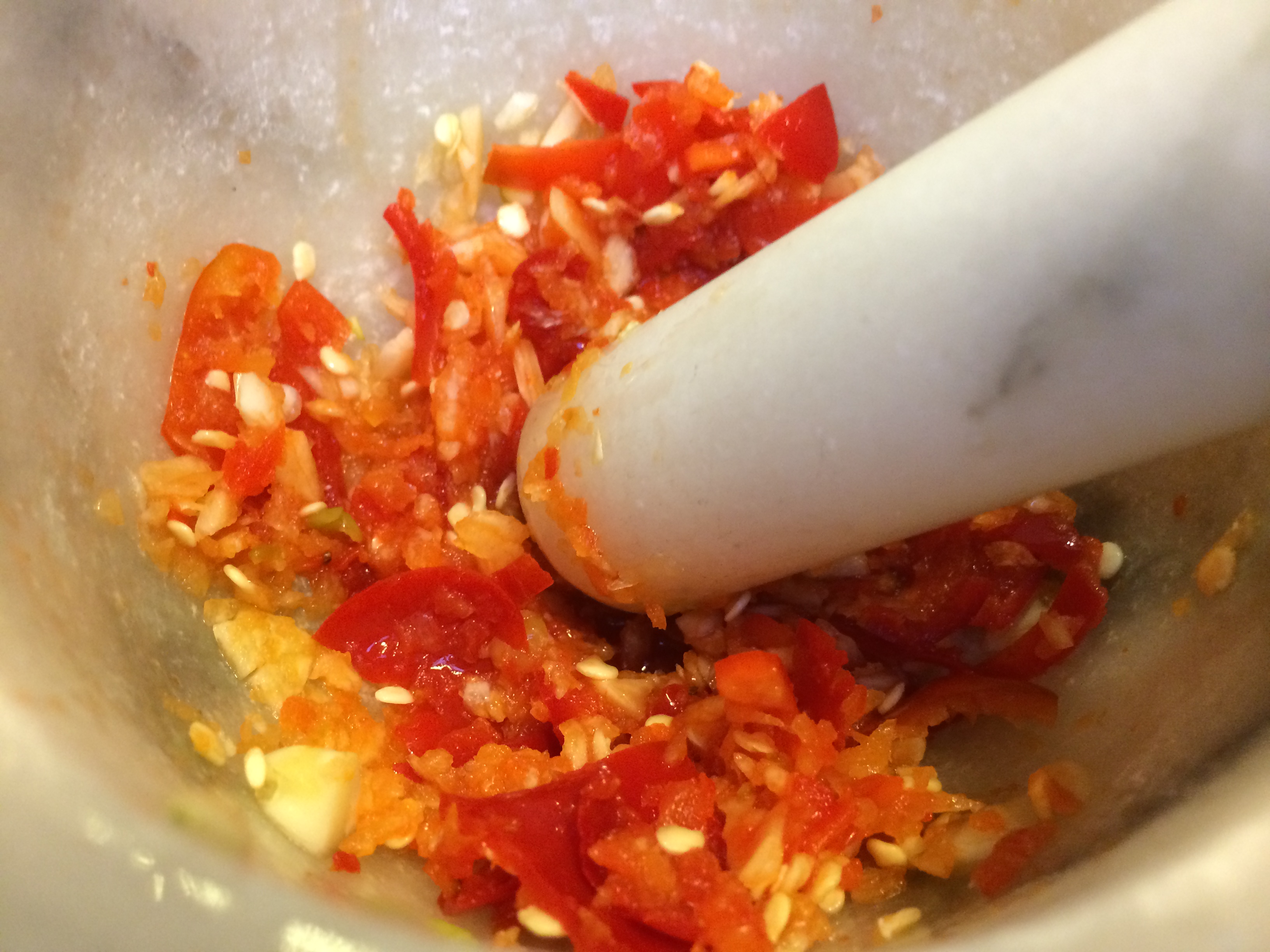
Garlic and red chilies

Pound it

Pound it

Anchovies too

Anchovies too

Paste

Paste

Slice the winged beans

Slice the winged beans

Saute

Saute

Sauteed

Sauteed

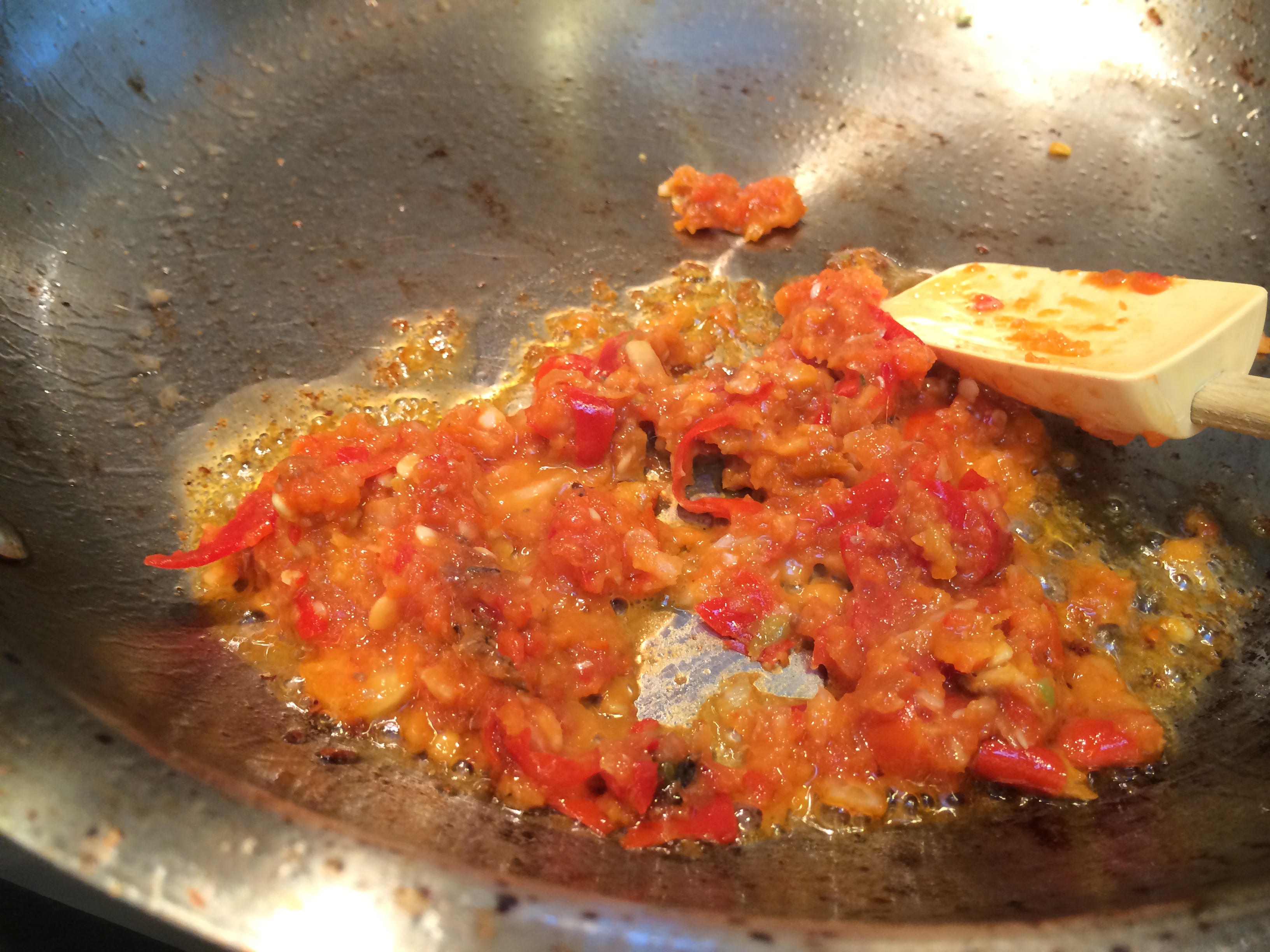
Fry paste

Fry paste

Fried paste

Fried paste

Enter the beans and fish sauce

Enter the beans and fish sauce

Winged bean stir-fry

Ingredients:
  • 3-4 cloves garlic
  • 1-4 fresh red chilies, or according to taste (use fresh green if you can’t find fresh red, I got mine from my garden)
  • a few anchovies (packed in oil)
  • 1 pound winged bean pods (green beans or asparagus would make a good substitute)
  • 1 tablespoon fish sauce
  • 1 – 2 tablespoons oil (I used sesame oil)
Method:

Make a paste of the garlic, fresh chilies and anchovies in a mortar and pestle. Takes about 7 minutes, not too bad. Wash, trim and slice the winged beans lengthwise. If you are using green beans or asparagus, just trim them and leave them intact.

Meanwhile heat half the oil in a wide thick-bottomed pan. When it shimmers put in the winged beans. Stir-fry them on high heat for a few minutes until the frills look a little browned. Remove them with a slotted spoon or tongs.

Add the rest of the oil and fry the paste. It will take a few minutes for it to dry out and for the oil to separate. Watch it carefully and use medium heat to make sure it doesn’t burn. Once this is done, put the winged beans back in, add the tablespoon of fish sauce. Stir to coat the beans with the paste and fish sauce, cover for a few minutes to steam before serving.

(Click here to find me on Facebook and here on Twitter.)

My slimy old pal, stuffed

Stuffed okra

Stuffed

Here is a riddle for all you wonderful folks. Two cousins. One is hairy, one is slimy. I have talked about the hairy one quite a bit recently. The slimy one doesn’t get much love because many people object to its sliminess. Fear not! There are many ways to make it unobjectionable.

Here is the hairy one. And here is the slimy one. Both from the mallow family.
Cousins

OK I have dragged this one out enough. Of course, the hairy one is cotton. But the slimy one is the subject of today’s recipe — okra. The slime is a form of soluble fiber that has many benefits, from slowing absorption of glucose (diabetics take note) to capturing toxic bile and helping with constipation.

Now okra is often not popular. When I mentioned to my husband that okra and cotton were from the same plant family, he said, ‘no wonder okra tastes like cotton’. Funny guy.

But here’s the thing. You can do one of several things. You can use okra in recipes that absolutely thrive on its sliminess and use it to give cohesion to soups and stews. Like gumbo. Or, you can fry and crisp it up. Once you do that, no one would guess at the great gobs of sticky runny goo that normally erupts out of okra pods.

Or, you could do this.

Okra stuffed with spices (Bharela bhindi)

For this dish, the okra pods are left whole. A slit is made along the length of the pod with a paring knife, taking care to leave a pocket, not bust through to the other side. Stuff the pocket full of spices. Fry it. This process seems to dissolve the sliminess as well and makes it a delicious meal with some roti or rice and dal on the side.

While picking okra one has to be careful to pick the very young pods, where the ribs have not turned fibrous and woody (once that happens, there is no going back, and you will not enjoy eating them). A gentle squeeze while selecting them at the market will tell you if the pods are still young. The pods I found at the farmers market are from a variety that has been bred to have minimal ribs, and can be left on the plant longer without risk of turning woody. Nevertheless, I did find one or two that had, and I discarded them.

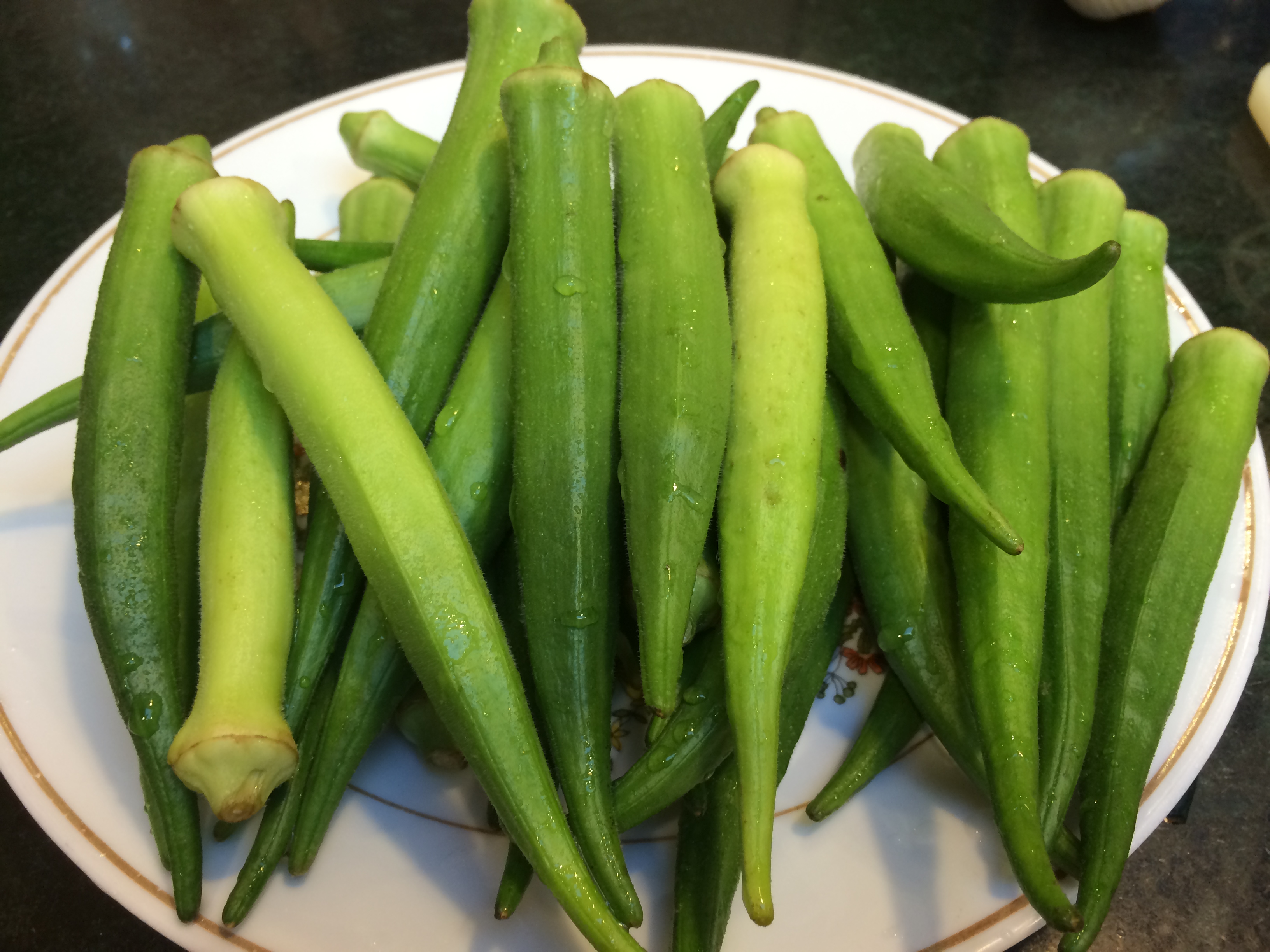
Pound of okra pods

Pound of okra pods

Whole spices

Whole spices

Roasting spices

Roasting spices

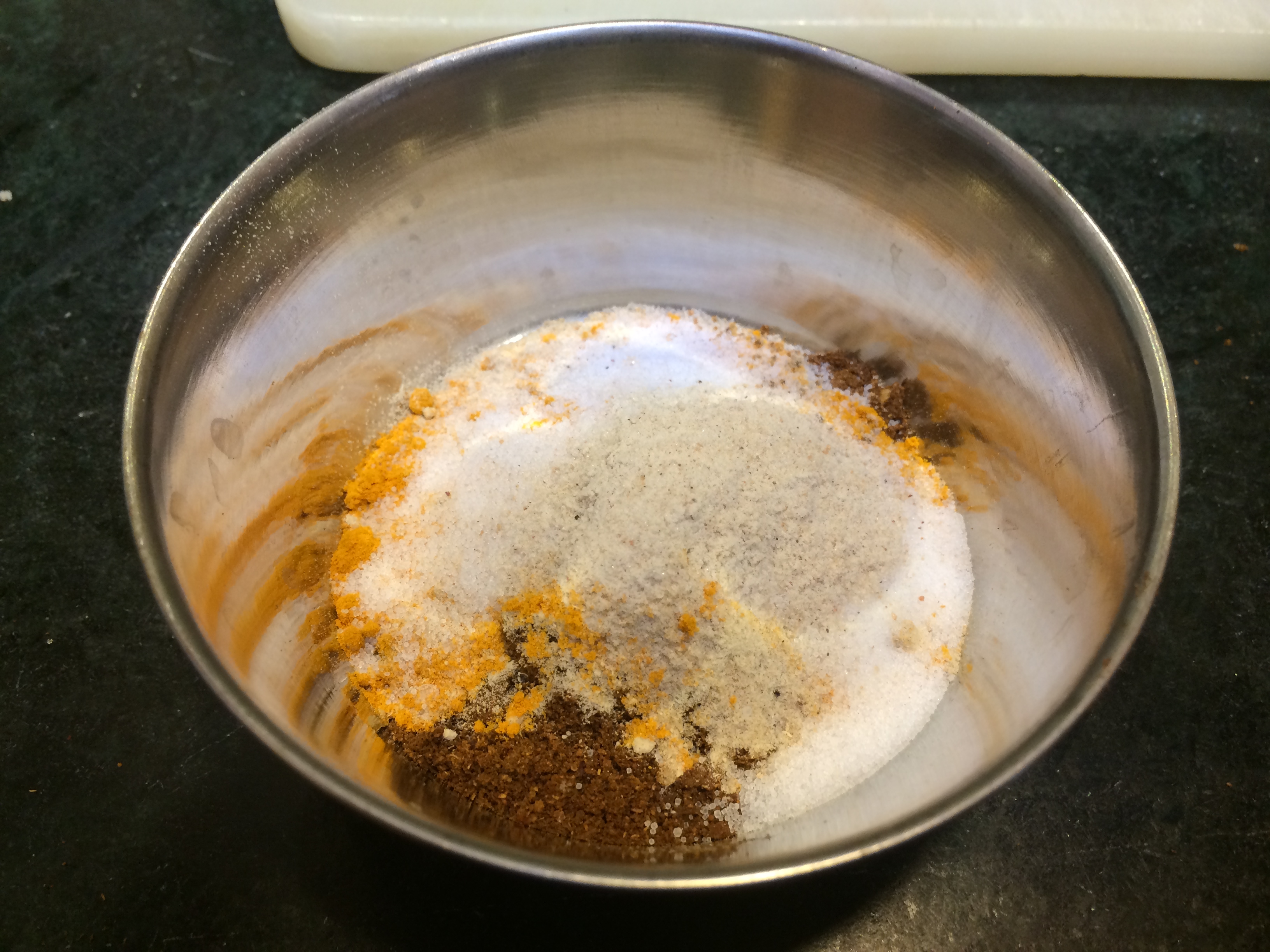
All spices mixed in a bowl

All spices mixed in a bowl

Pocket

Pocket

Stuffing the pocket

Stuffing the pocket

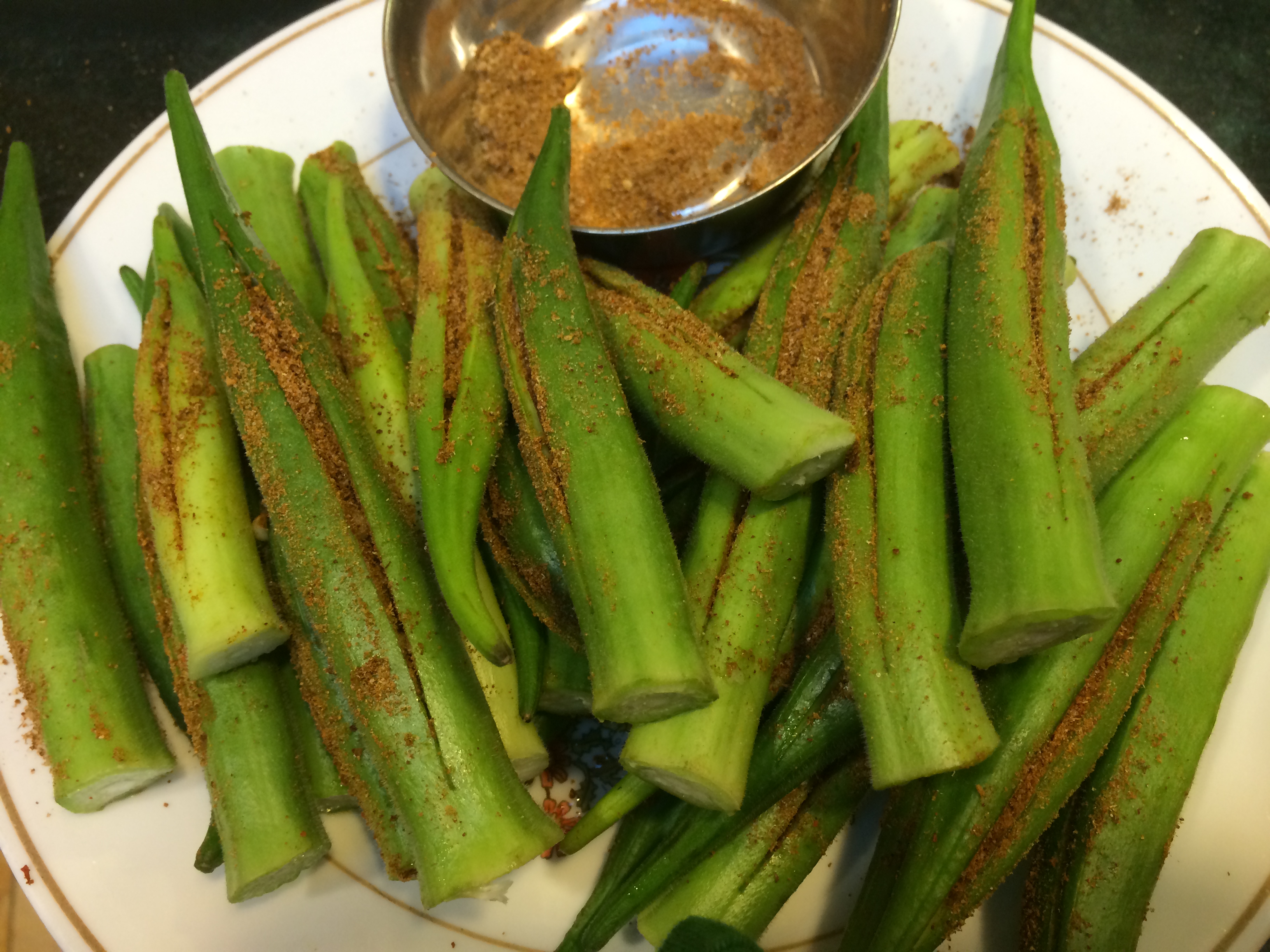
Stuffed and ready to go

Stuffed and ready to go

Frying

Frying

Add onion

Add onion

Done

Done

Stuffed okra/bharela bhindi

Ingredients for the spice mix:
  • 2 teaspoons whole coriander
  • 2 teaspoons whole cumin
  • 1/2 teaspoon whole fenugreek seeds
  • 1/2 teaspoon whole fennel seeds
  • 2 whole red chilies, more if you like
  • 1 teaspoon dry mango powder (aamchur)
  • 1/2 teaspoon turmeric powder
  • 1/4 teaspoon asafetida
  • 1/2 teaspoon red chili (if you want more heat) or paprika (for color and flavor)
  • 1 teaspoon salt
Ingredients for okra
  • 1 pound okra pods
  • 3 tablespoons oil
  • 1/4 onion, sliced (optional)
Method

Roast the whole spices from coriander to red chilies in a thick-bottomed pan, just until an aroma arises. Take it off the heat, wait a few minutes for them to cool and grind in a clean coffee grinder. Now mix in the powdered spices from the dry mango powder to the salt.

Wash and completely dry the okra. Take off the very top, the hat that looks like a beanie where the okra is attached to the stem. Using a sharp paring knife, make a slit along the length of the pod, stopping a little short on both ends, to make a pocket. Fill each okra with the spice mixture. A small spoon is very helpful for this. Then using your fingertips, spread spices nicely inside the pocket.

Once all the okra pods have been stuffed, heat the oil in a wide, thick-bottomed pan. When it shimmers, lay the okra pods flat in a single layer. Let them cook on medium-high heat for 10 to 15 minutes until each side is browned. Once in a while give them a turn with tongs or a spoon. Mostly just leave them be.

When they look pretty much browned, squished and done, throw in the onions. The onions only need to cook for a minute or two, the hot pan will soften them quickly. They do not need to brown. Turn off and cover the pan for a few minutes to allow the steam to finish the job.


(Click here to find me on Facebook and here on Twitter.)

A Russian salad for America’s Independence Day

Russian Salad

Russian Salad

If by reading the title you expected intrigue and a spy-vs-spy story, you came to the right place. The story of Salad Olivier begins in Czarist Russia when wealth and luxuries were not yet verboten. A Belgian chef known as Lucien Olivier came to Moscow in the 1860’s bearing secrets of French cooking. He opened a fancy-shmancy restaurant in Moscow called The Hermitage. This was not a one-room affair, rather an entire building with multiple dining rooms. Here Chef Olivier served a salad with every manner of luxury ingredient and choice meat — caviar, capers, game hen, crayfish tails. He called this the Salad Olivier.

Hermitage restaurant, Moscow (source: http://www.sras.org/russian_olivier_salad)

Hermitage restaurant, Moscow (source: http://www.sras.org/russian_olivier_salad)

Of course, he did not invent this salad out of his sheer imagination but rather based it on a famous dish from Provençe known as Le Grand Aioli. This is essentially a feast of vegetables and meats, laid out separately to serve with aioli, which is basically a mayonnaise with garlic and mustard. He served his salad in layers, the ‘Provençal sauce’ on the side, to be poured over. His Russian customers would dispense with the niceties and simply mix it all up. So he followed their lead and Salad Olivier was served the Russian way, all mixed up with his Provençal sauce.

Salad Olivier made his restaurant famous; although the main ingredients of the salad were obvious for all to see, he never divulged the secret of what went into his mayonnaise. Now remember that mayonnaise at the time was a French import, not ubiquitous on every grocery shelf from Japan to the United States. It had to be made by hand. It is an emulsion, which means the liquids involved in it are so well mixed together that it is impossible to tell what went into it. So as you can see, mayonnaise is inherently mysterious. So is milk, another emulsion.

A lovely graphic showing emulsion by blog.ioanacolor.com

A lovely graphic showing emulsion by blog.ioanacolor.com

Sorry for the bad pun, but Lucien Olivier milked it. The secrets of his mayonnaise remained hidden until his grave. They had to come to his restaurant for the salad, or else go without. But then, a disgruntled local employee called Ivan Mikhailovich Ivanov tricked him into leaving his kitchen momentarily while the famous mayo was being whipped up. He managed to note down the ingredients, left the restaurant, and began selling his facsimile of Salad Olivier at a different restaurant, under the name of Capital Salad (Stolichny Salad).

This stolen salad was never quite as good as the original, but it did mean that the rest of middle-class Russia was able to partake in it. With the revolution came the backlash against all things bourgeois, and this salad was stripped of its more expensive ingredients. A sort of consensus developed around a small set of ingredients — potatoes, hard-boiled eggs, boiled chicken, peas, pickles.

From Russia it spread to the Middle-east and Asia, and to India. Growing up, my introduction to Russian salad happened in a vegetarian restaurant in India that avoided the chicken. Somewhere en route from Russia to India a very important modification was made to it — Russian salad in India always includes chunks of some crunchy fruit — pineapple, apple, etc. In my opinion this is the best part.

In fact that makes it, to my palate, more delicious than the potato salad that is traditional for July 4th barbecues, so that is what I brought to a friend’s. Any hint of treason is purely for taste.

First the mayonnaise. Lucien Olivier’s mayonnaise was an aioli, which includes garlic and mustard. I used this recipe (which used this recipe) and whipped it up in a jar.

Garlic and mustard

Garlic and mustard

Eggs, oil, garlic-mustard, lemon juice in a jar

Eggs, oil, garlic-mustard, lemon juice in a jar

Improvised double-boiler

Improvised double-boiler

Garlic mustard mayonnaise (aioli)

Ingredients:
  • 1 cup almond oil (you can use any light-tasting oil)
  • 2 medium eggs or 1 large
  • 2 cloves garlic
  • 1 teaspoon mustard seeds
  • Juice of half a lemon
  • Salt to taste
Method:

Put minced garlic and mustard into  a mortar along with a pinch of salt. Give it ten minutes to sit and then pound it to a paste together. You do not have to powder the mustard seeds completely. Put the oil, eggs, garlic-mustard, lemon juice in a Ball jar or Weck jar or empty jam jar. Using an immersion blender, whir it for just about 30 seconds or a minute. The mayonnaise should come together right away.

Now my salad was going to be sitting out in the sun so I chose to heat it up to to 135ºF in a double boiler while blending away. You do not need to do this, specially if you use pasteurized eggs.

Now for the Russian salad, based on a French salad, made the Indian vegetarian way, for America’s Independence day. These are the ingredients I used, but please be creative and add whatever makes sense to you.

Ingredients for salad

Ingredients for salad

All diced

All diced

Dish lined with lettuce

Dish lined with lettuce

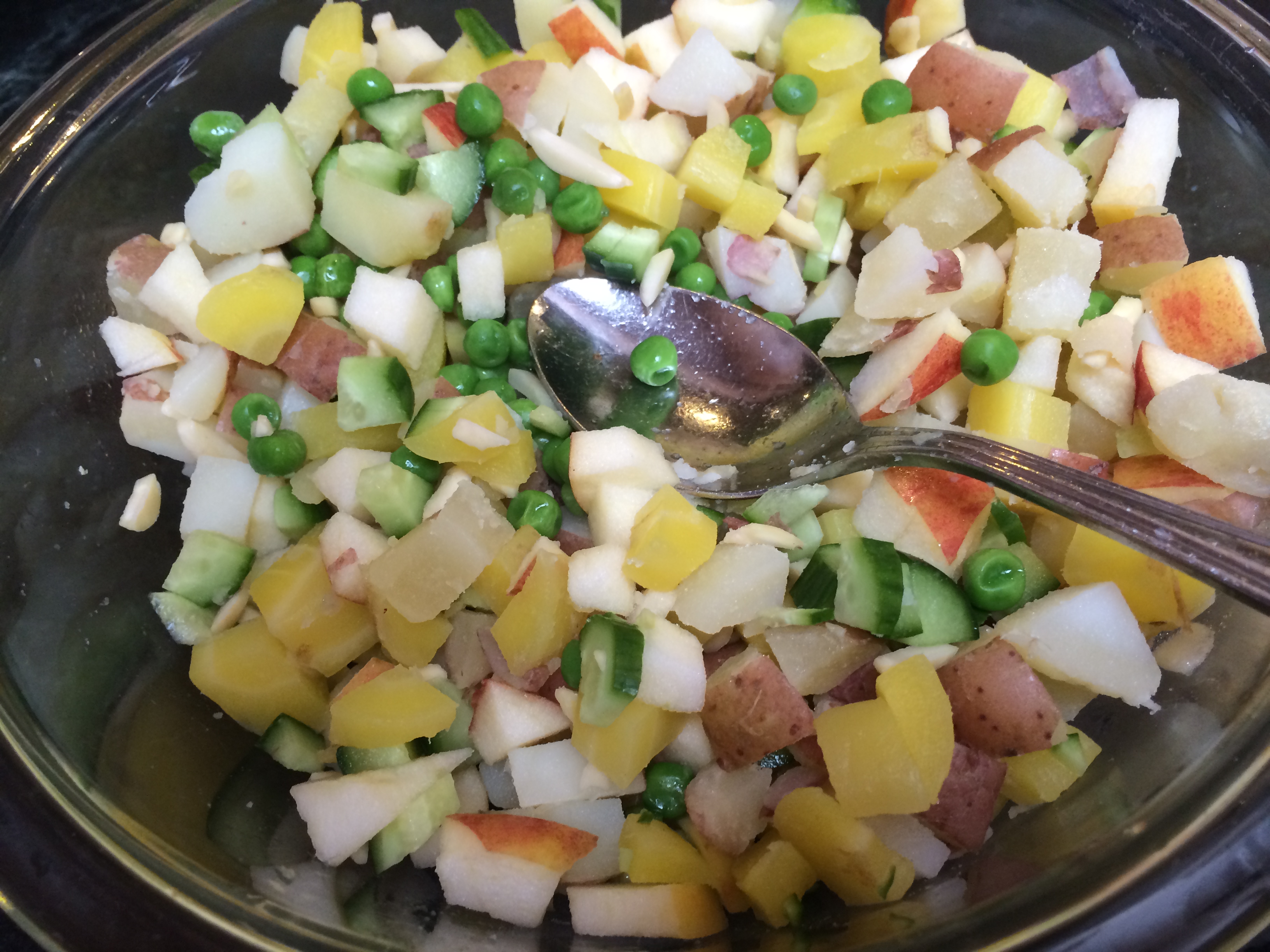
Mixed

Mixed

Vegetarian Russian Salad

Ingredients:
  • About 6 small red potatoes
  • 1 large carrot
  • 1 cup of frozen peas, thawed
  • 3/4 large red apple
  • 3 tablespoons slivered almonds
  • 1 small cucumber (substitute with celery)
  • About 8 outer leaves of butter lettuce
  • Half a teaspoon paprika, more for garnish
  • Salt to taste
  • About a cup of mayonnaise from above
Method:

Boil the potatoes and carrots in their skins, in salted water. When done, drain, let them cool, then dice into small pea-sized pieces. Dice the apple and cucumber into similar sized dice as well. Leave the skin on (adds a nice colorful touch). Thaw the peas.

Line your serving dish with the lettuce. Mix the ingredients together in a mixing bowl. Add the mayonnaise, paprika, and salt to taste. Mix together nicely. Serve it out in the bed of lettuce.


(Click here to find me on Facebook and here on Twitter.)

Global unity through hot sauces

Sambal

Sambal Hebi

The other day I was doing my favorite thing — making a hot sauce, in preparation for doing my other favorite thing — eating a meal with a hot sauce. And I started to think upon the unity of all humanity. While I have been known to have the occasional Deep Thought, I usually need some prodding to produce one. The prodding that produced this particular Deep Thought was the following.

Over the course of the past couple months I had occasion to make a few hot sauces. These were from different cuisines: we made burritos at home, so I made a Mexican hot sauce once; another time, for dosas, I made a tomato chutney; and then the other day, experimenting with Malaysian food, I tried making a chili paste called Sambal Hebi. I seem to be doing the same thing over and over, I thought. With just a couple twists each time to add some local flavor.

Tomato chutney

Tomato chutney

Well, given that they all use dried red chilies for heat, and perhaps some garlic or onions as aromatics, there certainly is commonality. Humans from these three rather disparate regions of the world really do seem to think alike — perhaps we are all the same under the skin?

So here is my global hot sauce template; if you are able to adapt this method to yet another hot sauce from another cuisine I’d love to hear about it.

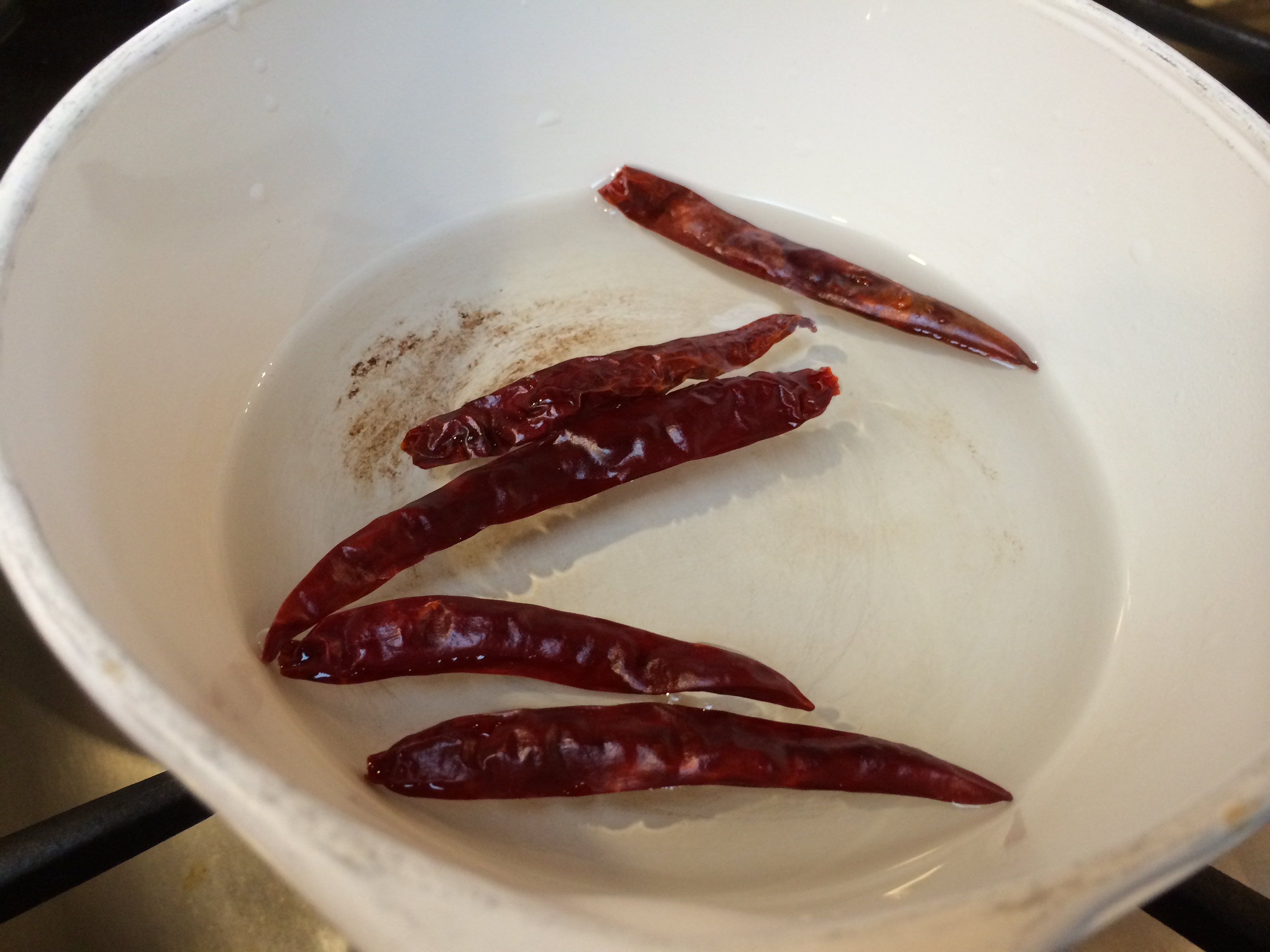
Step 1: Soak the dried chilies in hot water.

Same for all the hot sauces. Choose a mix of large, not-so-hot dried red chilies, and small, hot dried red chilies, according to your heat tolerance. Bring a cup of water to a boil and soak chilies in it until softened, about 15 minutes. Pull off the stem and remove seeds and ribs if you like. They are ready for the sauce.

Soaking dried red chilies

Soaking dried red chilies

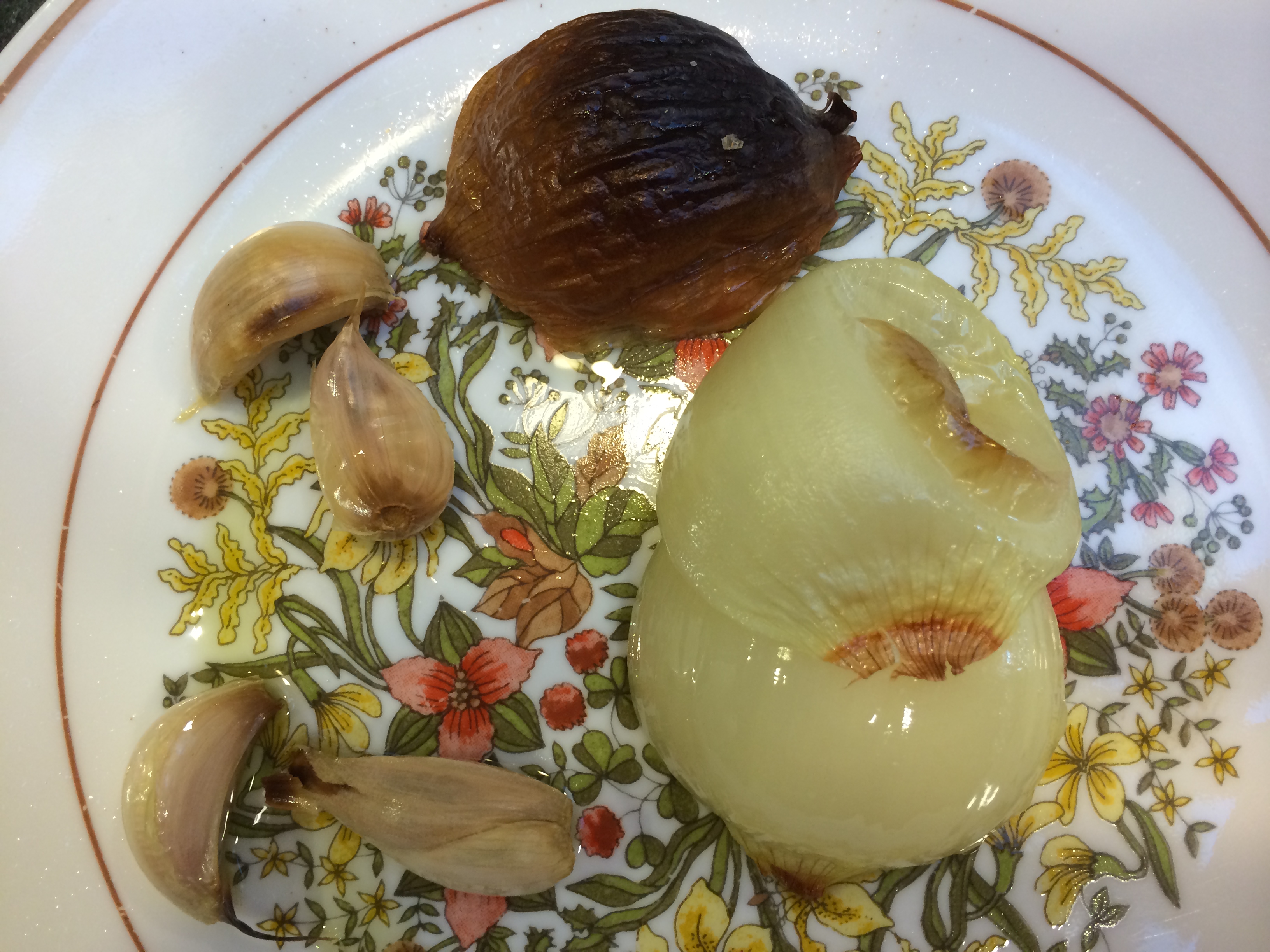
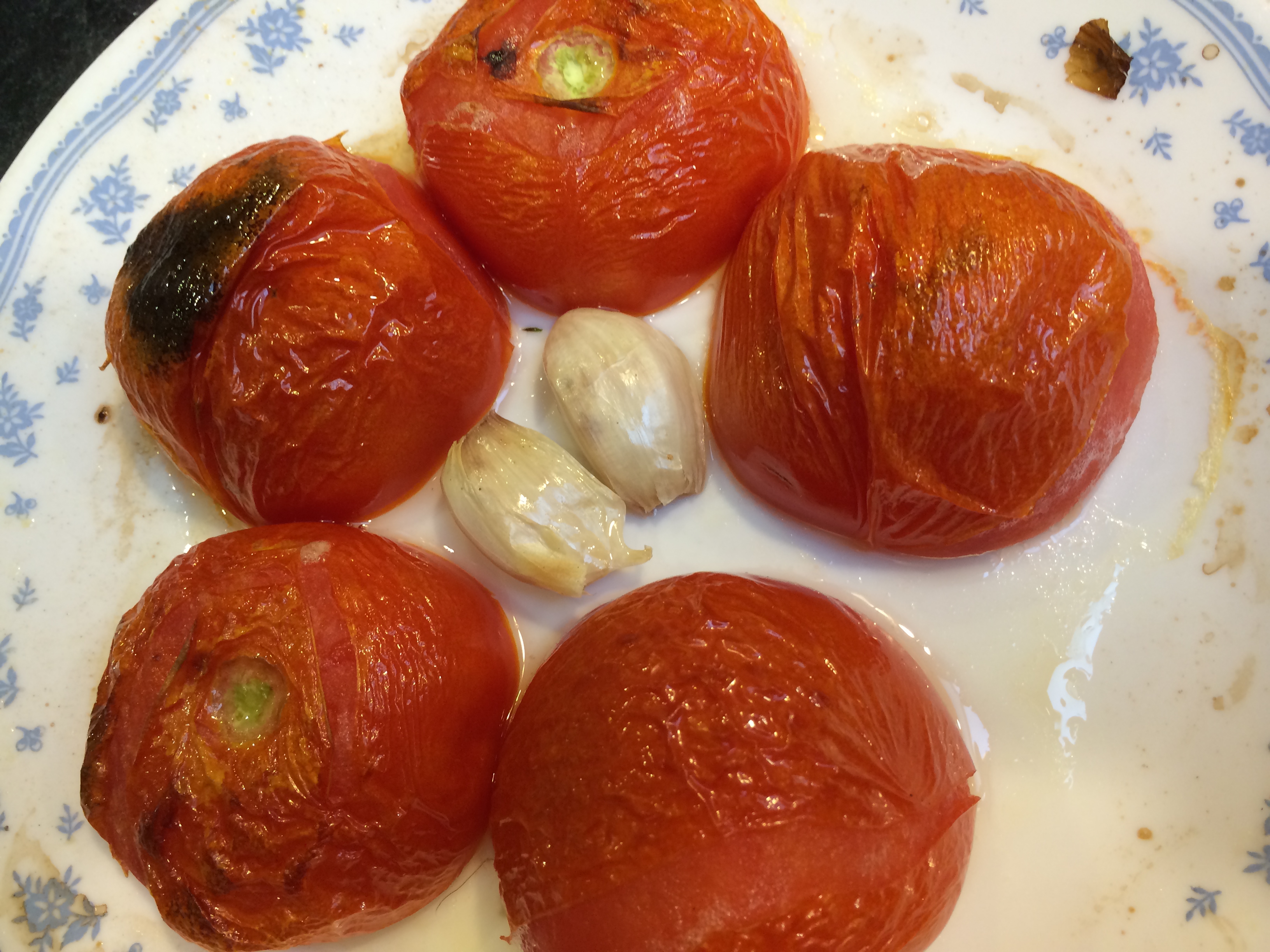
Step 2: Broil the vegetables.

Mexican hot sauce: I used half an onion, 3-4 cloves garlic, 3 tomatoes, halved. South Indian tomato chutney: I used 2 cloves garlic, 3 tomatoes, halved. Malaysian sambal: I used half an onion, 3-4 cloves garlic.

Leave the garlic, onion, tomato unpeeled. Rub some oil over and broil for about 6 minutes. At this point, the papery skin of garlic/onion will have darkened, and the tomato skin can simply be peeled off.

Broiling onion and garlic for Sambal

Broiling onion and garlic for Sambal

Broiling tomato and garlic for tomato chutney

Broiling tomato and garlic for tomato chutney

Step 3: Blender

Vegetables and softened chilies go into the blender together. Along with salt to taste. If you need liquid to make the blender happy, pour in some of the oil and collected juices from broiling the vegetables; if you need more, add some of the chili soaking liquid.

Step 4: Cook

Empty out the blended hot sauce into a pot and bring to a boil. Then simmer. It only needs to cook for a few minutes. The color will change. Give it a preliminary taste to make sure the salt is right.

Tomato chutney on stovetop

Tomato chutney on stovetop

Step 5: Finishing for the Mexican hot sauce:

If you are doing a Mexican hot sauce, add a teeny bit of vinegar or lime; that’s it, you are done. Slather it over some refried beans.

Step 5: Finishing for the South Indian tomato chutney:

You can let this chutney cook longer to dry it somewhat more than the Mexican hot sauce, as it doesn’t have to be of a pouring consistency.

Heat a tablespoon of coconut oil in a pan. When hot, put in a half teaspoon of split and dehusked urad dal (Vigna Mungo), when that reddens, half a teaspoon of black mustard seeds, when they pop a few curry leaves. When they shrivel turn off the flame and pour the coconut oil into the tomato chutney. Stir to combine.

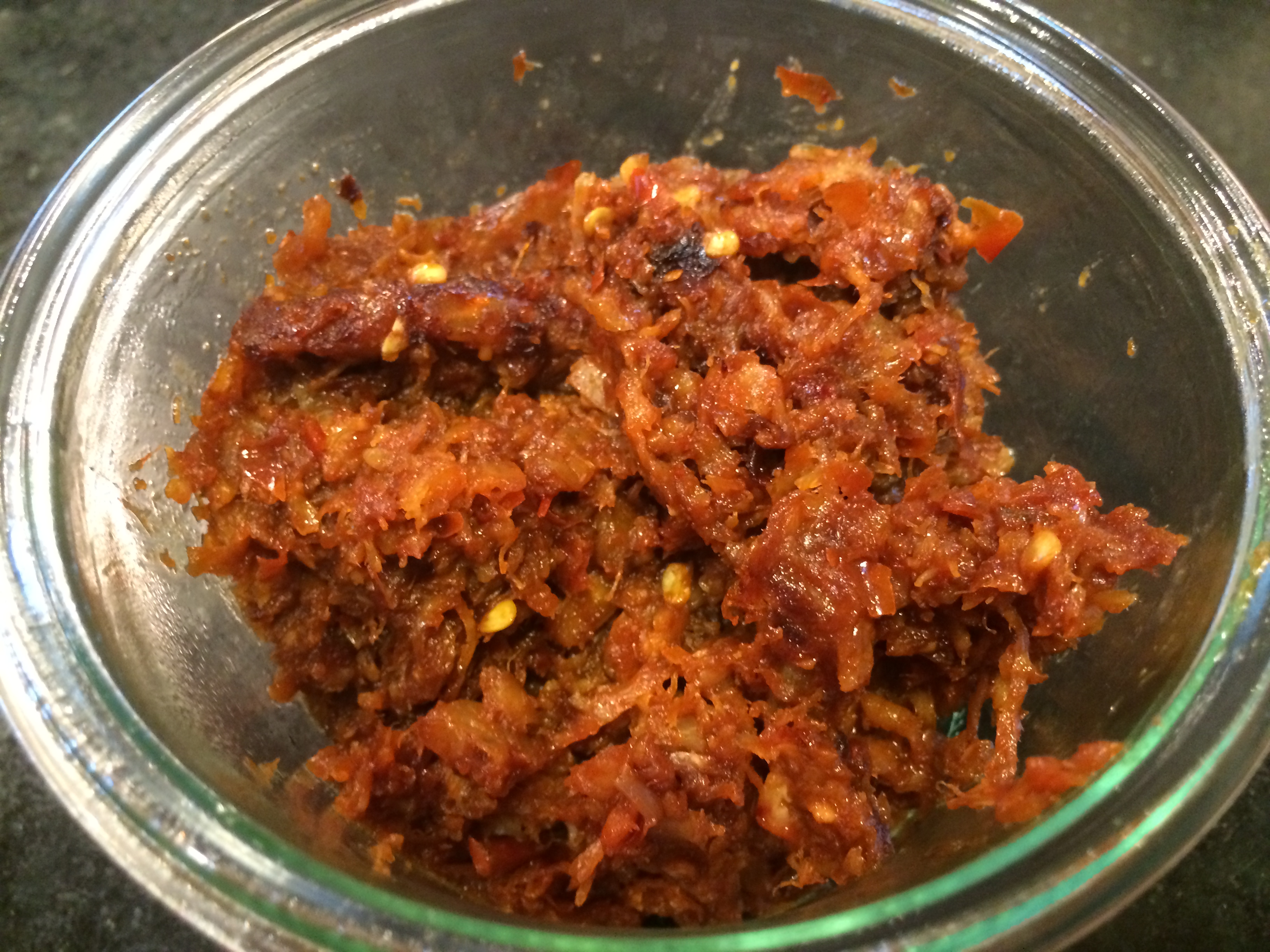
Step 5: Finishing for the dried shrimp sambal (Sambal Hebi):

First, a bit about this chili paste, because it was new to me. ‘Sambal oelek’ is a simple chili paste used all over Singapore/Malaysia as a base for many of their dishes; while ‘Sambal Hebi’ has added dried shrimp, garlic and shallots. With the excellent umami additions, this paste can be had as a simple and delicious accompaniment for rice (that’s not how I used it, but the story of what I did with it will have to wait).

Bags of dried shrimp should be available at an Asian grocery store. Here is an online source of it: The Asian Cook Shop. While you are preparing the rest of the sauce, soak about half a cup of dried shrimp in hot simmering water to soften. In 15 minutes, that should be done; take the shrimp out and smash them in a mortar and pestle if you have patience, if not, whirl them in a blender.

Dried shrimp for sambal

Dried shrimp for sambal

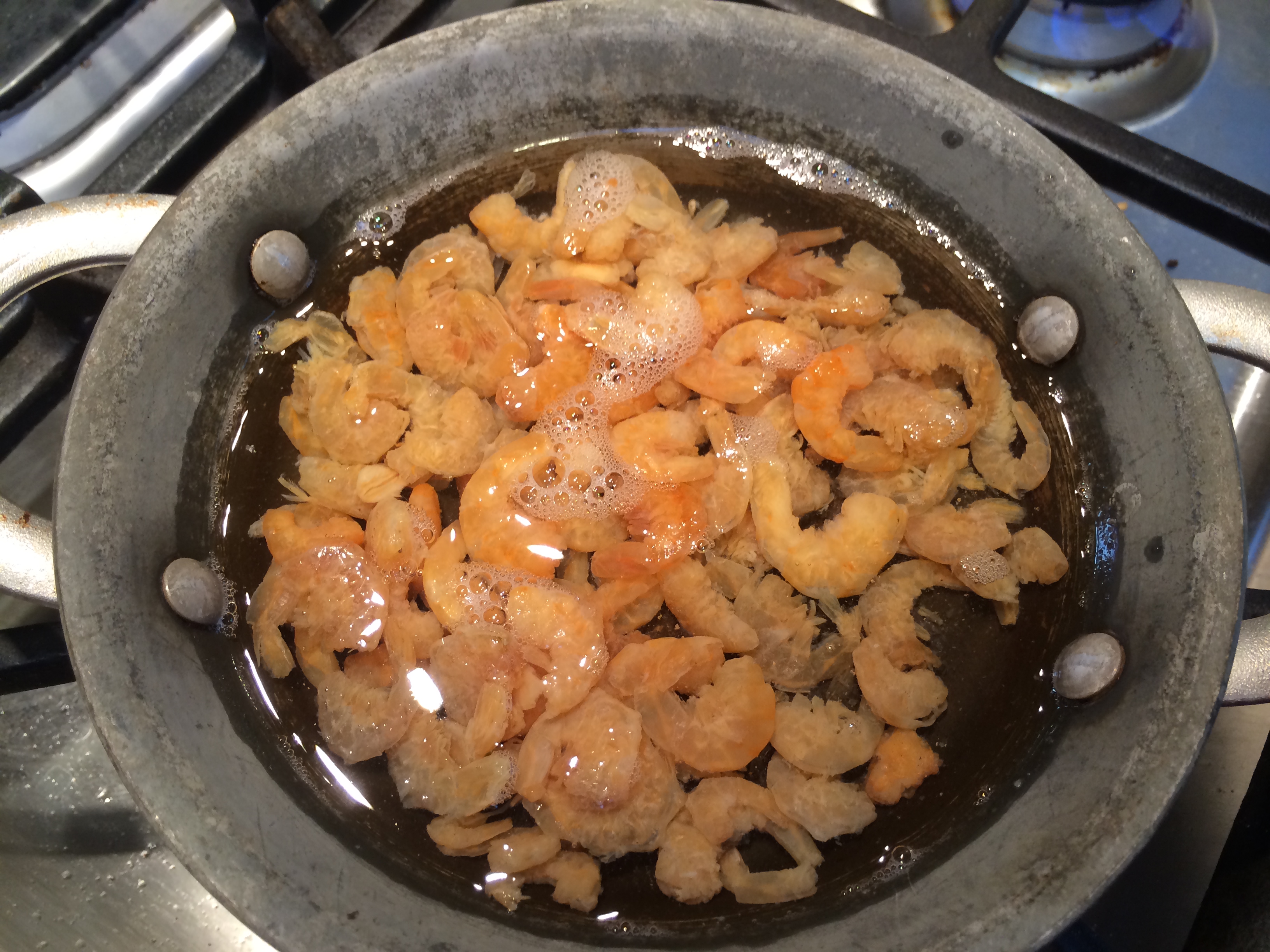
Dried shrimp softening in hot water

Dried shrimp softening in hot water

Now remember for the sambal we did not use any tomato, just the garlic, onion and chilies. So the paste will be drier to start with. When you cook the paste, use a bit of oil, and cook it longer than the above two until the oil separates. Also, I did not use any salt at all, preferring to add enough soy sauce to cover the needed saltiness.

Next put the dried shrimp into the pot: stir to have them cook and the entire paste dry up — about 10 minutes. Add a tablespoon of soy sauce, stir to combine, and you are done.

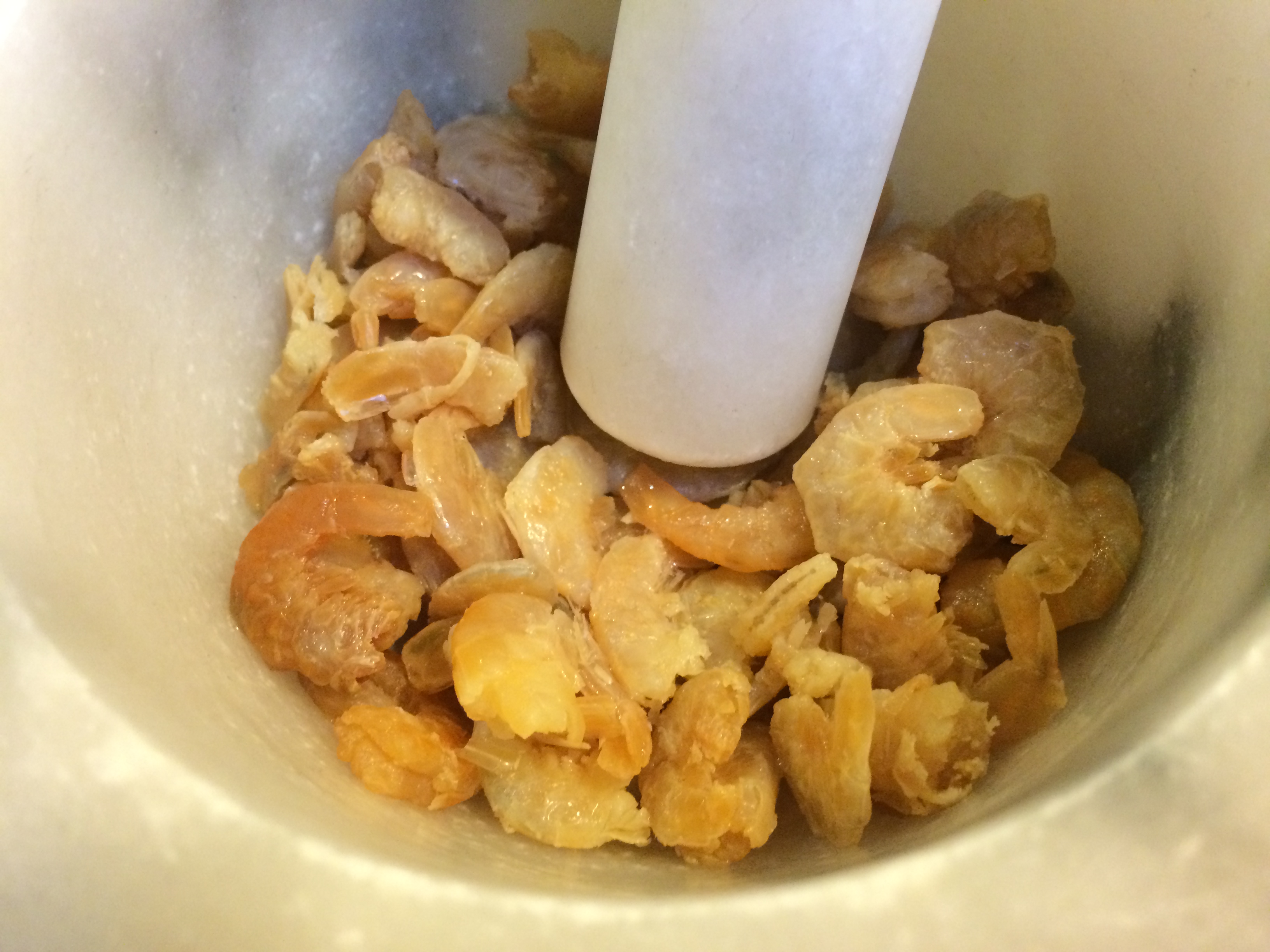
Pounding dried shrimp

Pounding dried shrimp

Pounded dried shrimp

Pounded dried shrimp

Sambal Hebi is done, ready for use as a base for noodles, as a sauce for vegetables, or simply with rice. Recipe source: Indochine Kitchen.

Pounded shrimp added

Pounded shrimp added

Soy sauce added

Soy sauce added

Mexican hot sauce

Ingredients:
  • 3 large tomatoes
  • Half a medium onion
  • 3-4 cloves garlic
  • Mix of hot and mild dried red chilies according to taste
  • Salt to taste
  • 1 tablespoon lime juice or 1 teaspoon vinegar
Method:

Described in detail above but in brief: soak the dried red chilies in hot water for 15 minutes. Cover with oil and broil the vegetables (unpeeled) for 6 minutes. Blend along with salt. Cook on stovetop for a few minutes. Add lime juice/vinegar.

South Indian tomato chutney

Ingredients:
  • 3 large tomatoes
  • 3-4 cloves garlic
  • Mix of hot and mild dried red chilies according to taste
  • Salt to taste
  • 1 tablespoon coconut oil
  • 1/2 teaspoon urad dal (split and dehusked black gram)
  • 1/2 teaspoon black mustard seeds
  • Few curry leaves
Method:

Described in detail above but in brief: soak the dried red chilies in hot water for 15 minutes. Cover with oil and broil the vegetables (unpeeled) for 6 minutes. Blend along with salt. Cook on stovetop until reduced a bit. Heat coconut oil until shimmering. Add, in this order, the urad dal, when they redden the mustard seeds, when they pop the curry leaves. Turn off and empty the coconut oil into the chutney and stir well.

Malaysian sambal hebi

Ingredients:
  • Half a medium onion or couple shallots
  • 3-4 cloves garlic
  • 1 tablespoon oil
  • Mix of hot and mild dried red chilies according to taste
  • 1/3 to 1/2 cup dried shrimp
  • 1 tablespoon soy sauce
Method:

Described in detail above but in brief: soak the dried red chilies in hot water for 15 minutes. Cover with oil and broil the vegetables (unpeeled) for 6 minutes. Blend to a paste.

Meanwhile prepare the shrimp: soak in hot water for 15 minutes until softened. Pound with a mortar and pestle.

Heat oil in a small pot. Empty the chili paste from the blender into it and cook until the oil separates. Add the shrimp to the pot, stir well to combine, and cook for 10 minutes until dry. Now add the soy sauce and stir nicely.


(Click here to find me on Facebook and here on Twitter.)
Beet parathas; a classic recipe book

Beet paratha

Beet paratha

Some years ago I found a book in a used bookstore that really spoke to me in the depths of my soul. It electrified me from the title alone, even before I cracked open the pages.

Now a few books have been known to be enormously influential in people’s lives. For some it may be ‘Thus Spake Zarathustra’ by Nietzche, or ‘Atlas Shrugged’ by Ayn Rand. For others it might be ‘War and Peace’ by Tolstoy. For me, it was this:

tasty dishes from waste items by Aroona Reejsinghani

tasty dishes from waste items by Aroona Reejsinghani

For the 1970’s in India, in the midst of famine, this book was quite apropos. I remember talk of the high prices of vegetables at every social gathering. Meat for many was simply out of the question. This book begins with an acknowledgement of the scarcity that every housewife has to deal with. It goes on to celebrate the leaves, stems, peels, leftovers that most of us throw away. The author painstakingly lists the vitamin content of each of these leaves and rinds, including the mysterious Vitamin P (?)

Not only is it completely impressive that she was able to do this research in the days before Google, it is astounding how many recipes she was able to come up with.

In here one finds 5 recipes that make use of banana peels (throw away the outer green part, she advises), 9 recipes that use turnip leaves, 2 that want you to fry up potato skins. Curdled milk, of course, is an industry, and the author dwells on that for a bit. Stale bread gets its own section with 36 recipes. Leftover fish, meat, chicken each get their own sections as well.

Now we no longer live in a world of food scarcity but quite the opposite. Most developed countries don’t spend over 10% of their income on food, in the US, where I live, it is around 7%. But the message of this book is more relevant than ever. The cost of food production remains very high, it just doesn’t come out of our paychecks, but instead we pay for it with depleted soils and poorer biodiversity.

I have to admit I don’t go scavenging around the thrown away peels for my next meal, but instead compost everything. Given my chunky waistline, I figure it is even better to feed the worms than me.

Beetroot

Beetroot from foodreference.com

Beetroot from foodreference.com

Now, about beets. Here is basically the entire beet plant from roots up to the leaves. Stare at the leaves for a bit. You all know that the greens are nothing but chard, right? Beetroot and chard are not even different species but simply different breeds. Just like a Dalmatians may be bred for running and bloodhounds for tracking a scent, but both remain dogs, chard is bred for fancy leaves and beetroots for fancy roots, but both remain Beta vulgaris. The roots of the first and the leaves of the second can be eaten. This website has more on this: Is chard root edible.

If you have no use for the greens, you could discard them I guess, but for goodness sake don’t throw them away and then go buy chard at the market!

Out of the bunch pictured, here are the parts I ended up throwing away for this recipe, the rest was all eaten. I threw away the long tails of the roots. I threw away the part where the roots turn into stems — that tends to be tough. I peeled the roots thinly with a vegetable peeler. Last, some stems have thick fibers that simply zipper all the way off; if I caught hold of some of those, I threw them away, otherwise I chopped them up along with the stems and leaves.

Parathas with beet root and greens filling

A reader might be forgiven for wondering if I’m going through the little-girl spectrum for my parathas; some time ago I did a recipe for purple parathas, this time they are pink.

Anyway, the idea of the stuffed paratha is simple — it is a whole wheat flatbread stuffed with filling inside. The filling for these consists of the grated root and the finely chopped leaves and stems, cooked together with seasonings. Parathas are great with some plain yogurt on the side.

Tails trimmed

Heads and tails trimmed

Greens finely chopped

Greens finely chopped

Grated, cooking with oil

Grated, cooking with oil

Cooked down and dry

Cooked down and dry

Uncooked paratha, pink showing

Uncooked paratha, pink showing

Cooked paratha, stacking up

Cooked paratha, stacking up

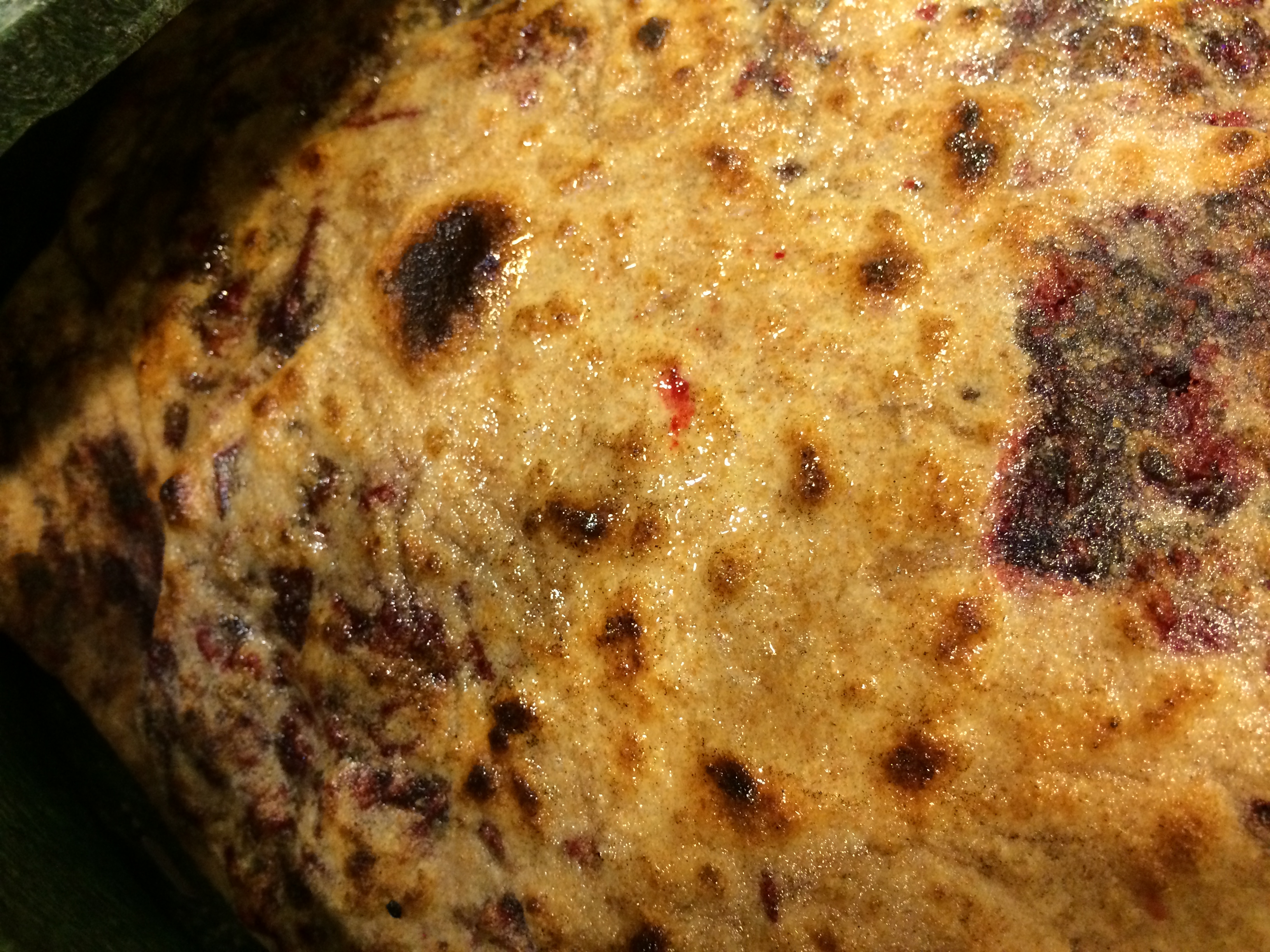
See the pink?

See the pink?

Parathas with beet root and greens filling

  • Servings: 8 parathas
  • Print

Ingredients for filling:
  • 3 medium beetroots with greens and stems
  • 1 teaspoon salt
  • 1 teaspoon red chili powder (or to taste)
  • 1 teaspoon chaat masala, substitute with dry mango powder, substitute that with lime/lemon juice
  • 1 tablespoon oil
Ingredients for parathas:
  • Roti dough made out of about 1 cup whole-wheat flour as in this recipe
  • Oil or ghee or butter for shallow frying on griddle.
Method:

Make the dough and set aside for half hour to rest. Make the filling: peel, trim and grate the roots. Rinse and finely chop the greens and stems. Heat the 1 tablespoon oil in a wide pan. When it shimmers, put in the beets, greens and all. Stir to coat with oil. They will very quickly start to cook down. Add the salt, the red chili, and the chaat masala and stir. The point is to dry out the filling. Once it looks pretty dry, turn off the flame and wait for it to cool. Taste for seasoning and adjust. I generally prefer the filling to be highly seasoned because the dough does not have any seasoning at all.

To make the parathas you can refer to this recipe, but I’m including most of the steps anyway. The dough is the same as used for rotis/chapatis. Roll out a thin circle about 5-6 inches wide. Place a couple tablespoons of the filling in the middle. Gather up the edges of the disk into a pouch. Flatten the pouch with your fingers, then roll it out again carefully so as to prevent the filling from escaping. Once it is a flat disk once again, about an eighth of an inch thick, it is time to shallow-fry on the griddle.

Heat the griddle on medium-high. When some drops of water thrown on it sizzle, it is time to put the rolled out paratha on. Wait for 30 seconds while the underside cooks; then flip it. Wait for another 30 seconds while the second side cooks. Now spread a few drops of oil or ghee on the top surface and flip it, to have the bottom shallow-fry in oil. A minute of this, now spread a few drops of oil on this surface and flip it again, letting it cook another 30 seconds. This way, each surface has been cooked twice, first roasted dry, then with oil, on the griddle.

Stack up the prepared parathas; enjoy them with some plain yogurt on the side. Greek yogurt is very popular nowadays, it would make a great dip for these.

I’m entering this in the Family Foodies challenge for May, which is to do with frugal eating. Perfect! Minds knitted together across the interwebs…that’s what blogging is all about.

This is hosted over at Bangers and Mash and Eat Your Veg…this is a link to the May challenge. May the cheapest skinflint win!


Like bhaji on pav

Pav bhaji stall (Photo credit: http://burrp.in.com)

Pav bhaji stall (Photo credit: http://burrp.in.com)

A couple posts ago I did the recipe for pav bread, and possibly some of you thought — well, ok, but where’s the bhaji? Especially if you have lived in Mumbai for any length of time. Those who have not might be forgiven for wondering what the fuss is all about.

You see, there aren’t a lot of dishes that Mumbai can claim as its own: most are brought in from other regions of India by immigrants. Pav bhaji is one of very few that were invented in the city. Just like the culture of the city itself, it is a bit of a mongrel; just like the city itself, it is imbued with street culture. It is street food, but it is so much more than food. It is a fixture of street life. It is fuel for hungry office-workers, cart-pushers, delivery-boys, ward-boys, brick-layers, day-laborers. A cheap lunch date for college romances. For a city that thrives on masala (spice), whether in food or in movies, it is a way to cram as much masala as is humanly possible onto the smallest paper plate.

The Bhaji

Now the word ‘bhaji’ is a bit like my most hated word — ‘curry’ (read this if you want to know why I hate it), in that it is a generic word for spiced and cooked vegetables. It suggests a hodge-podge, something that is so mixed up that one has to resort to vagueness. But in fact, although this dish was invented as a hodge-podge, it has now come to mean one exact dish, with one exact spice mix and one exact set of vegetables. Especially when used with ‘pav‘, as in ‘pav bhaji’.

This particular hodge-podge consists of several boiled vegetables, fried and mashed with spices. The whole thing is done on a giant griddle. Butter is spread all over the griddle and then the boiled vegetables sautéed. The mashing, as I remember, is done with a flat metal spoon. The mashed mixture is served with two pieces of pav bread, which have been sliced and toasted with butter and some of the spicy mix spread on it. The dish is topped with more butter. So there is butter underneath it, in it, and on top of it. Then, raw onions and cilantro are chopped fine, mixed with lime to make a bit of a relish, and that relish is thrown on top to garnish your paper plate.

The whole thing for less than 20 rupees.

Pav bhaji served

Pav bhaji served

History

Pav bhaji was invented by street-food vendors out of leftovers. In the late nineteeth century Bombay’s main industry was textiles; there were 130 mills in the central area of Girgaon (‘mill village’). The last shift let out at midnight. Street food vendors that sprung up around them threw together whatever scraps of vegetables they had from the day’s cooking and mashed it all up to hide its lack of pedigree. For the masala powder, once again, they threw everything in it indiscriminately, from garam masala (warm) spices like cloves to hot spices like dry red chilies.

From textile mill workers the dish became a standard for the underworld that was just getting started up around that time. A movie from some years ago called Vaastav depicts the story of an underworld don who gets started in business by opening a pav bhaji stall. Here is a clip of a song from the movie. I realize it is a little unconventional for a food blog to showcase Bollywood songs, but this one does show how the dish is made. This time, that is my excuse. (Next time I embed a song I won’t need an excuse.)

(Rough translation: here is a short man with a big belly, a man with money. He is eager for food. The griddle is hot, let’s throw the butter on it.)

Pav Bhaji

Today vendors of Pav Bhaji are everywhere from street-food stalls to expensive restaurants. It has lost its whiff of the underworld. Many variations have sprung up — Jain pav bhaji that omits onions and potatoes, khada pav bhaji that isn’t much mashed, Mexican pav bhaji that includes baby corn.  I’m still faithful to the original, so that is what I showcase here. In fact the spice mix has also become commoditized and is available for sale in most Indian grocery stores in nice neat packages labeled ‘Pav Bhaji Masala’, but of course we have to make it from scratch…so here we go.

First the spice mix:

Whole spices for pav bhaji masala

Whole spices for pav bhaji masala

Roasting

Roasting

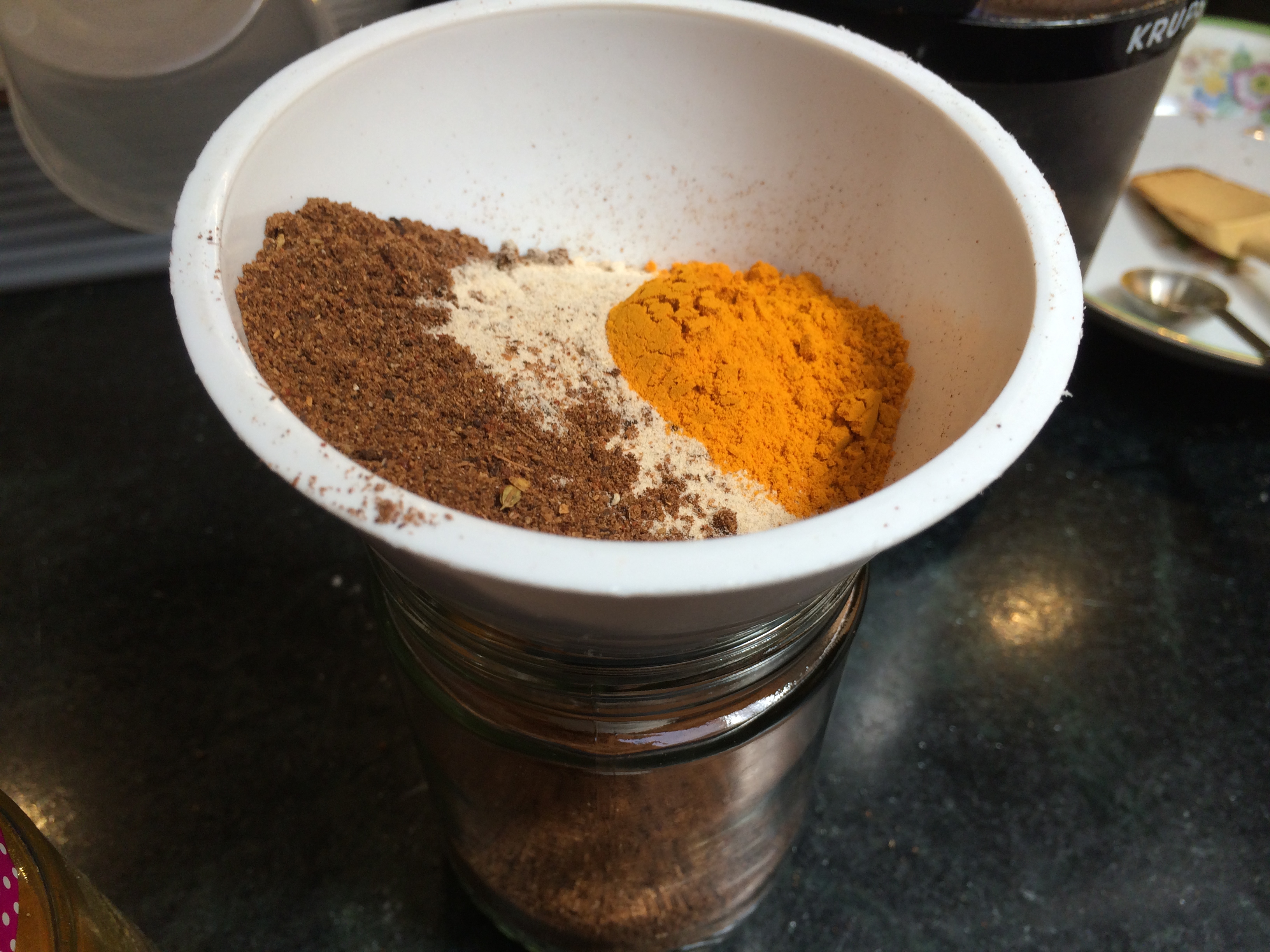
Going thru the funnel

Going thru the funnel

My 8-year-old helping with a chopstick

My 8-year-old helping with a chopstick

Done and labeled

Done and labeled

Pav bhaji masala

Ingredients:
  • Quarter cup cumin seeds
  • Quarter cup coriander seeds
  • 2 tablespoons whole black pepper
  • 2 tablespoons cloves
  • 1 tablespoon fennel seeds
  • 3 black cardamom (use half of what I have pictured above)
  • 10 dry red chilies (change amount to suit your taste, this is pretty hot)
  • 1 tablespoon turmeric powder
  • 1 tablespoon dry mango powder
Method

Heat a cast-iron pan on medium heat. We are going to roast spices so be sure you have your windows open and fan on. Roast each spice separately until each is fragrant and slightly darkened. Empty into a plate. Grind them together in a clean coffee grinder. Pour into a jar using a funnel. Now is the time to mix in the already ground turmeric and dry mango powder. Shake to combine. Label and save.

Then the bhaji (vegetables):

Vegetables

Vegetables

Veggies about to be boiled

Veggies about to be boiled

Boiled veggies roughly mashed

Boiled veggies roughly mashed

Saute onions and green bell peppers

Saute onions and green bell peppers

Add ginger-garlic-chili paste

Add ginger-garlic-chili paste

Add tomatoes

Add tomatoes

Dry spices go in

Dry spices go in

Cook dry spices

Cook dry spices

Add vegetables

Add vegetables

Pav bhaji served

Pav bhaji served

Pav Bhaji

Ingredients:
  • Ginger-garlic-chili paste made from 6 garlic cloves, 1 inch piece of ginger, 2 green chilies
  • 1 medium onion chopped up
  • 3 medium tomatoes chopped up
  • 1 green bell pepper (capsicum) diced
  • For boiling:
    • 2 carrots
    • 10 or so green beans
    • 1 medium potato
    • Quarter of a medium cauliflower
    • Quarter of a medium head of cabbage
  • 1 teaspoon salt
  • 2 tablespoons butter or ghee
  • 2 tablespoons pav bhaji masala from above
  • 1/2 teaspoon turmeric powder
Method:

Roughly chop the vegetables that are for boiling, add half a cup of water and the 1 teaspoon salt. Bring to a boil, cover and cook on a simmer until softened, about 15 minutes. When they are done, roughly mash with a potato masher.

Meanwhile heat the ghee in a thick pan. When it is hot add the onions and bell pepper. Let them soften on medium heat for about 4 minutes. The important thing with the onion is that it must not caramelize — that adds a sweetness and brown flavor that does not go with this dish. Add the ginger-garlic-chili paste and stir, until the oil separates, which means the paste is cooked. Now in goes the tomatoes. They have to first liquefy then dry up. You can turn up the heat for this part.

Once they are dry, you can add the dry spices — the pav bhaji masala and the turmeric powder. Stir them in and cook for a minute. Plop in the mashed vegetables. Mash some more, cook for 10 minutes or so, gently stirring and mashing as you please, until they are well combined.

Give it a taste — now is the time to make adjustments. Adjust the salt. Add red chili if it is not hot enough. Add more ghee or butter swirled in on top for lusciousness.

Serve with pav bread, optionally sliced and toasted on the same pan, with a bit of butter. Garnish with minced onion and lime juice.

Let's connect... FB-f-Logo__blue_29 pinterest_badge_red Google+ twitter-button-small

I love you, Alemany Farmer’s Market! Plus: what one does with Bitter Melon Greens

Bitter melon greens with paneer

Bitter melon greens with paneer

I do so love you, Alemany Farmer’s Market! I love all the other farmer’s markets too but you are soooo special.

I have found that there are two types of farmer’s markets in the Bay Area. There are farmer’s MARKETS and then there are FARMER’S markets. The former are a lot about marketing. They sell produce, sure, but a lot of it is overpriced, and more than half the stalls are filled with high-profit-margin goods like infused oils in precious glass bottles. I can do that for free at home in an emptied jam jar and no preciousness.

Alemany Farmer's Market (Copyright: Kurt Rogers, The Chronicle)

Alemany Farmer’s Market (Copyright: Kurt Rogers, The Chronicle)

But Alemany farmer’s market, you truly are a FARMER’S market. I love you because you tickle my fancy every time I visit. Where else can I find corn that is blue and smaller than my palm and sticky. Where else can I find a fleshy, hairy stalk that is labeled ‘wild potato’ (even Google flopped on that one). Where else would I see tiny blotchy eggs that were apparently laid by a quail. Where else would I find a prickly pink egg, and not only giant taro with their purple stem still attached but also taro leaves. Where else can I find not one, not two, but three or four choy-related greens.

And no matter how strange and unfamiliar the sight I see, there’s always a crowd of customers expertly assessing, holding, pressing, rifling through the produce. There I stand, mystified, in awe, only to be elbowed aside by a little old lady with her cloth bag who has zeroed in on the unnamed leaves and is tossing aside the rotten ones and snagging the good ones. She is gone before I can gasp — excuse me, lady, can you save some for me, and by the way, what on earth is it?

In this farmer’s market, advice abounds. As soon as I pick up a fruit or vegetable and stand there regarding it, someone or the other’s voice will speak up beside me — you chop it, you fry it with garlic. Or boil it with chicken. Or what have you. More often than not, the English is broken and heavily accented and the accents could come from any part of the world from Africa to Vietnam. If San Francisco is a microcosm, then Alemany Farmer’s Market is a micro-micro-cosm. Or a micro-cosm-cosm? Something like that.

Best of all is when this market reintroduces me to some childhood friends that I didn’t at first recognize. The other day this happened to me twice. First I see these pretty round leaves tied in a bunch. The person at the stall informs me that they are moringa leaves, grown all over the world from Africa to the Himalayas to South-east Asia, a miracle vegetable that can cure all sorts of ailments. Sounds familiar, but what is it? Hold that thought…a post on that will come next.

Bitter melon greens

Bitter melon greens

Next I see a stall with these simply humungus bunches of bright green leaves with tendrils sticking out all over. Turns out these are leaves from the bitter melon plant — bitter gourd, karela, call it what you will. Well. That is an old friend and I love it. I have cooked with it many times. But I didn’t know that the leaves were edible too.

Bitter melon greens with paneer

Turns out they are, down to the stems. They are certainly bitter though, so I tried cooking them with something creamy to smooth out the bitterness. I used ghee and paneer.

The other thing about this recipe is that it is more of a mindset rather than a fixed set of steps. If you don’t have paneer, you might substitute with ricotta. If you don’t have the bitter melon greens, either dandelion greens, radicchio or frisée would be a great replacement. Out of the spices used, if you don’t have one, just leave it out, although of course the character of the dish will morph. The cumin seeds in particular, I would try not to leave out. Heat can come from any source like the cracked red pepper that the Italians use. Ghee of course, can be replaced with butter. Mmm…now I can’t wait to try this completely new recipe with all the replacements made! Here are pictures of the process.

Slicing the greens

Slicing the greens

Other ingredients: paneer, onion, garlic, chili, cumin

Other ingredients: paneer, onion, garlic, chili, cumin

Frying garlic, chili, onion

Frying garlic, chili, onion

Paneer goes in

Paneer goes in

Powdered spices go in

Powdered spices go in

Stir to coat

Stir to coat

Greens go in

Greens go in

Done

Done

Bitter melon greens with paneer

Ingredients
  • 1/2 pound paneer
  • Half a bunch bitter melon greens
  • 1 large shallot or half a medium onion, chopped fine
  • 4-5 cloves garlic, sliced
  • 1-3 serrano chilies, sliced
  • 1 teaspoon cumin seeds
  • 1/4 teaspoon turmeric powder
  • 3/4 teaspoon salt
  • 1/2 teaspoon red chili powder (optional)
  • 1 tablespoon ghee
Method

Rinse and slice the greens. The finer you slice the greens the better the final result. I ultimately didn’t get it super fine but I did try to ensure no stem was longer than half an inch. Dice the paneer into little blocks about 1/4 inch on each side. Finely chop the shallot, garlic and chilies.

Heat the ghee in a wide pan on medium heat. When it is shimmering, put in the cumin seeds. They will presently sizzle, then in goes the garlic and chilies. Let them get a little shriveled (couple minutes) and put in the onion. The onion only needs to cook until pink and translucent, not browned.

Put in paneer at this point, along with the dry masalas (turmeric powder, red chili powder and salt). Stir to combine. Greens go in next. Toss with paneer and spices. Then don’t need to cook for long. When they look shrunk down and shiny, add about half a cup of hot water, cover and cook on low for just about 4 minutes and you are done.

This goes well with chapatis/rotis or rice.

Let's connect... FB-f-Logo__blue_29 pinterest_badge_red Google+ twitter-button-small

For inspiration on green beans, look east

Green beans with Bengali spices

Green beans with Bengali spices

Bengal is a pretty far away land for me, since I am from the west coast of India, and ancestrally hail from even farther away Sindh. Exotic, I think, is the word I would use. In addition to that, I’m fond of the way Bengali sounds (not intelligible to me), full of rounded vowels; and the things they choose to say, seem old-world and fancy. Then, there is art. Sorry, I meant Art. This is what Bengal is known for above everything else (go google Rabindranath Tagore and Satyajit Ray, just to start). And if you think about it, great art is a lot about judicious choice.

So this is what I want to focus on today. A few  choices, judiciously made.

This dish is a dry sauté of green beans, with a simple tempering of whole spices. For vegetables cooked this way, a few choices you make are very consequential. How you cut the vegetables and how small. If they are small enough the high-heat sauté will be enough to cook them all the way through. If not, a slight steam-braise will be necessary, so cooking on low with the lid on to finish is called for. What fat one uses. Subtle choice, and often not subtle at all; the choice of fat can dramatically alter the dish. How high of heat one uses. High enough it is practically a wok-ish stir-fry. Low enough, and the primary means of cooking is from the steam emanating from the vegetable itself.

Naturally, the spices thrown into the fat to temper is consequential too. This is where the Bengali flair comes in. The famous Bengali spice mix, paanch phoran, consists of five disparate seeds from disparate plant families, that nevertheless come together in oil in an unforgettable partnership. For green beans, I find this to be very congenial and I usually cook them this way.

stuff 026Here is what goes into the paanch phoran, from bottom to top:

Fenugreek seeds: Fenugreek is a legume just like beans and peas. It has a distinctive smell that some have compared to maple syrup and a pleasing bitterness.

Fennel seeds: From the carrot family, fennel seeds are used as a mouth-freshener all over India.

Nigella seeds: Also known as kalonji, these small black droplet-shaped seeds are from the buttercup family. A relative, love-in-a-mist, is grown widely in England as an ornamental, I hear. Their flavor is reminiscent of onions when roasted.

Cumin seeds: Another carrot family member. Cumin has been used as a spice in India since ancient times. Its flavor is earthy and sharp at the same time.

Mustard seeds: Little brown balls with a kick. I have always thought of them as having a biscuity taste, whatever that means.

Bah, one can’t really describe a flavor. Go try it and I won’t need to.

Green beans sauteéd with Bengali spices

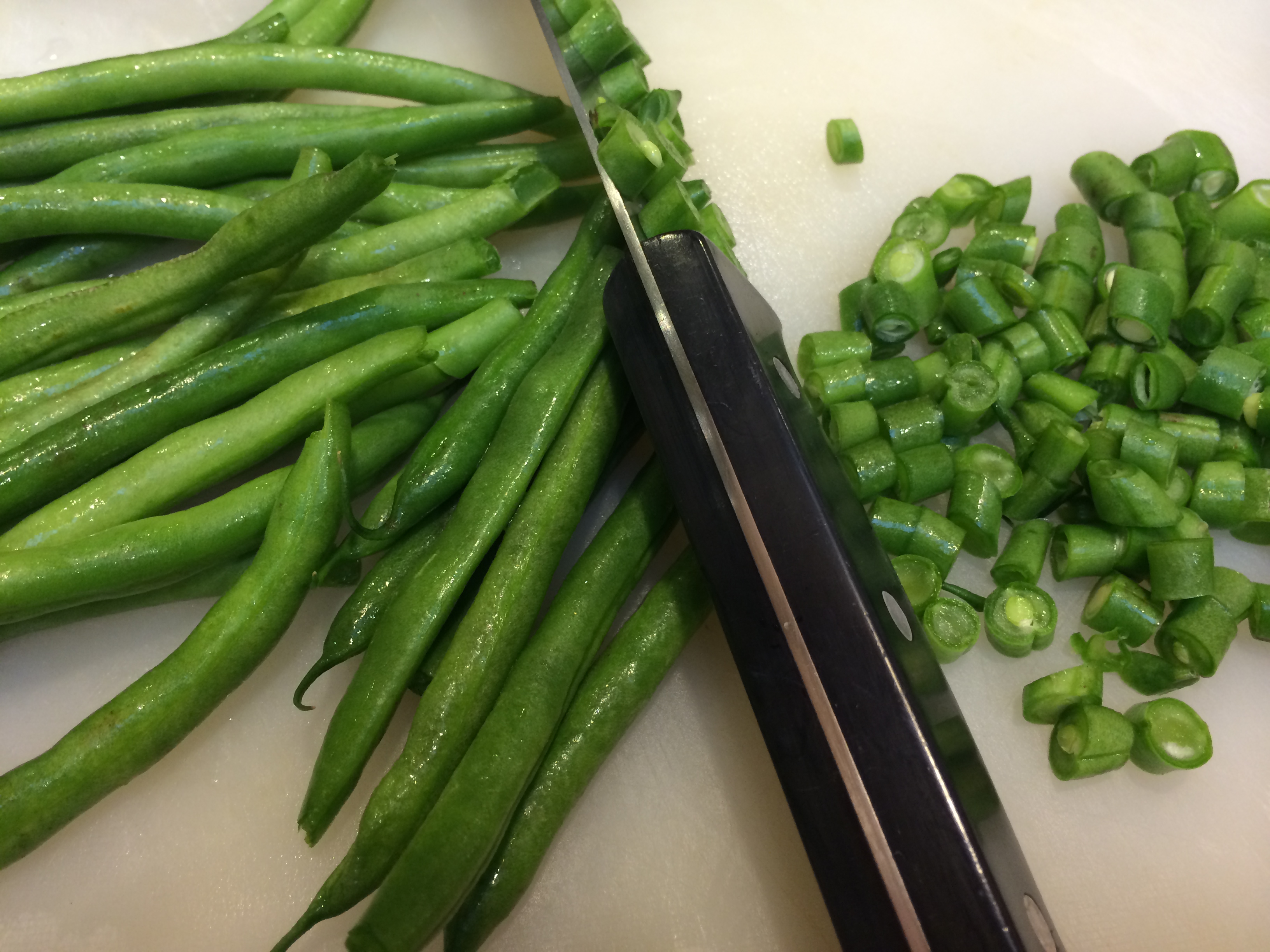
I want the green beans to be basically done with the sauté, so I cut them into small pieces, none wider than about a quarter inch. For the fat, I use mustard oil, for more of the Bengali style.

Cutting the green beans into small rounds

Cutting the green beans into small rounds

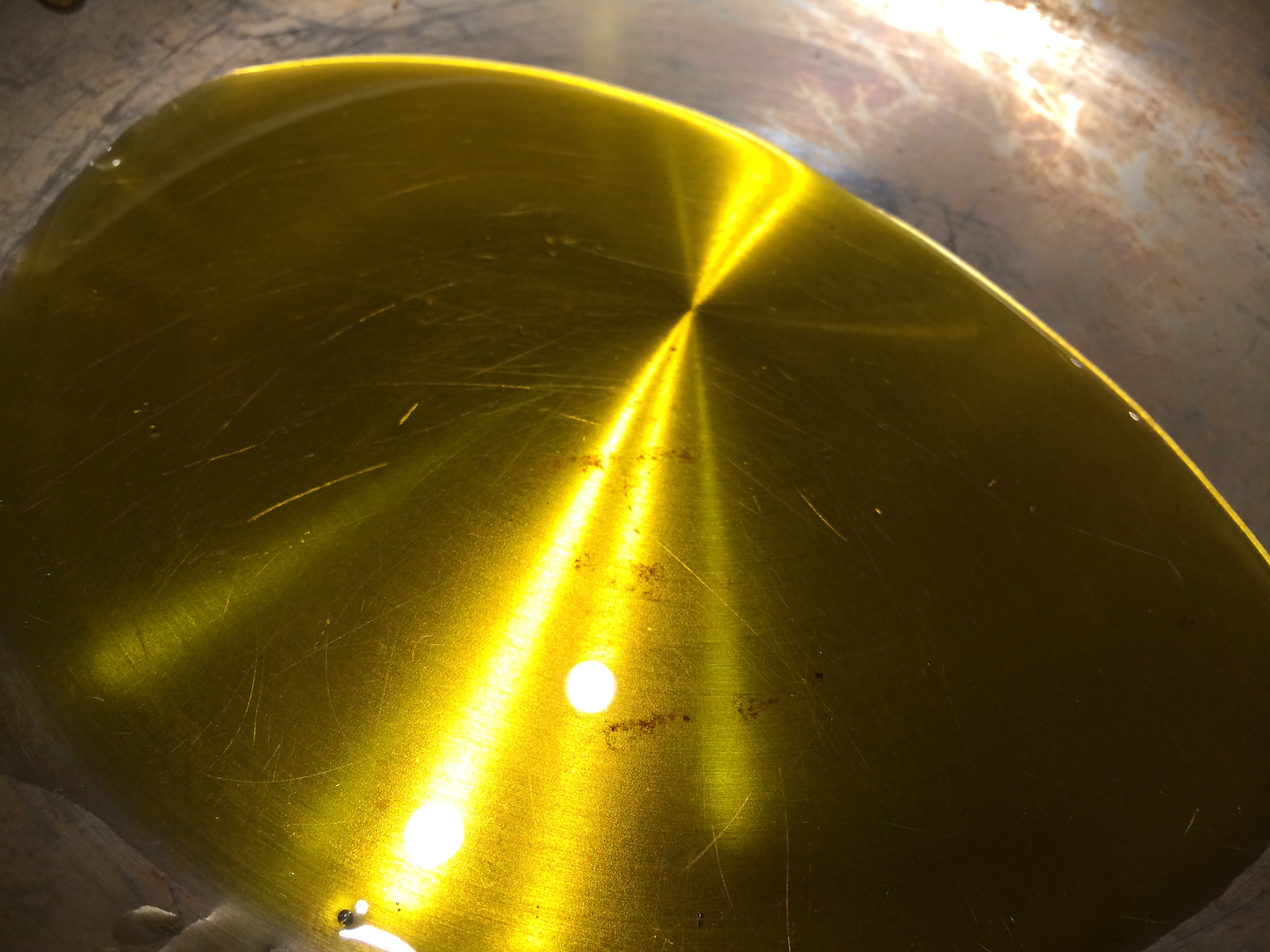
Look how golden the mustard oil is

Look how golden the mustard oil is

Red chili powder

Red chili powder

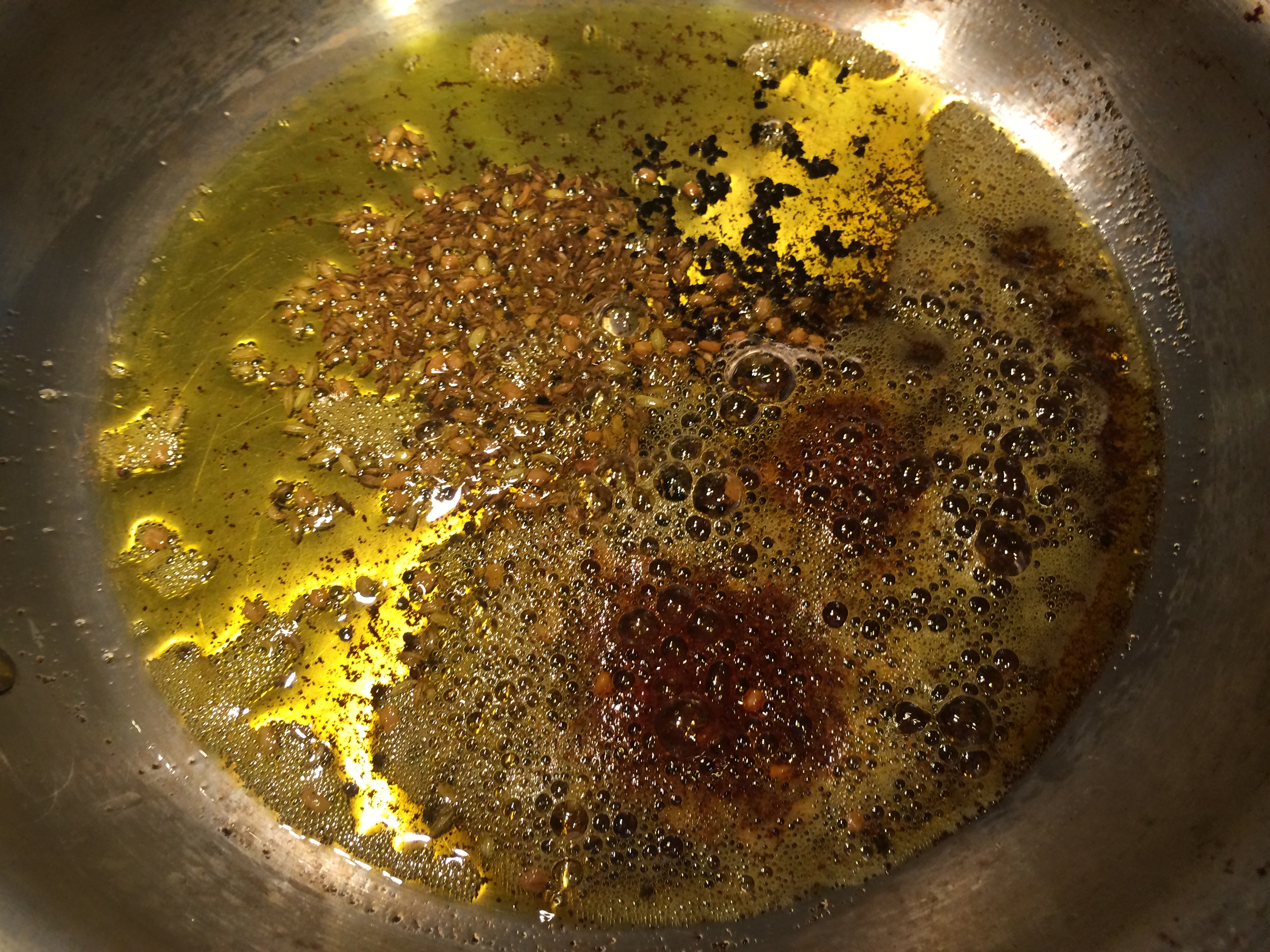
Tempering spices

Tempering spices

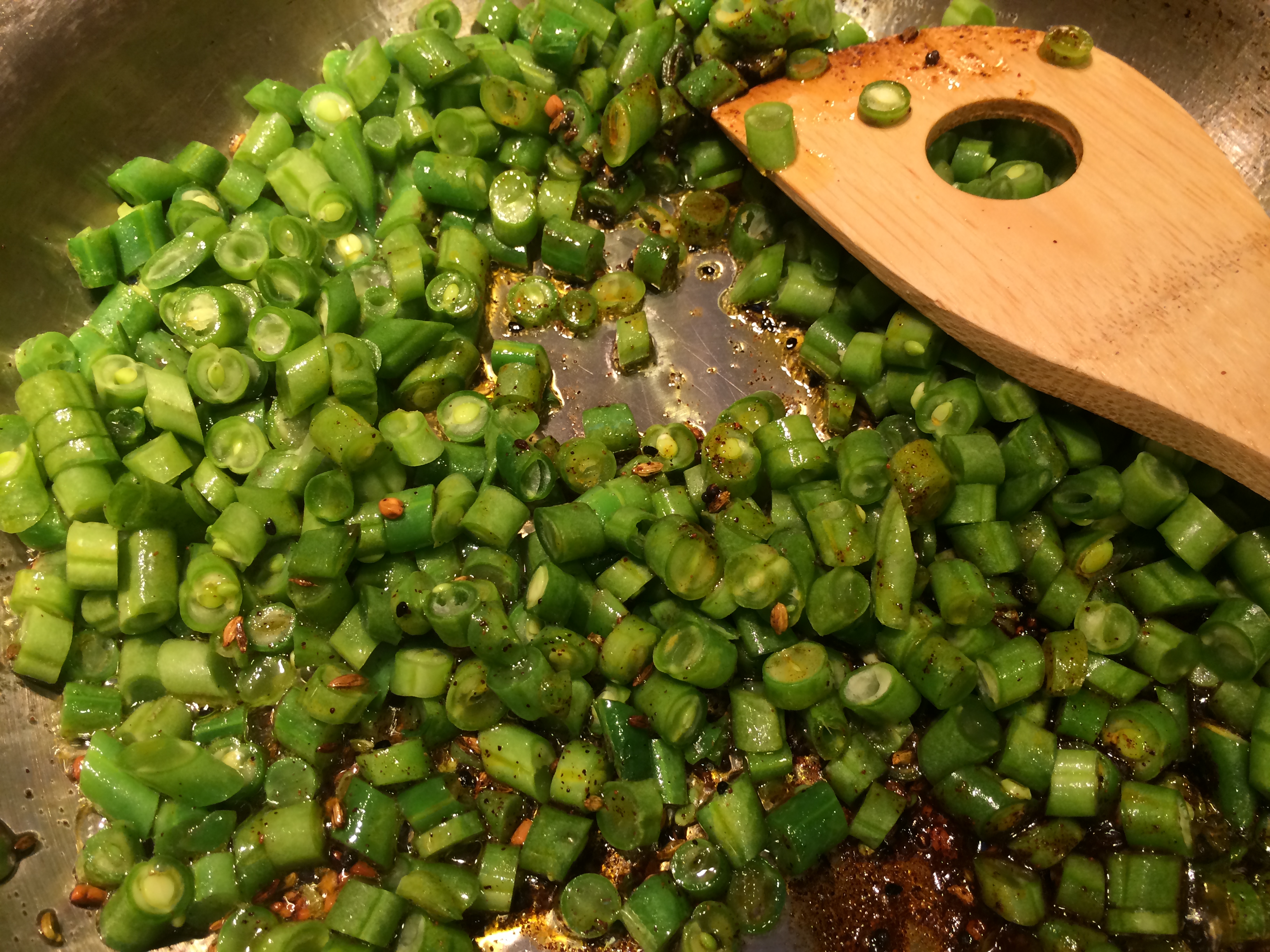
Throw in the green beans

Throw in the green beans

Cook for 10 minutes, uncovered

Cook for 10 minutes, uncovered

Green beans sauteéd with Bengali spices

Ingredients
  • Half a pound of green beans
  • Half a teaspoon red chili powder, or more according to heat tolerence
  • Quarter teaspoon fenugreek seeds
  • Quarter teaspoon nigella seeds (kalonji)
  • Half teaspoon cumin seeds
  • Half teaspoon fennel seeds
  • Half teaspoon mustard seeds
  • 3/4 teaspoon salt
  • 2 tablespoons mustard oil
  • 1 teaspoon brown sugar or jaggery
Method

Heat the oil on medium-high in a wide thick-bottomed pan. This is the temperature that the entire dish will be cooked at. Most Bengali recipes recommend letting the oil smoke first, but I hear that is bad for you, and I like the kick of mustard oil and don’t want to quell it, so I don’t let it smoke.

Throw in the spices in the following sequence: first the red chili powder; then the cumin; when it sizzles the nigella and fennel; when they sizzle the mustard seeds; when those pop the fenugreek.

Now in go the green beans. Stir to coat with oil. Let them cook, uncovered, occasionally stirring. Five minutes in, sprinkle in the salt. Ten minutes in, the beans will be mostly done, some charred, most shriveled, and still crunchy.

In this dish, I really like the effect of some sweetness. The sugar goes in towards the end of cooking, and is simply stirred in. Done.

The ? vegetable, roasted

Question

This vegetable taunts and beckons me every time I walk by it at the grocery store. I have earlier compared them to caterpillers or seaweed, but now I’m thinking it looks like nothing but a question mark.

What am I? it seems to say at the grocery store. Don’t you want me? And then when I break down under the emotional blackmail and buy some, the bag sits in the fridge untouched for a couple days while I wonder what on earth to do with it. What will you do with me, huh? they say. Why did you buy me if you have no idea what to do with me? Why? How? What? And more importantly, when?

A permanent rebuke, is what it is. But I’m no slouch. I don’t let a mere vegetable sit there passing judgment on me. I’m a food blogger, is what I am.

Thus fortified, let us try to seek the heart of fiddlehead ferns once again. Here is the first such quest. I think I did better this time.

Here is the thing about fiddleheads. Their flavor is often compared to asparagus, but I feel like it has a sort of medicinal sweetness like that of artichoke, which is enhanced by cooking. The fleshy part is quite scanty compared to that of an artichoke, and comes encased in a stem, the fibrous parts of which would be nice to crisp up. So — it would be nice to fully cook the inside and crisp up the outside. Last time I had tried sautéing it and noted the difficulty of getting it to take on a char that way. So this time I tried a different method.

Blanching for 5 minutes to get the inside to cook. Then roasting in a single layer for the crispness.

Roasted fiddlehead ferns

You can see how it turned out. For me, it was finger food. Next time — add some chili powder and maybe lemon squirted on top.

Ingredients:
  • Half a pound of fiddleheads
  • 2 fat cloves of garlic
  • Olive oil — some
  • Salt — some
  • Coriander powder — some
Method:

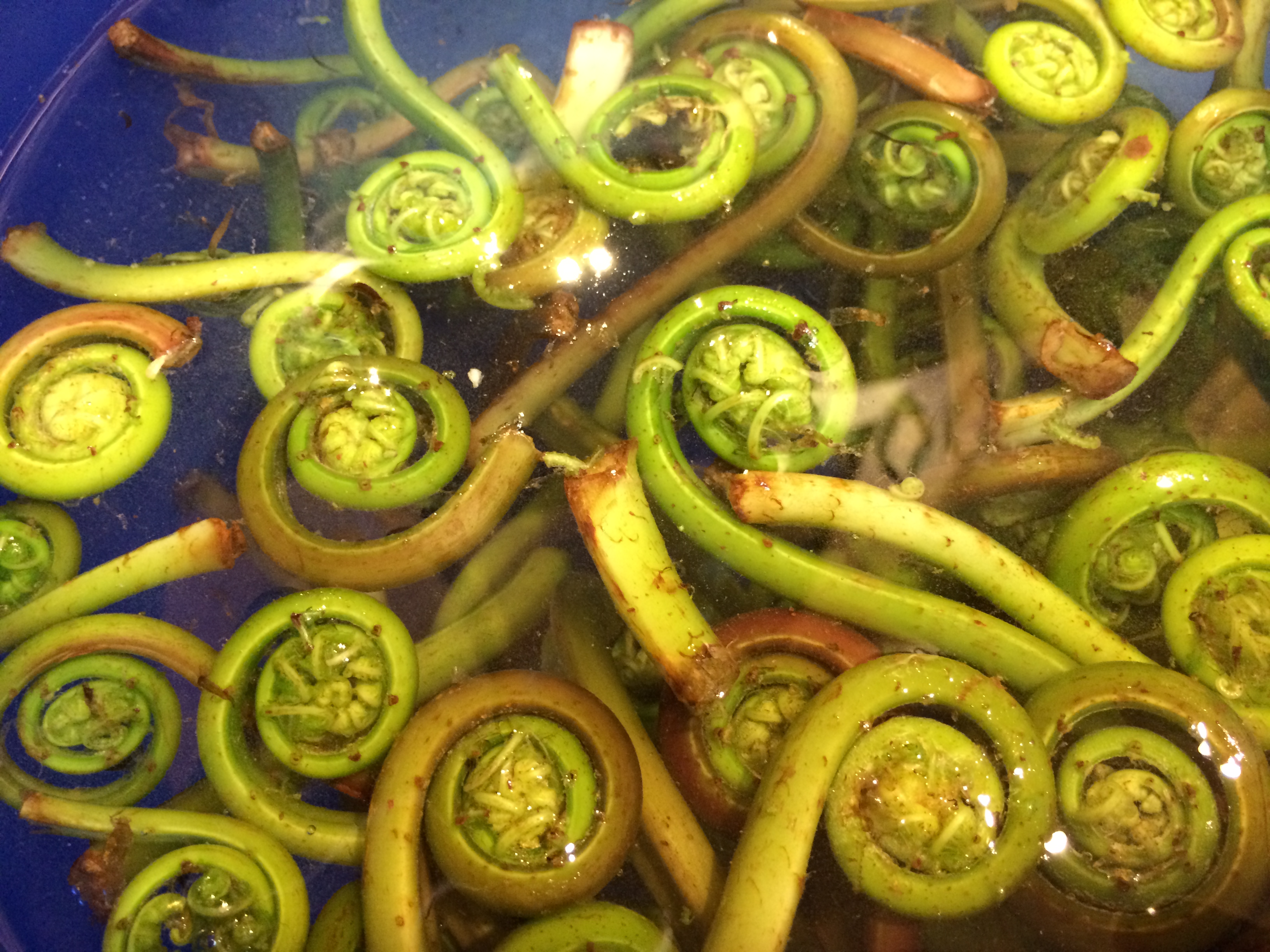
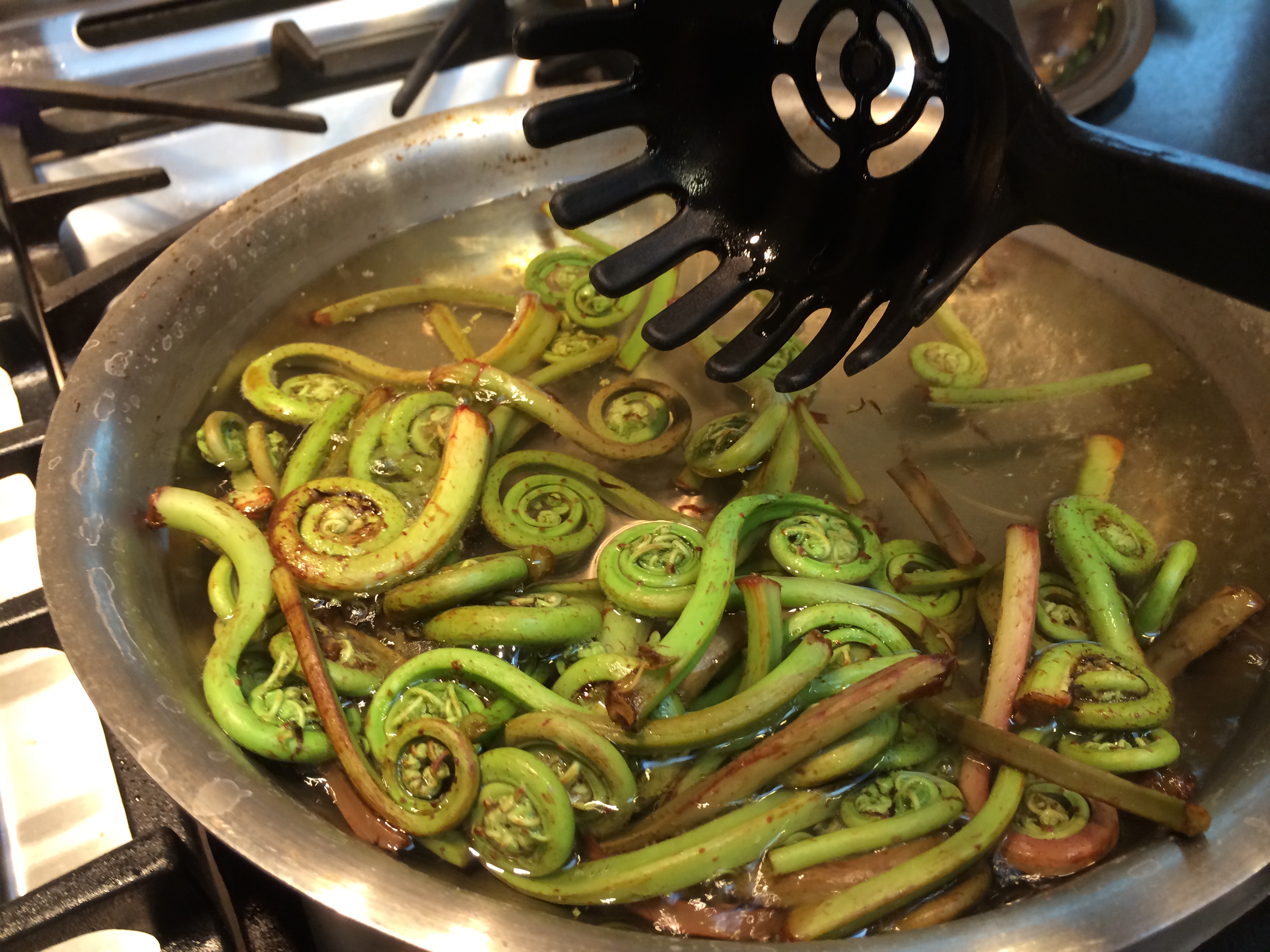
IMG_1328 IMG_1333 IMG_1335Wash the fiddleheads by soaking in a tub of water and swirling it around and possibly rubbing the baby ferns gently. Bring about 4 cups of water to a boil and salt it. When it is boiling, put the fiddleheads in, bring to a boil once again, and let them blanch this way for about 5 minutes.

Fish them out. Lay them out on roasting pan. Cover with more salt and olive oil. Rub coriander powder all over. Place the two fat cloves of garlic tucked in in a  couple places, covered with oil also. Roast at 450°F open, for about 8 to 10 minutes. Halfway during cooking, pull it out and stir to turn most of them over.

IMG_1351IMG_1352

The garlic is also fully roasted by this point, and the paste from inside can be squeezed out like from a toothpaste tube. A teeny bit of garlic paste with a fingerful of crisp fiddlehead spindles — it was delicious.

For more information on fiddleheads (they are the immature fronds of ostrich ferns)  read this:

http://umaine.edu/publications/4198e/

and of course, don’t miss Wikipedia on the subject:

http://en.wikipedia.org/wiki/Matteuccia_struthiopteris

Tomato-garlic gravy or bust

Tomato-garlic gravy with purple potatoes and peas

Tomato-garlic gravy with purple potatoes and peas

So I’m a pretty laid-back person generally but for this recipe I am absolutely a stickler. I am a tyrant. This must be made with these ingredients — no, don’t throw in ginger, don’t throw in cumin. Leave that onion out, you will ruin it. I realize that canned tomatoes will make your life easier but this recipe calls for fresh ones, and what recipe wants, recipe gets.

Don’t leave anything out either. I realize that curry leaves are not easily available everywhere. If you don’t find them, I guess you must leave them out. But please, do so with regret. And don’t go substituting it with something else.

However even though I am so particular about the gravy itself, on the subject of what you put in it — the floaters — my laid-back self reasserts itself. Put anything in it — anything. Potatoes? Yes, diced. Peas? Yes, sure, no need to thaw. Paneer — cube it, pop it in. Cauliflower? Certainly, deflowered. No, I mean, floreted. Green beans, bell peppers, eggplant, name it — use it. Even tofu, why not? Use your imagination, I encourage you every step of the way.

Presenting the:

Tomato-garlic gravy

A very simple way to zest up your basic vegetables for weeknight eating. Potatoes go specially well, diced. This makes enough for a dinner for two. Goes with chapati or other flatbread. Made more liquid, can go with rice.

Ingredients:

  • 3 – 4 large cloves of garlic, sliced
  • 1 – 3 serrano or other green chilies, depends on your preference
  • 6 – 7 curry leaves
  • 1 teaspoon mustard seeds
  • 1/4 teaspoon turmeric powder
  • 1 teaspoon coriander powder
  • 2 medium tomatoes (I used roma / plum tomatoes)
  • 1 – 2 tablespoons oil
  • 1 teaspoon salt
  • 1.5 cups of chopped vegetables, see above.

Method:

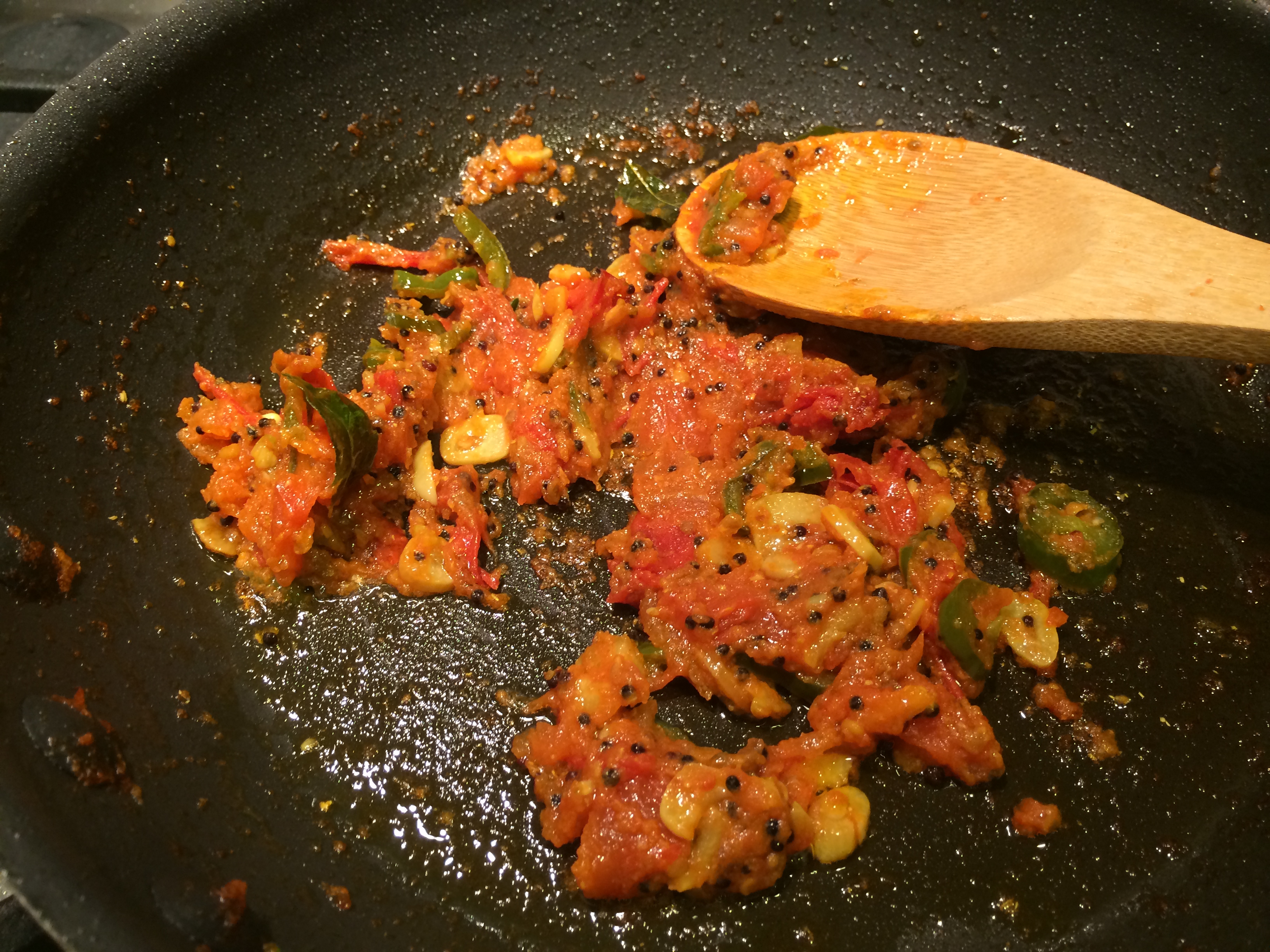
Chop the garlic, slice the chilies. Dice the tomatoes. Heat the oil in a thick-bottomed pot on medium-high heat. When it shimmers, throw in the mustard seeds. When they start to pop, the garlic, chili and curry leaves. The will sizzle and start to shrivel. Now is the time to put the tomatoes in. Stir to coat with oil and spices. Now let it cook for ten minutes or more on medium. No need for lid. First they will liquefy, then boil off the liquid, till they become pasty.

IMG_1066 IMG_1068 IMG_1069 IMG_1071

This is how you know when the tomatoes have cooked enough — you see bits of the peel separated from the flesh, rolled up into little sticks. If you look carefully at the completed dish picture you will see them.

Add the dry spices, stir for a minute. Put in about a half cup to a cup of hot water, depending on how wet you want the final result. Let the water come to a boil, simmer for 5 minutes.

The floaters go next…each vegetable must cook for its specific length of time…so this must happen in a choreographed way. Potatoes take about 15 minutes; cauliflowers too; green beans about 10, frozen peas just need to thaw and they are done. So use your judgment on the timing.

This dish is great with chapatis with some moong dal on the side. Cilantro works for garnish.

IMG_1072