A method to the meadness

Dear Reader, are you willing to follow me in an experiment?

You will be following along in real time, just like a reality TV show! Suspense, excitement, a slightly risque end-product, and the very real possibility of failure. Hopefully this means high ratings!

We will attempt to make mead.

A goblet of mead, Konstantin Makovsky

A goblet of mead, Konstantin Makovsky, from Art and Faith blog

Mead is the grand-daddy of alcoholic beverages. This past New Year’s Eve when you got nicely liquored up, knowingly or not, you raised your glass to the original makers of mead. Those were the guys about 11000 years ago who discovered that honey diluted with water, when left outside, will turn into a hotbed of yeast infection; those yeasties will eat up the sugars in honey thereby turning the beverage ‘dry’; and clearly yeasties that eat must excrete, which they will do, in great globs of alcohol. Those ancients also discovered that this yeast excretion — namely alcohol — has a nicely happy-making effect, adding zest to New Year’s celebrations.

What a perfect season to attempt mead.

This past Christmas we visited my brother and sister-in-law on the East coast. They own a mead-making set, which they have used once, with moldy results. This post chronicles their second attempt. This time, they are determined to see the bubbles of carbonation arise and sip actual alcohol. The Odd Pantry will be reporting from the field.

Deepak and Shannon’s Mead

Ingredients: 

  • 3.25 lb pure honey (buy from a health/nature type of store. Grocery stores often carry adulterated honey. Check the label. If it says the name of the flower it is probably good. Also if it is crystallized it is pure.)
  • Acid sanitizer (amount according to directions on bottle)
  • Yeast nutrient (urea) — 1 teaspoon
  • Yeast energizer — 1 teaspoon
  • Wine yeast — 2.5 g (half package)
  • 1 gallon distilled or spring water
  • Mix of spices and dried fruit (optional), for example a sliver of orange peel; raisins; cinammon; cloves; cardamom

Equipment:

  • Funnel
  • A large bowl for sanitizing
  • A large bowl for mixing
  • Small bowl for rehydrating yeast in 2 cups water
  • 1 gallon glass jug with airlock, or 1 gallon plastic carboy with separate airlock
  • Rubber stopper with no hole for the jug
  • A thermometer that you can sanitize
  • Weighing scale
  • Spatula

Method:

The recipe that follows is adapted from this source.

In a large bowl, make a sanitizer and water solution. In this, sanitize all the equipment you will be using, including the inside surface of the mixing bowls. You can use the equipment directly without rinsing off the sanitizer.
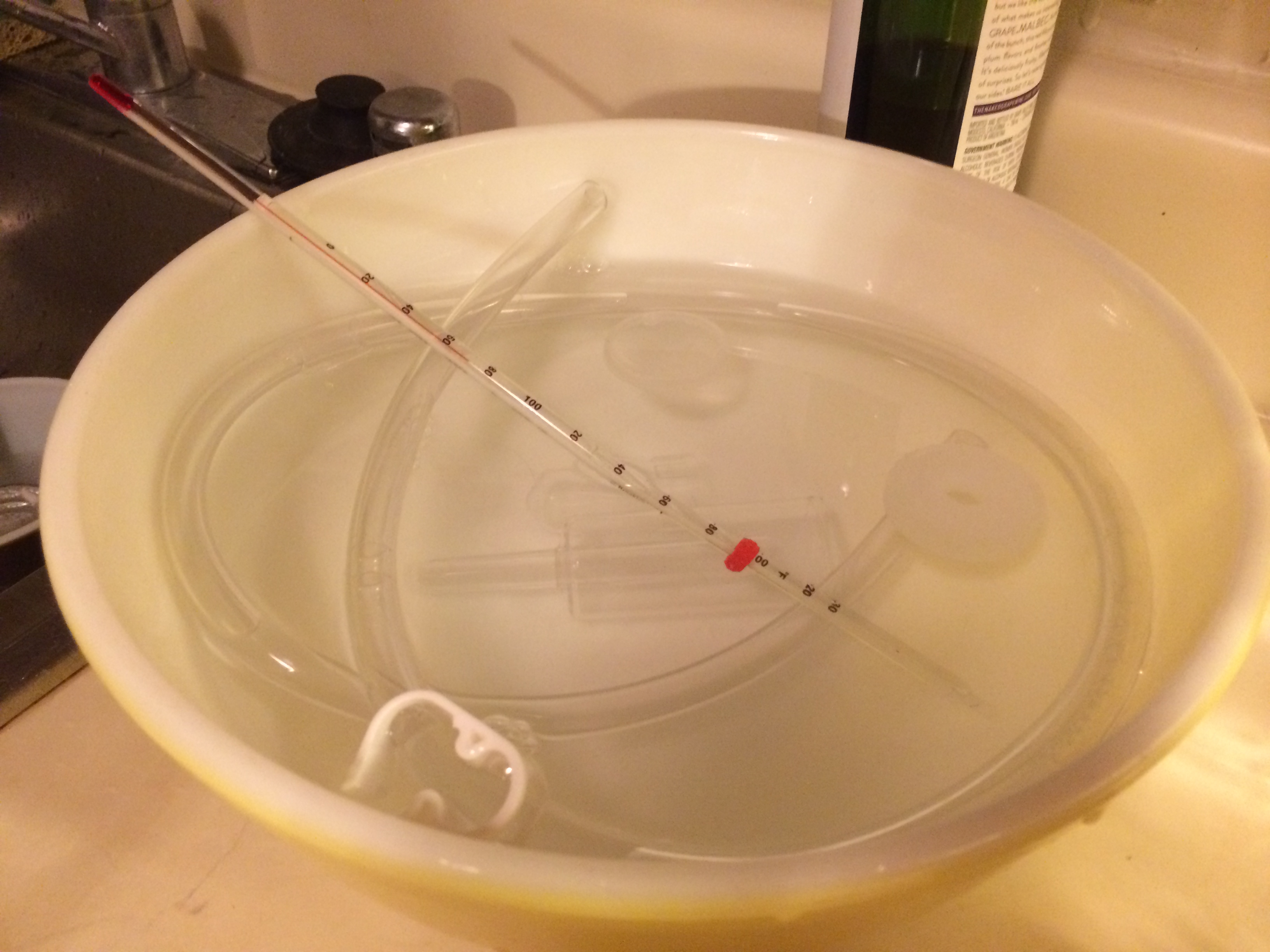
Sanitizing

Sanitizing

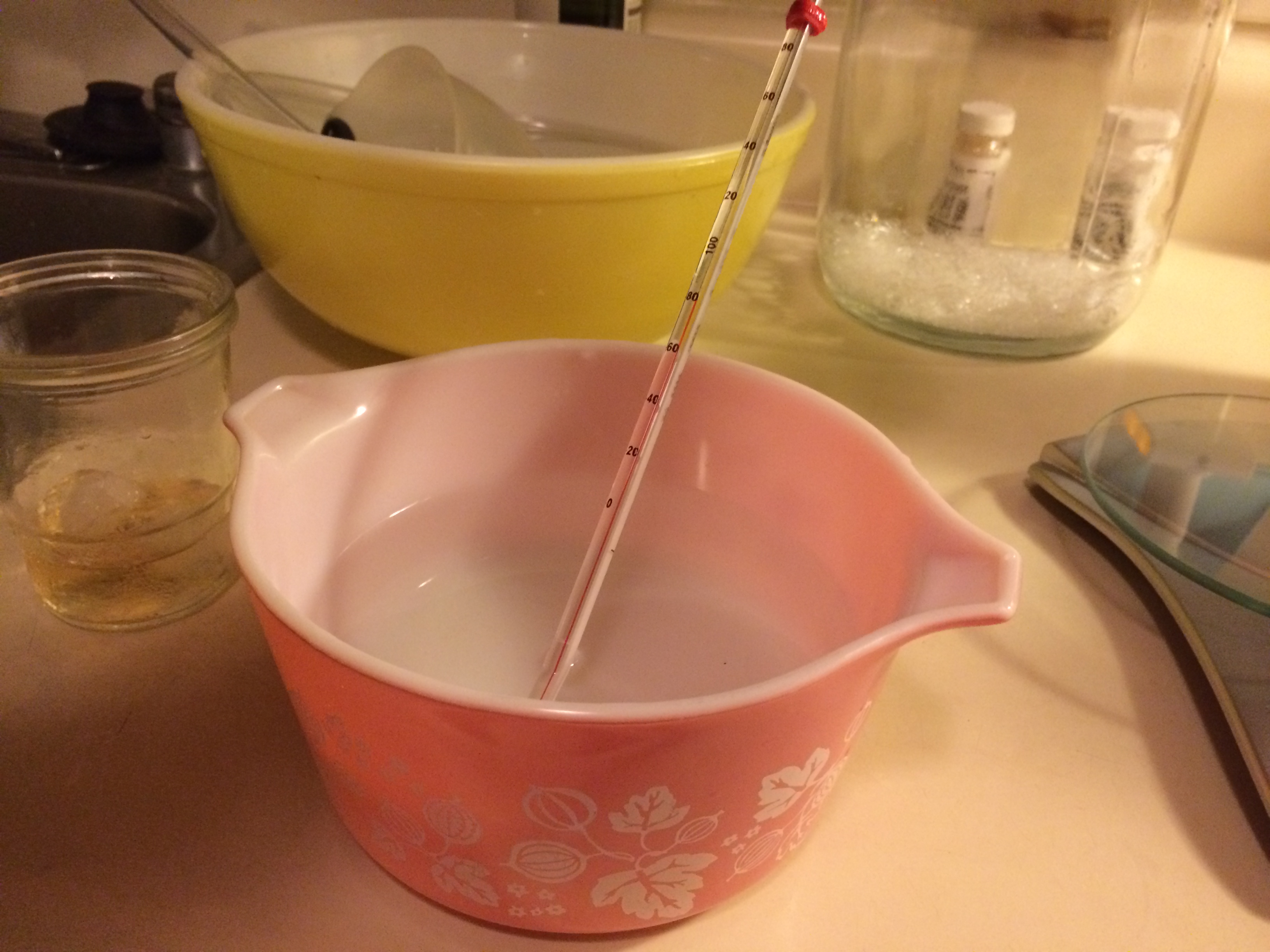
Use 2 cups of the spring water in a small bowl to rehydrate yeast: heat the water in a microwave to between 104 F to 109 F degrees (use the thermometer for accuracy) and pour half the package of yeast in. No need to stir — we will do that in 15 minutes.
Washington DC trip 229 Washington DC trip 231

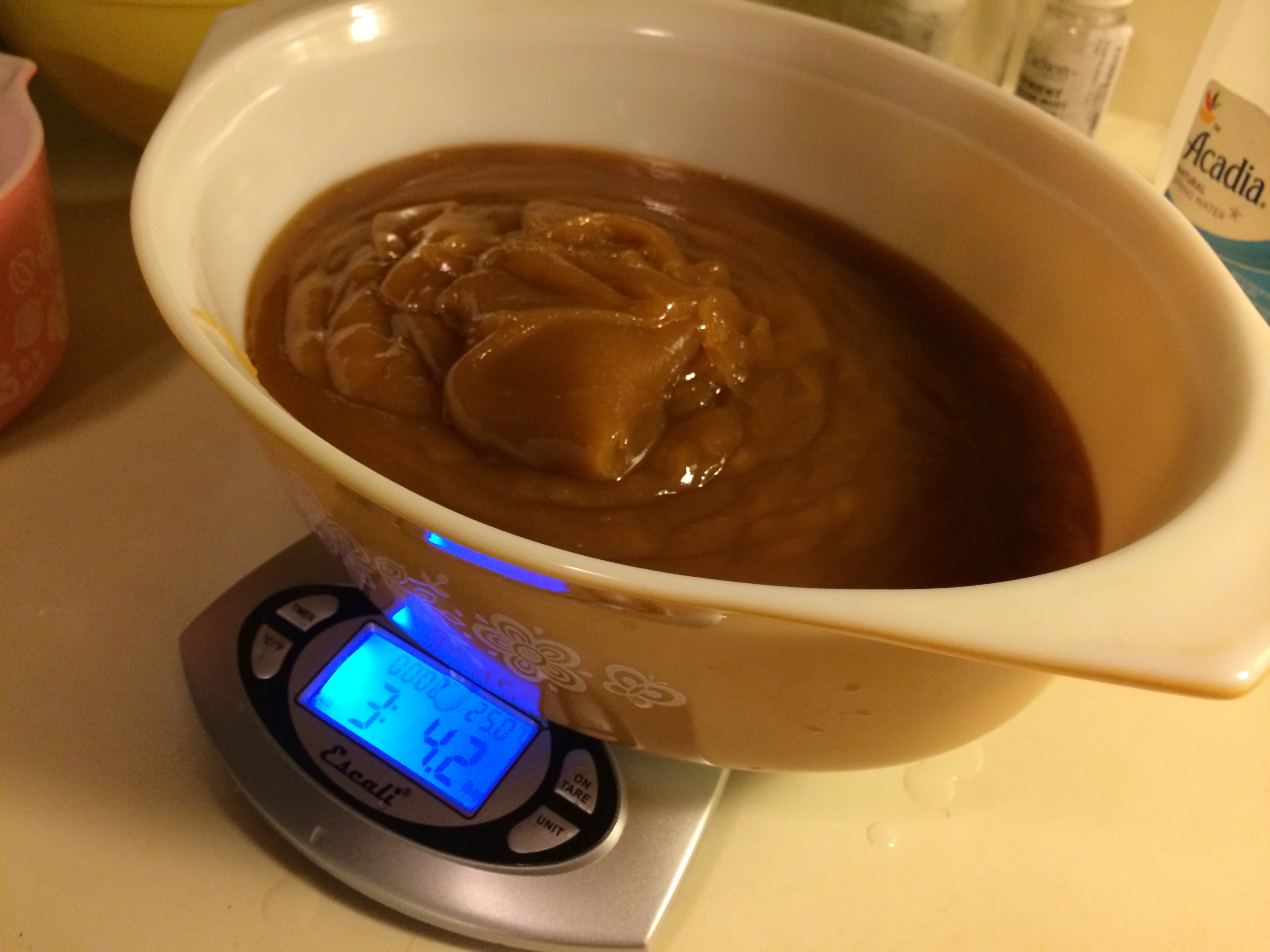
Meanwhile, weigh out 3.25 lb of honey in the large mixing bowl. If the honey has crystallized, you can liquefy it by first putting the jug in a warm water bath; do not microwave it. Add about 2 cups of the spring water in and stir it with the spatula; we are simply making the honey easy to pour into the jug.

Washington DC trip 233 Washington DC trip 235 Washington DC trip 238

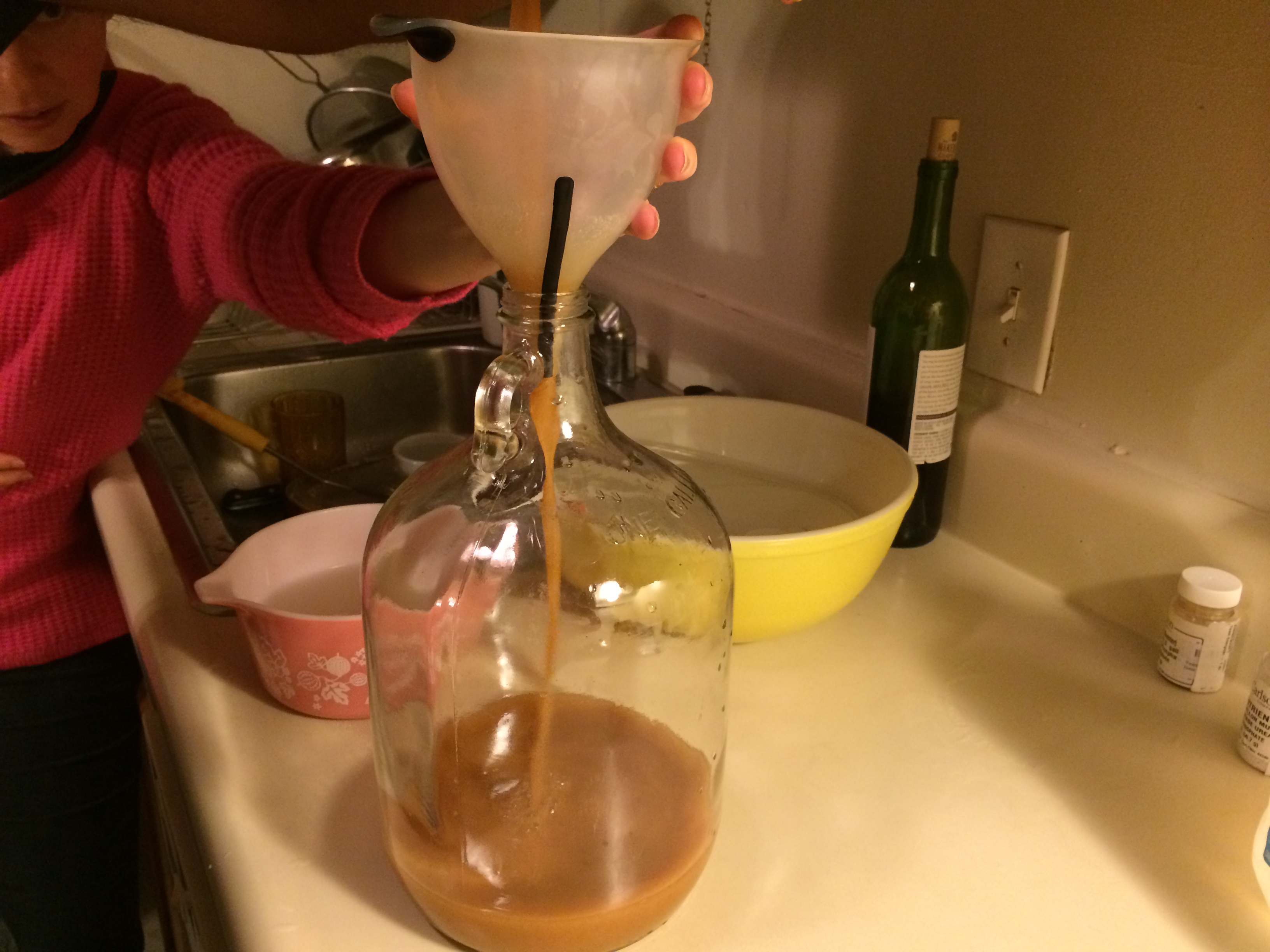
Pour the honey-water mix into the jug using the funnel. If you are using fruit or spices, now is the time to put them into the honey-water mixture.

Add another 1 cup of the spring water in the mixing bowl, and add your 1 teaspoon of yeast nutrient, and 1 teaspoon of energizer. Stir and pour into the jug with the honey-water mix.

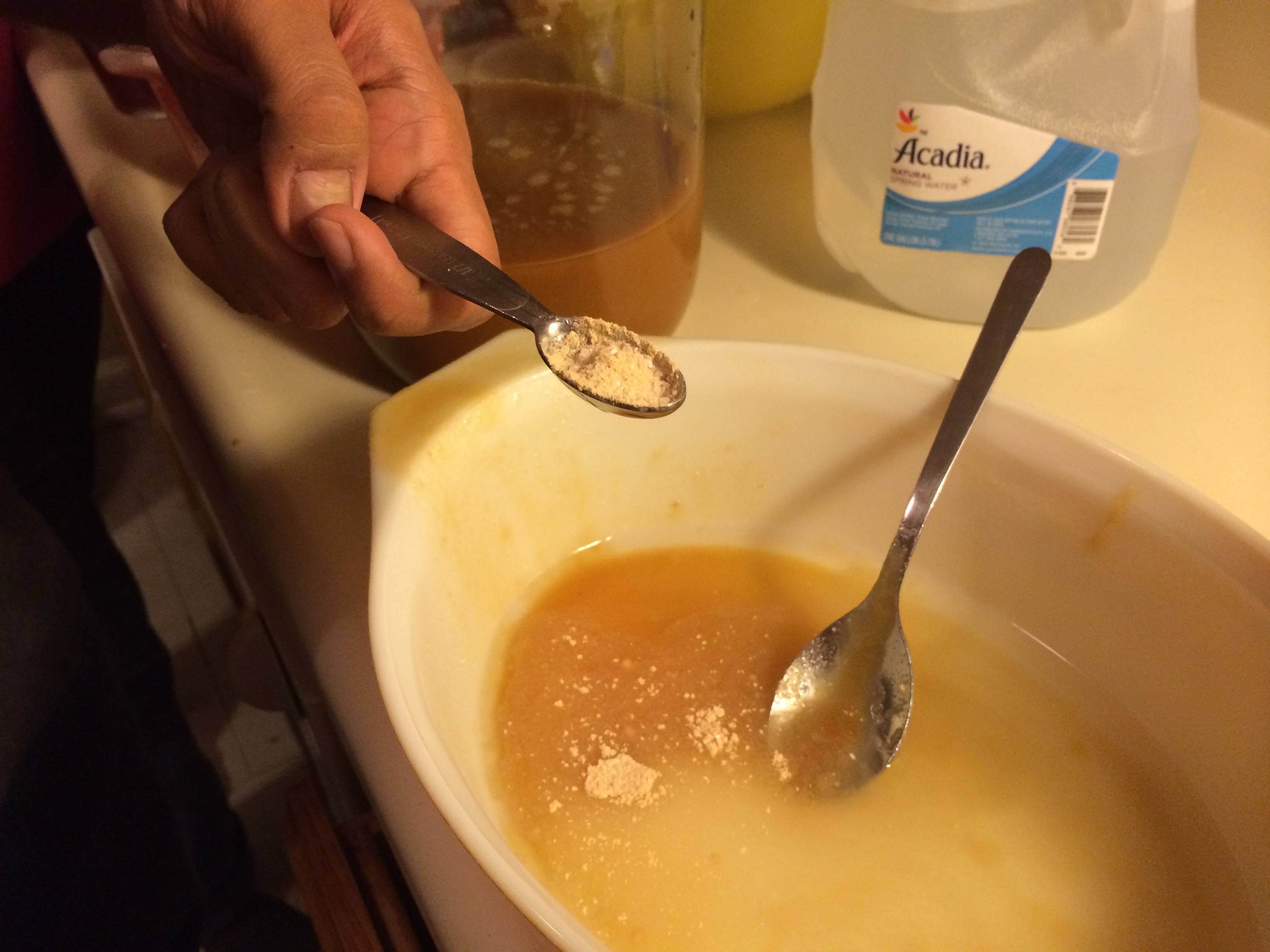
Washington DC trip 243 Washington DC trip 242

By now the yeast has been rehydrated; give it a stir and pour into the jug as well.

Add enough spring water to the honey in the pitcher to bring it up to the 1 gallon mark. Put the rubber stopper on tightly and give the jug a good shaking for five minutes.

The shaking is important for two reasons — it not only homogenizes the mixture, it also aerates it. Which is something the yeasties need. So, while you are shaking, put it down at intervals, take the rubber stopper off a couple times and let the air escape; put the stopper back on and resume shaking.
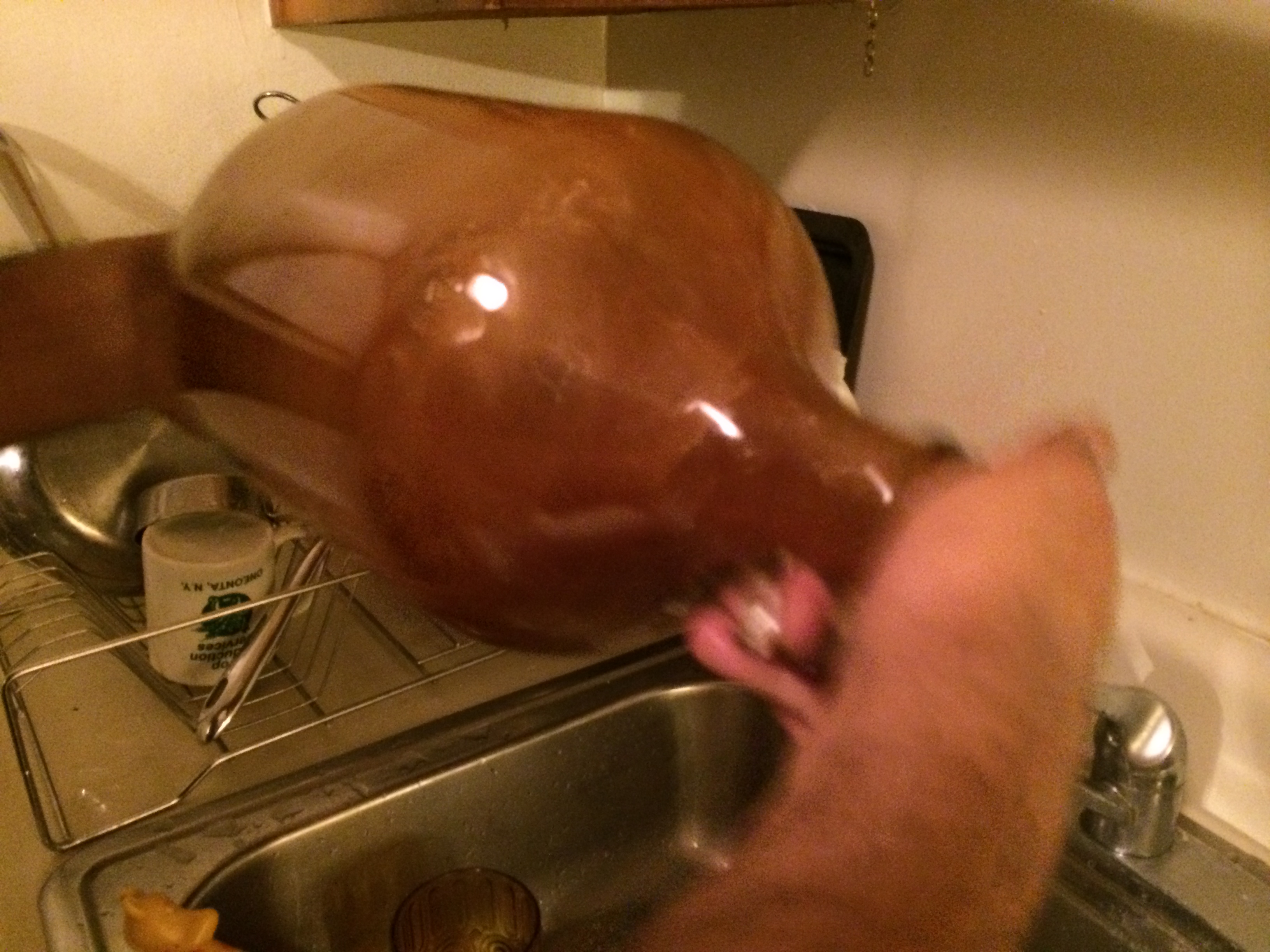
Shaking the jug to aerate

Shaking the jug to aerate

Put your sanitized airlock on the jug and cap it. Place the jug in a cool dark place in the house where it will lie undisturbed. Label and date the jug. As you can see, we neglected to do this.

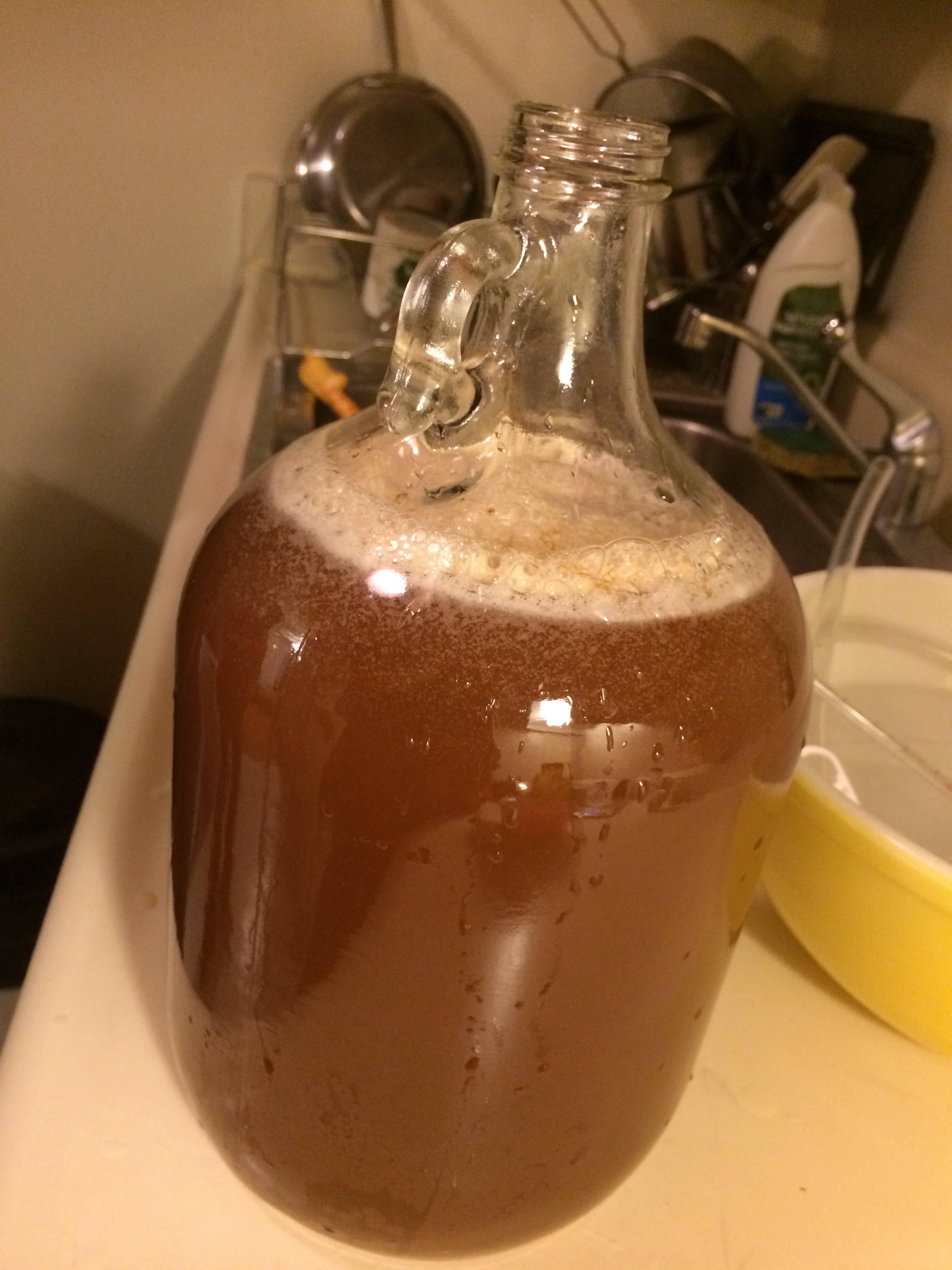
Washington DC trip 250 Washington DC trip 249

In a few days, we should see bubbles of aeration arising in the airlock. Then, the bubbles should die down in a couple to three weeks. Will this happen? To be continued….

Update: 6 days later.


You say potato pancake, I say aalu tikki, she says kartoffelpuffern

Potatoes take supremely well to crisping up in oil. The brown crunchy coating that they develop, given enough oil and heat, is quite beguiling. Then again the insides consisting of the potato itself tends to be quite bland, so needs some help in the taste department. Also, potato does not hold itself together while frying, so it also needs some help in the ‘having integrity’ department. A conscience? No, a binder.

I have basically described an aalu tikki — a cake of mashed, spiced potato that is bound with some bread and fried in oil. This is a common Sindhi dish, eaten as an appetizer, a side, or an evening snack with possibly some sweet and hot chutney on the side.

My first clue that cultures have discovered this basic paradigm over and over came from a Swiss girl who interned at my work place. Invited over to our home for a meal, she spied a plate of aalu tikkis and said — ‘kartoffelpuffern!’ Kartoffel — potato, puffern — cake. Till today, this pair consists of the only German words I know.

Another such concoction is the Eastern European/Jewish latke. Here the potato is grated rather than boiled and mashed, and clearly the Indian version is more spicy, but the end result is similar. Latkes are traditionally eaten at Hannukah; we are a little late for that, but nice and early for the next one.

The recipe below makes about two dozen tikkis.

Aalu Tikki

Ingredients:

  • 3 russet or other starchy large potatoes
  • 1 tablespoon salt for boiling
  • 3 slices bread. It should not be sweet. I used crusty sourdough.
  • 1 tablespoon chaat masala, substitute with dry mango powder, substitute that with lime juice
  • 2 teaspoons coriander powder
  • 1.5 teaspoons salt
  • Quarter to half cup finely chopped onion
  • Quarter to half cup finely chopped cilantro leaves
  • 3 – 4 finely sliced fresh chilies, if you are cooking for kids you can leave them out.
  • Up to half a cup of oil

Method:

Boil the potatoes in about 3 – 4 cups of water. Put them in cold, add about a tablespoon of salt to the water, bring to a boil, and simmer, covered, till the potatoes are soft. I used a pressure cooker and it took about 10 minutes under pressure. Drain the potatoes when done and peel them when cool.

IMG_0270 IMG_0272

Meanwhile have the bread slices soaking in water until the crusts are softened. This will take at least 15 minutes. Now, squeeze out the water from the slices and save the bread. This will be used as the binder.

IMG_0274

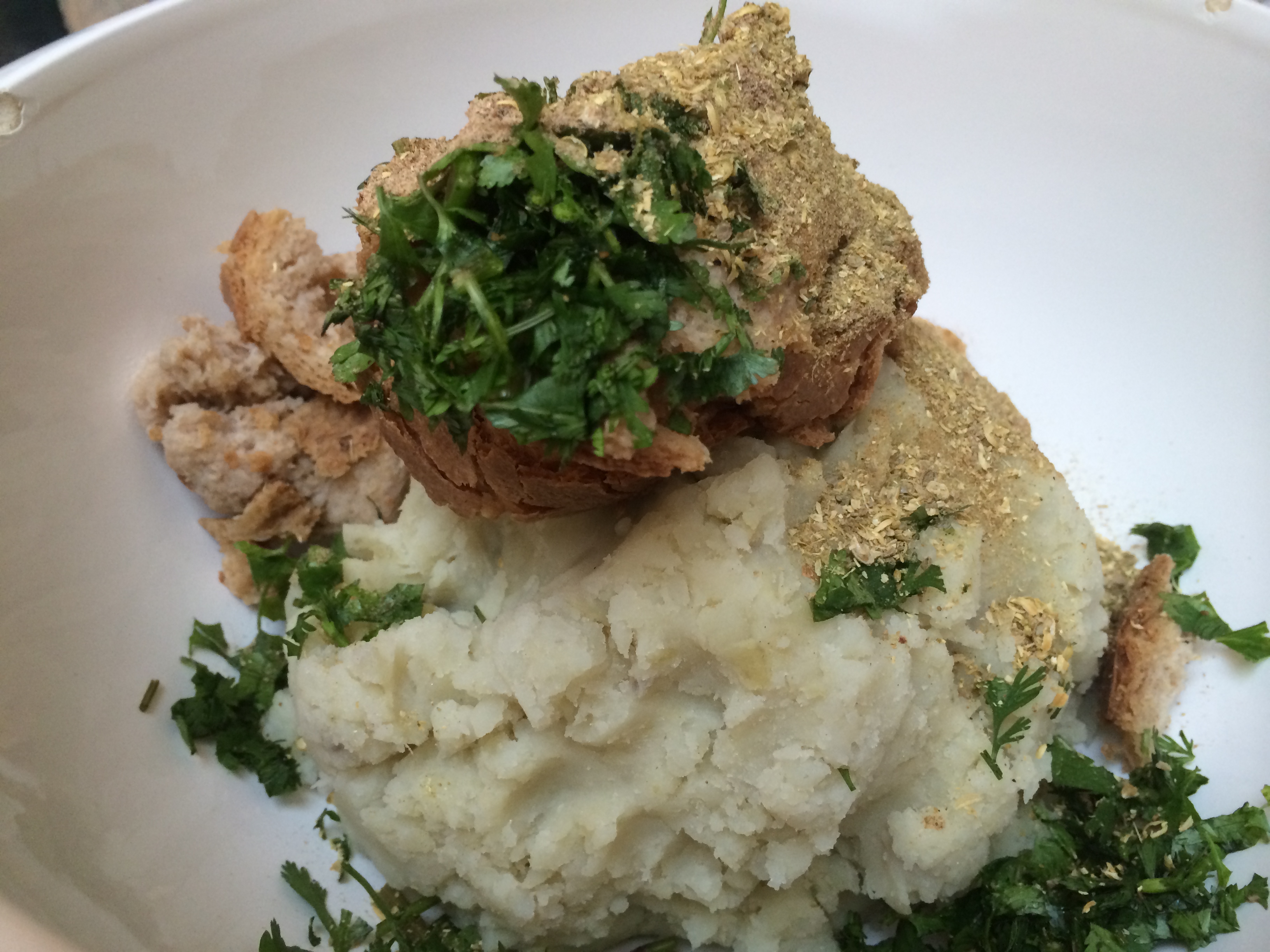
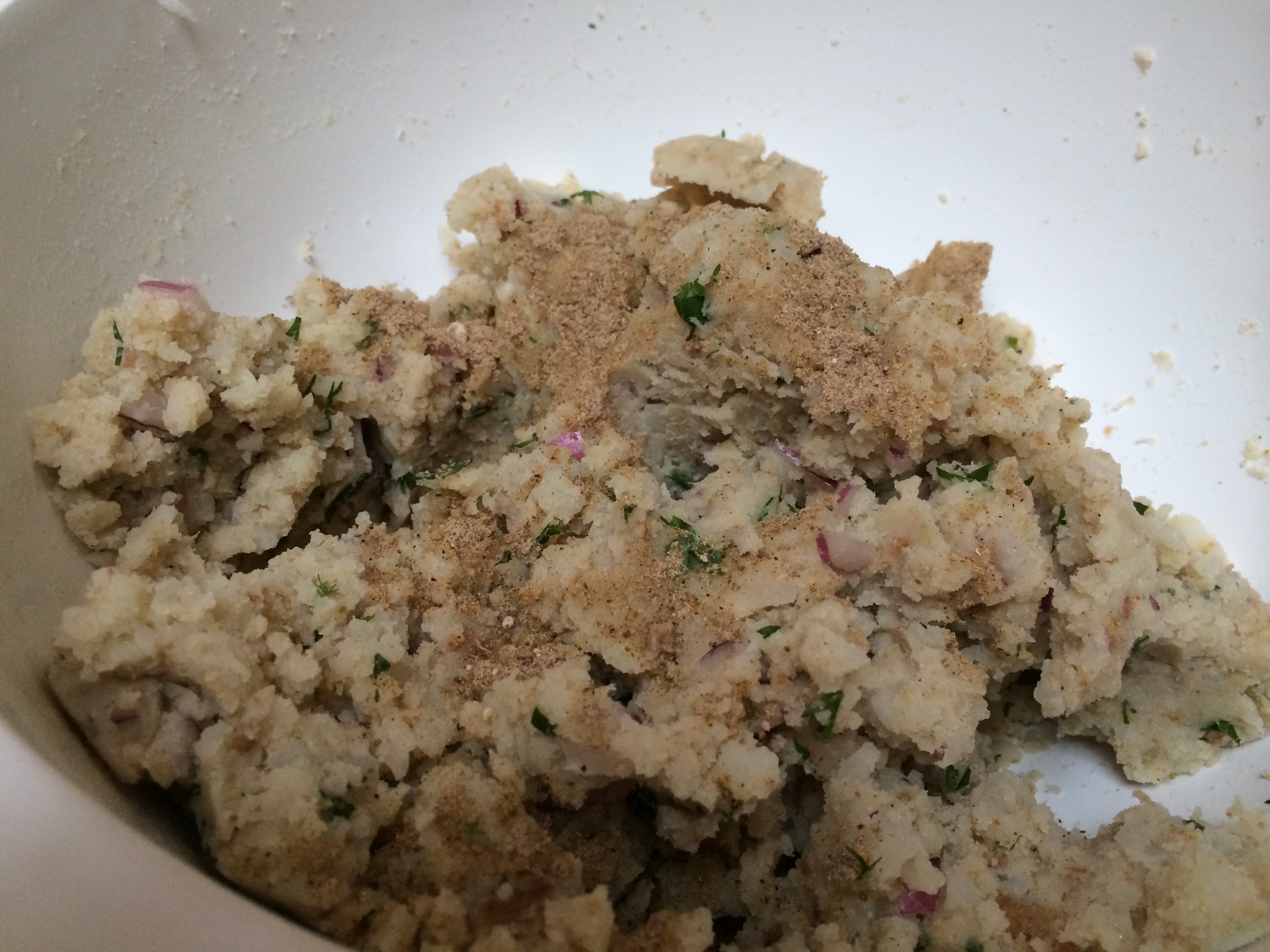
Mash the potatoes. Once the lumps are more-or-less gone, add in the squeezed bread, the spices, salt, and the minced vegetables. The point is to mix this stuff nicely into a mostly homogeneous dough. I have found that this works best with your hands. There is no other kitchen implement that has five rubbery prongs with such fine control, plus the strength of the heel of your hand.

IMG_0276 IMG_0277

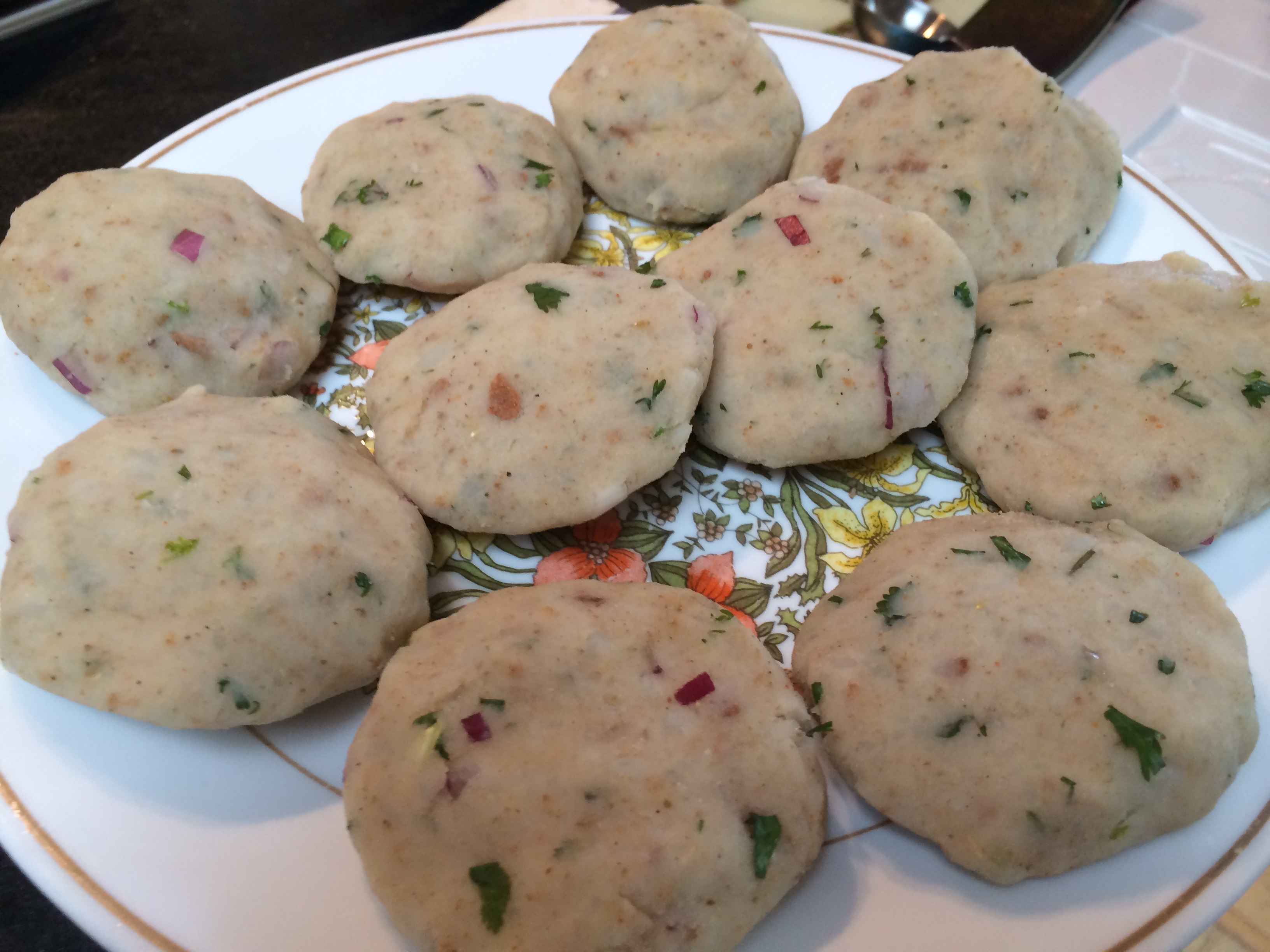
Anyway. Once the dough is ready, one is ready to fry them. Form small fistfuls of the dough into flying saucer shaped disks and save them on a plate. Clearly this must be done by hand, but oil your hands first to get it to not stick.

IMG_0278

Heat two tablespoons of oil at a time in a large, flat, thick-bottomed, non-stick pan. Once it is shimmering, put in as many disks as will fit in a single layer with gaps around. Flatten and spread them with a spatula somewhat. This is best done on high-ish heat with enough oil bubbling away beneath; in this configuration each side should take about five minutes.

Flip each tikki when it is browned underneath. Add more oil for this side. Five minutes on this side should suffice as well.

IMG_0280

Remove them and place on a paper towel to soak up the extra oil.

These are best eaten fresh, with a bit of chutney or ketchup on the side; if you like sandwich a tikki between bread slices and have it that way.

Daughter’s chocolate

Today is a special treat — a guest post from my eight-year-old daughter. She made this chocolate a week ago for us. Here is her writing, unadorned.
Suraiya’s Chocolate

First put cocoa butter in a pot and melt it.

pedicure and other things 011 pedicure and other things 014

After that is done, mix powdered milk, icing sugar and cocoa powder in a different bowl.

pedicure and other things 005 pedicure and other things 007

Add the cocoa butter you melted to your mixture. Then add a little bit of vanilla. After you’re done with that mix it well.

pedicure and other things 017

Then pour it into moulds and put it in the fridge. Wait for 2 hours before you take it out.

pedicure and other things 019

She learned this recipe from watching this lady called Karma on YouTube.

Feeding the husband’s habit

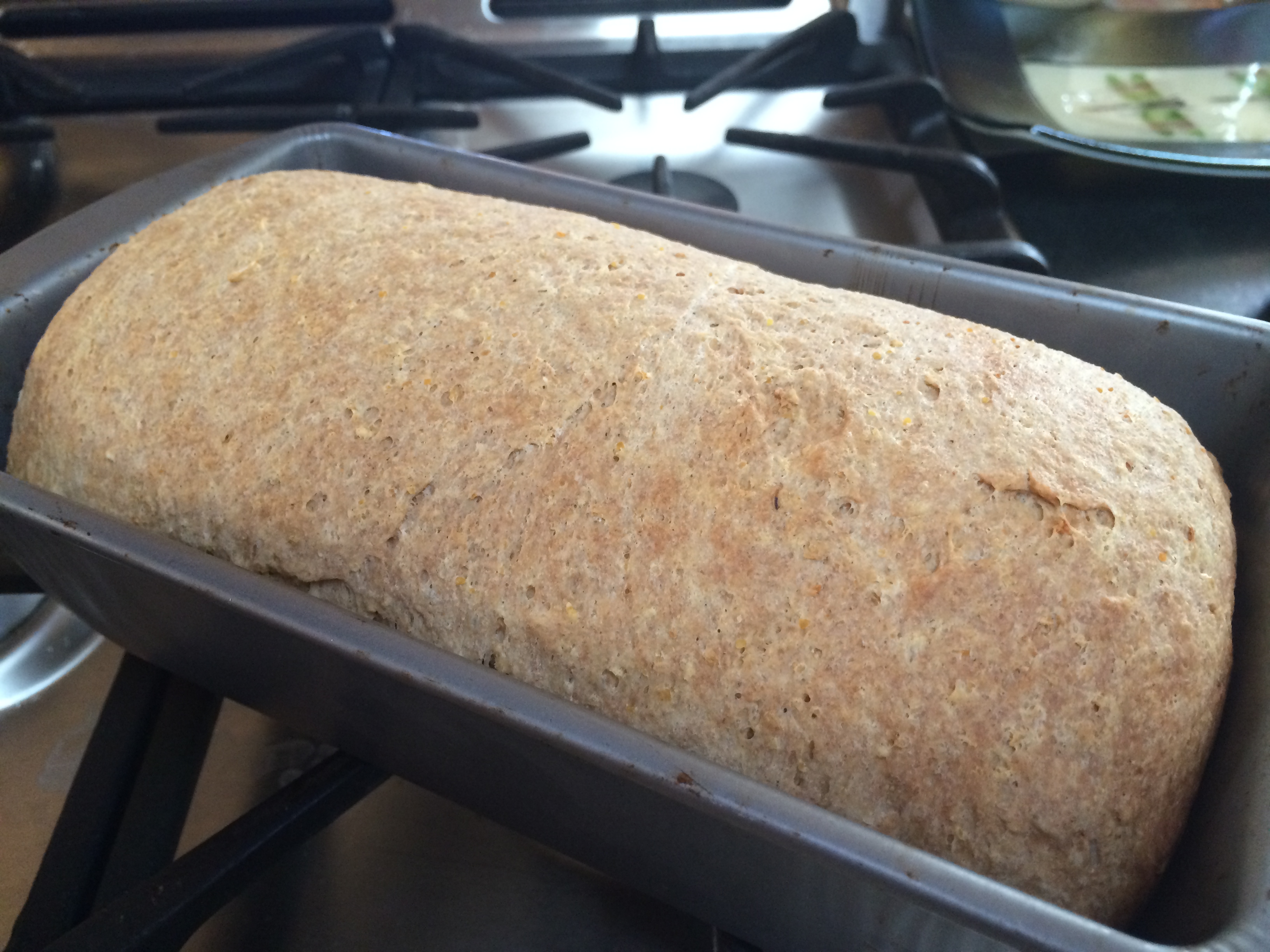
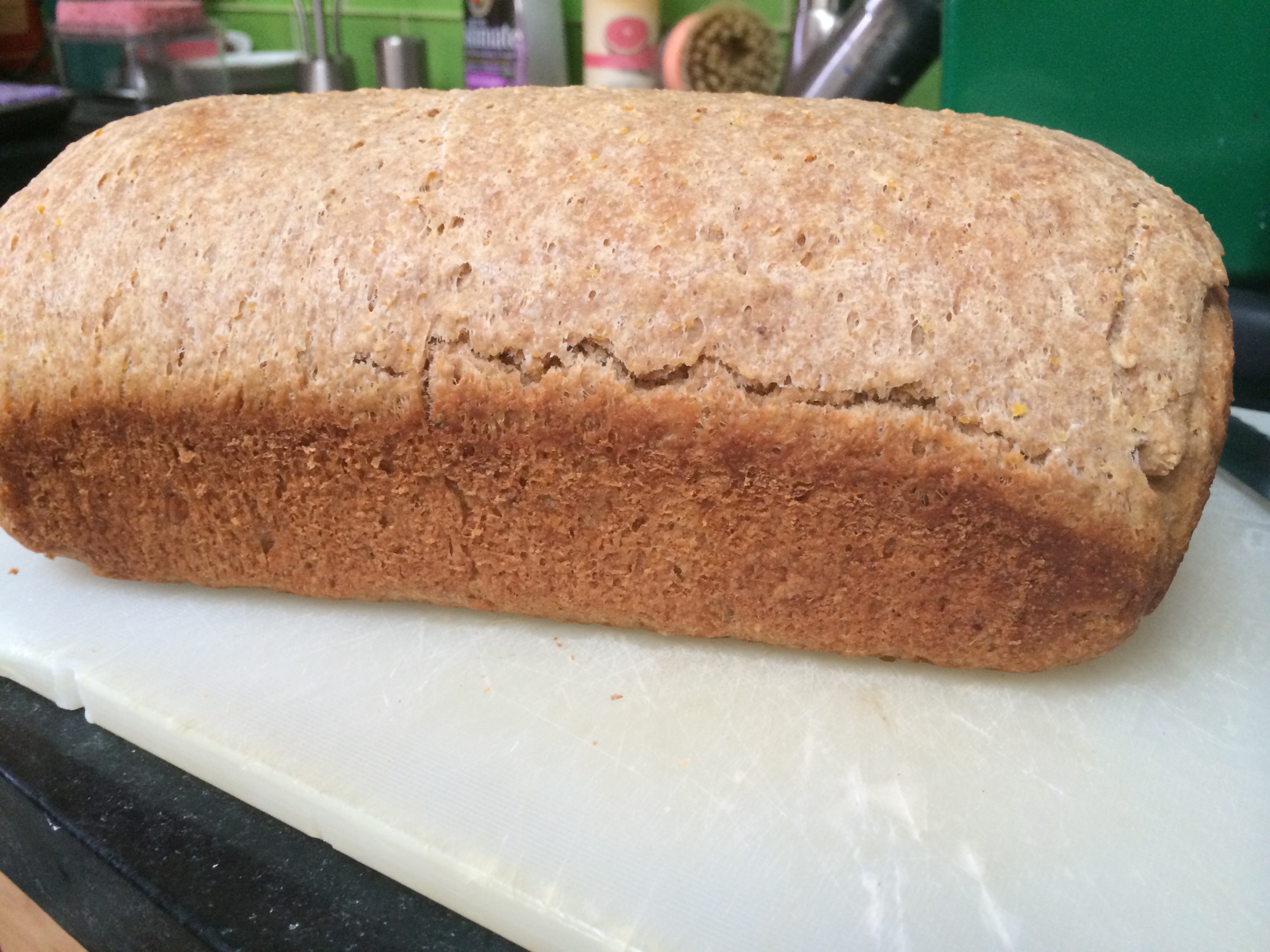
Husband's habit bread

Husband’s habit bread

Several years ago, poking around google looking for an oat bread recipe, I found that an unknown denizen of the Internet had put up a good-sounding recipe under the name of ‘Habit Bread‘. I made it that very day. My husband, who is a big fan of oat breads (he has his toasted with almond butter), said that I had aced it on the first try.

Since then, this loaf has become a standard in our family. Like with every other recipe I have made modifications — I call my version the Husband’s Habit Bread. It is so much part of my husband’s weekly routine that I try to have a loaf sliced and frozen at all times.

Here is a trick to storing loafs of bread, specially of this dense variety. One thing I have found is that the freezer works great, but unless one wants to thaw the entire loaf at once, it is better to pre-slice it. Then you can pull out one slice at a time.

Go ahead, pull one out. What? You can’t?! You can’t because all the slices stuck together when they froze?

Exactly. That’s why I put sheets of parchment or waxed paper in between each pair of slices before I freeze them. Put all the slices thus separated in a freezer bag, squeeze out as much air as you can from it, bind it tightly and put it in the freezer.
Husband’s Habit Bread

This recipe makes one 9″x5″ loaf.

Wet Ingredients:

  • 1 cup dry rolled oats
  • 1/4 cup unsalted butter
  • 2 tablespoons honey
  • 1/2 cup corn polenta
  • 1/2 cup dry milk
  • 1 teaspoon salt
  • 2 cups water

Dry Ingredients:

2 cups whole wheat flour (I use King Arthur’s premium whole wheat)

1 cup bread flour

2 teaspoons instant yeast

Method:

Combine all the wet ingredients together into a pot and bring to a gently boil. Stir nicely to get it all to combine, paying special attention to breaking up the dry milk lumps. Once it comes to a boil, turn off the heat and wait for it to cool.

IMG_0186 IMG_0188 IMG_0189

The unknown denizen of the Internet who is the originator of the Habit Bread recipe mentions that a bowl of cooked oatmeal is notorious for holding onto heat and that is true. It takes a while for this mixture to cool to lukewarm. At the same time, you don’t want to wait too long, because then the mixture will turn into a giant lump and the bread will not mix very well. I have found through trial and error that this time period is about half an hour; but test before using.

Meanwhile combine the dry ingredients in the bowl of a mixer; if you choose to knead by hand, just combine in a large bowl. Stir the flours with a fork. Put the (lukewarm) wet ingredients in and stir with the dough hook for about 3 – 4 minutes until the dry ingredients are moistened. You may find you need to add up to 1/4 cup extra water while kneading. Leave it covered with a plastic wrap for about 10 to 20 minutes.

Come back to it; by this point due to the autolyse process the dough will be much easier to knead into a smooth ball.

Turn on the mixer with the dough hook for another few minutes or so; first the dough will come together into a shaggy mass. I like to finish kneading by hand until maximal smoothness.

Cover with oil and let it rise at room temperature in an oiled bowl for about 2 hours. It should double in volume.

IMG_0190 IMG_0192 IMG_0193

Take it out of the bowl, flatten it gently into a rectangle and roll into a loaf, while taking care to tuck the ends in. Squeeze the seam shut all the way across to seal it. Oil the shaped dough and put into a 9 inch by 5 inch loaf pan, also oiled. Cover with a plastic wrap and let it rise at room temperature for an hour to an hour and a half more.

This is a pretty dense bread, and it is quite a job for the wheat flour gluten to lift up the great heft of the oats and the corn polenta. Plus we are using a large percentage of whole wheat flour, the bran in which tends to counteract the lift of gluten. So this bread is not going to win any light-and-airy contests. By the time it has peeked over the rim of the loaf pan, it is probably done rising.

IMG_0194 IMG_0195

Bake in a 350 F oven for 55 minutes. An instant-read thermometer inserted into the meat of the loaf should read 200 F. Take it out of the oven and let it cool on a rack for an hour before slicing into it. Thank you, unknown denizen of the Internet.

IMG_0196

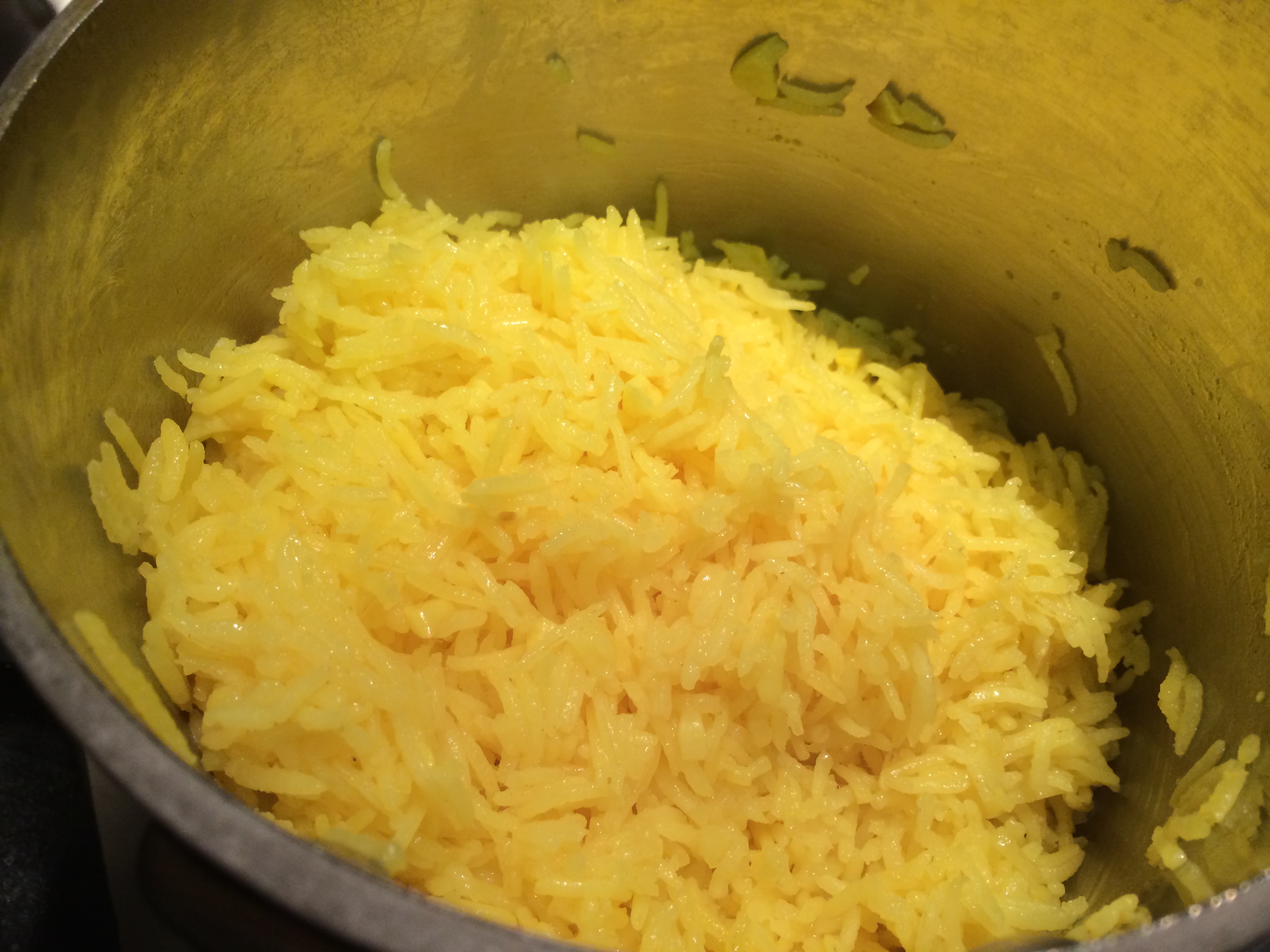
Yellow garlick rice

IMG_0170

Yes I know there is a misspelling in the title, I just like the way that looks. Please direct all complaints to: The Editor, The Odd Pantry, Internet.

This is a simple rice preparation that looks quite grand (some people will mistake the yellow as coming from saffron which is the world’s most expensive spice). But it is simple enough to do for an everyday meal. Basically, use this recipe when you want to do a minor feast; not, for instance, when you have the Prime Minister of Senegal over.
Yellow garlick rice

Ingredients:

  • 1 cup long-grained rice
  • 3 – 4 cloves of garlic, minced
  • Half a teaspoon turmeric
  • Quarter teaspoon salt
  • One tablespoon oil

Method:

Rinse the rice once and soak it for about 10 minutes to half hour. Drain the soaking water.

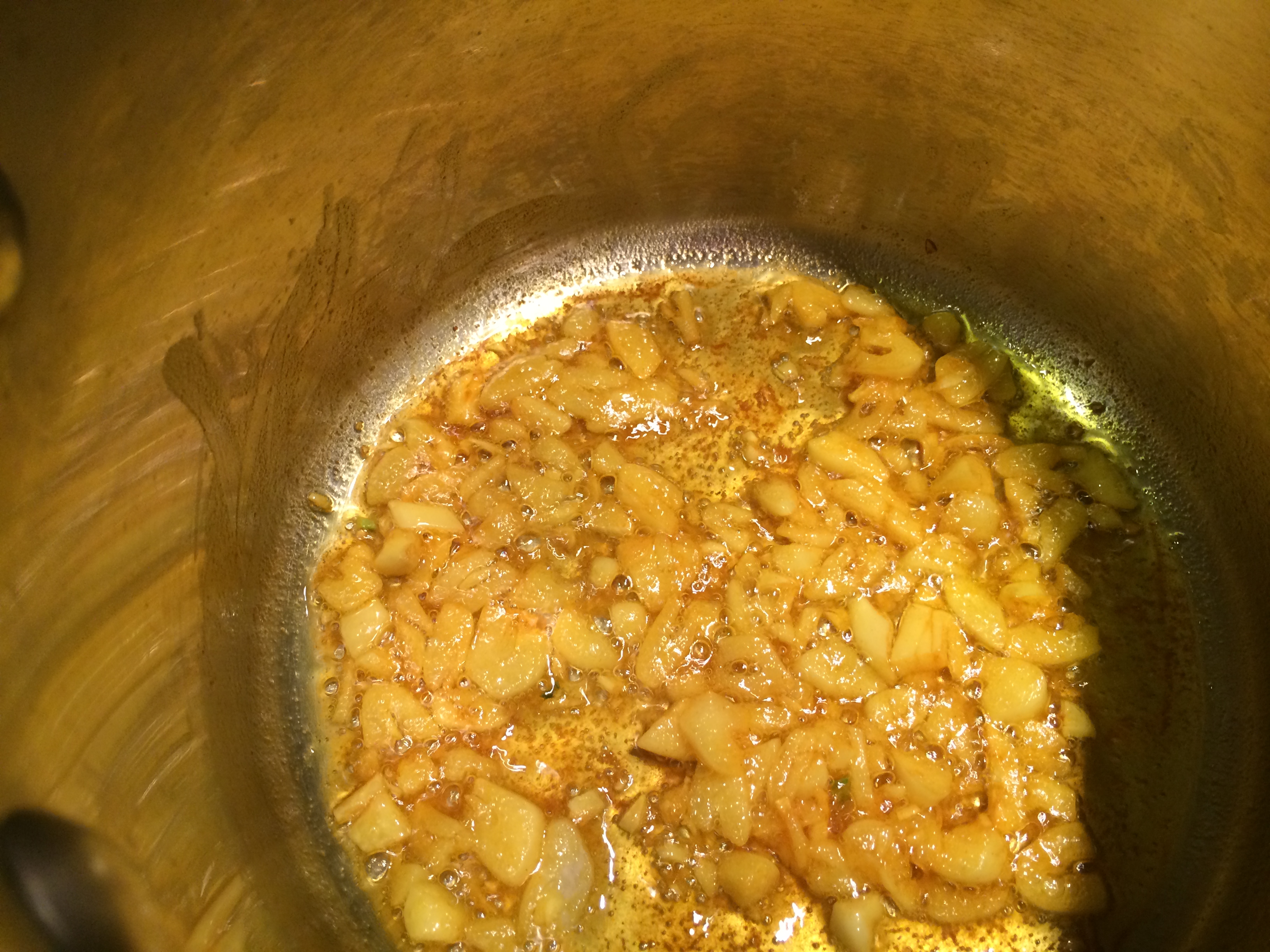
Heat the oil in thick-bottomed pot. Put in the garlic and the turmeric when the oil shimmers and stir it around for a couple minutes until the garlic looks shriveled. Now put in the drained rice and the salt, and stir to coat the grains with oil. Most of the grains will start to look opaque once they toast in the oil.

IMG_0167 IMG_0169

Put in one and a quarter cup of water and bring to a boil, covered. Turn it down to a simmer, tightly covered, and let it simmer for about seven minutes. Turn the heat off and leave it covered, in place, for about ten more minutes. This last step of waiting ensures that the collected steam is absorbed by the rice.

If you like, fluff with a fork before serving.

Variation: If you like, throw in a quarter cup of frozen peas before bringing to a boil. It will look a little fancier and be tasty too.


Licky spice mix

Sometimes exact translations don’t quite work, do they? Subtle thing, this language business.

Anyway, ‘chaat masala’ — so named because it is supposedly so delicious that one wants to lick — it? your fingers? — at any rate, one wants to lick some indeterminate thing — is today’s topic. ‘Chaat’ means ‘lick’ and ‘masala’ means spice mix in Hindi. Chaat masala is sprinkled on all manner of delicious snacky, faintly junky food, that are often eaten at street vendor stalls in the warm evenings while out on a stroll with your pals. In fact, many would claim, chaat masala is often responsible for the deliciousness. Making one want to lick stuff, is the key.

Here is the mix I use in my kitchen. I always have a jar on hand and hate myself when I don’t. So don’t be that person, and do make this mix.

Modified from 1000 Indian Recipes by Neelam Batra.

Chaat masala

Ingredients for chaat masala

Ingredients for chaat masala

Ingredients:

Method:

I realize that some of you will have to make a trip to an Indian grocery (if you live outside India) to collect these ingredients. Just be sure you don’t come back with a ready-made mix of chaat masala, though that will probably be available too, because that will wreck the whole point of this post.

Heat a small thick-bottomed pan on a medium-high flame. When it is hot put in the whole spices (cumin, black pepper, carom) — individually, because each of them will take a different amount of time to roast. Stir gently, and roast each spice for a couple minutes until they turn a shade darker. Empty into a bowl.

Stuff 021

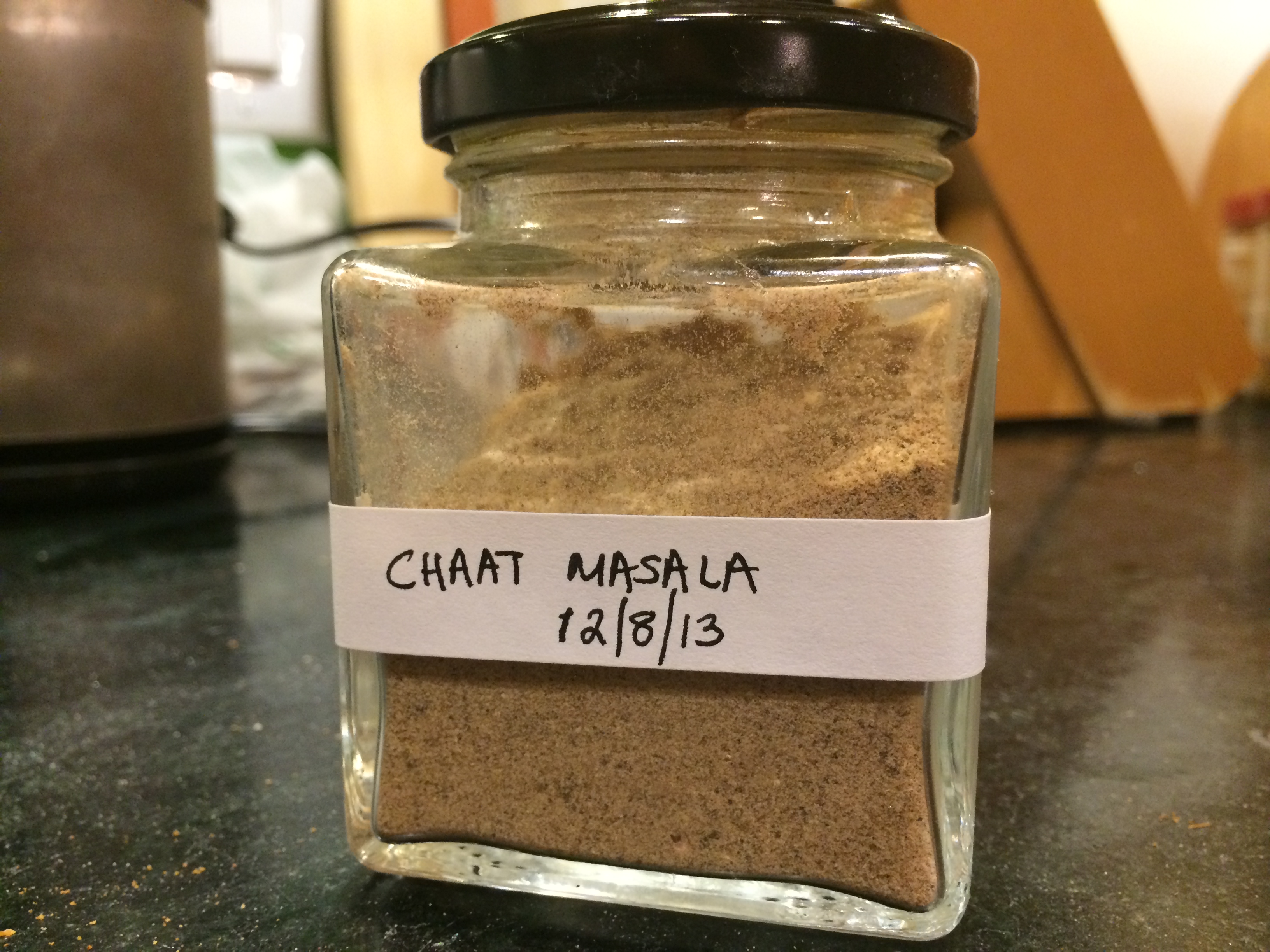
Using a clean coffee grinder, powder the three whole spices. Then pour into a clean jar with a funnel along with the other three already powdered spices — asafetida, black salt and dry mango powder. Close the jar tightly and shake to combine. Label it and date it.

Stuff 024

Chicken soup for the pungent soul

In my adopted country (the United States), chicken soup is a magical elixir that soothes every flu-ridden child. It is also a very successful franchise.

Well I have such a magical elixir too, and while it has no chicken in it nor is it a soup, The Odd Pantry is nothing if not opportunistic, so I will ride on the popularity of that successful franchise and call my elixir the chicken soup for the pungent soul.

It is pungent, I can guarantee you that. But not from chilies — from ginger.

In my family when we feel that familiar scratchy throat feeling coming on, we make this strong concentrate of ginger, lemon and honey. I have it straight, my husband dilutes it with water. I have often found that it has curative properties. Much as I am tempted to start dispensing this as medical advice, please be warned that I know nothing of medicine nor has the FDA gotten involved (yet!).

A word on the super-trio that goes into this elixir.

Ginger

Ginger

Ginger is an underground stem that is thick with stored water. Although it is extremely fibrous, one can squeeze out an exquisite, pungent, healthful juice out of it using a grater. I have a ceramic ginger grater from Japan that works wonderfully for this. It may be a single-use device, and everyone who knows me knows my intense scorn for single-use kitchen devices, but in this case, I make an exception.

There are compounds in ginger that help with inflammations generally. It also has antimicrobial and fever-reducing properties.

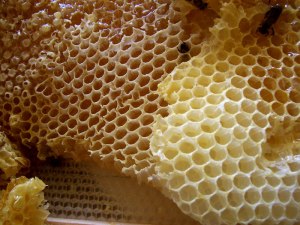
Honey comb

Honey comb

As for honey, those bees have quite a technology going there. Honey has plenty of health benefits, some proven, some not; but the one that concerns us is its antibacterial properties.

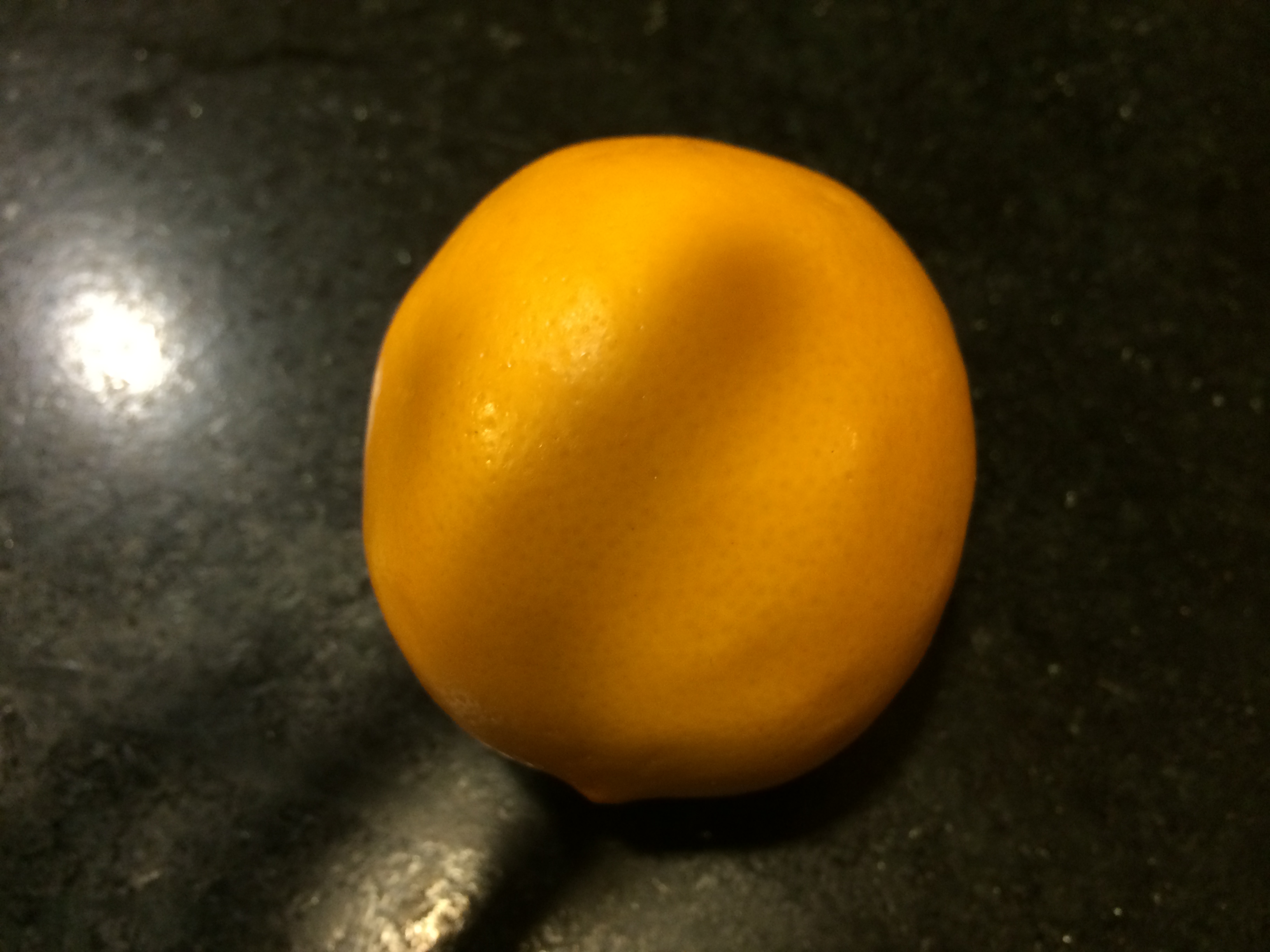
Meyer lemon

Meyer lemon

Lemon juice is a famous purveyor of Vitamin C, which is famous for…you know, colds, sore throats and stuff. Like I said, I am not a doctor. No link needed for this one.

The Odd Pantry’s magical elixir for colds, sore throats and flu

Ingredients:

  • One inch long piece of ginger
  • Juice of one lemon
  • One to one-and-half tablespoons of honey

Method:

Squeeze out the lemon juice, put in the honey and microwave for 20 seconds or so to get them to combine. Grate the ginger; this will produce some juice. Then you can gather up the fibers and squeeze them to collect more juice. Combine the ginger juice with the honey-lemon.

IMG_0157 IMG_0156 IMG_0161 IMG_0160

Drink a shot of this, straight if you can, diluted with water if you can’t. Have it warm. Feel better.

Even more magical elixir:

Mix in a tablespoon of brandy.

The bane of every Sindhi child

IMG_0176

This is a meal that every Sindhi child has made faces over at the dinner table while dawdling over their food. But by the time that Sindhi child has grown up into a Sindhi adult, they begin to crave it with an intensity that is only matched by their craving for home.

When I was the Sindhi child making faces at Sai Bhaji — which translates simply to ‘greens’ — no amount of talking up by my mother about how this meal is a nutritional powerhouse mattered to me at all. Now as an adult (and a mother myself) I’m thinking — a delicious, simple-to-make, nutritional-powerhouse meal-in-a-pot! What’s not to like?

Sai Bhaji is a stewed concoction of spinach and other greens, some lentils, with other veggies thrown in. It is eaten with rice and plain yogurt and possibly something fried on the side.

One of the selling points of this dish is that you can throw in basically any vegetable you have lying around in portions that are too small to make a meal themselves. The taste of spinach and dill is strong enough that all these mini-portions will be swallowed, subsumed, absorbed and spat out as part of the Sai Bhaji empire. Thus adding even more nutrition.

Sai Bhaji (spinach-lentils stew)

Ingredients:

  • One bunch spinach
  • Half a bunch fresh dill
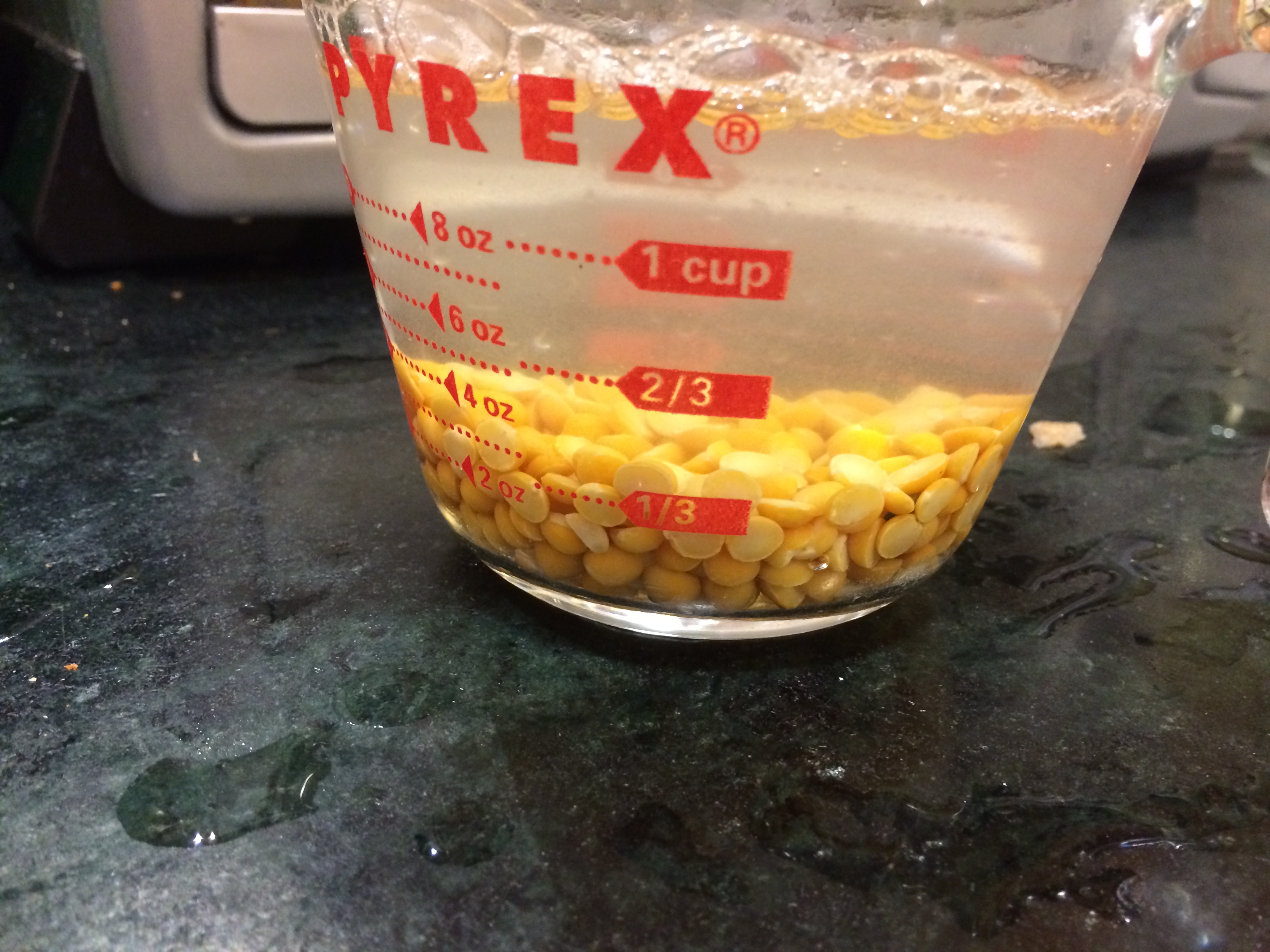
  • Two tablespoons channa dal, soaked for half an hour at least. This post talks more about channa dal.
  • 1 – 2 tablespoons oil
  • One small potato chopped
  • Half an onion, chopped
  • 1 – 4 fresh chilies, jalapeno/serrano/bird’s eye/cayenne
  • Half inch slice of ginger root, minced
  • One teaspoon coriander powder
  • Half a teaspoon turmeric powder
  • One teaspoon dry mango powder (aamchur) or substitute with lime/lemon
  • One teaspoon salt
  • Optional: 1 cup of other chopped vegetables, such as eggplant, zucchini, tomato, carrots, bell peppers, etc.

Method:

Have the channa dal soaking in plenty of water for about half an hour. Wash the green thoroughly in a sink full of water a few times. Chop them up roughly including the stems that are not too woody.

IMG_0163 IMG_0162

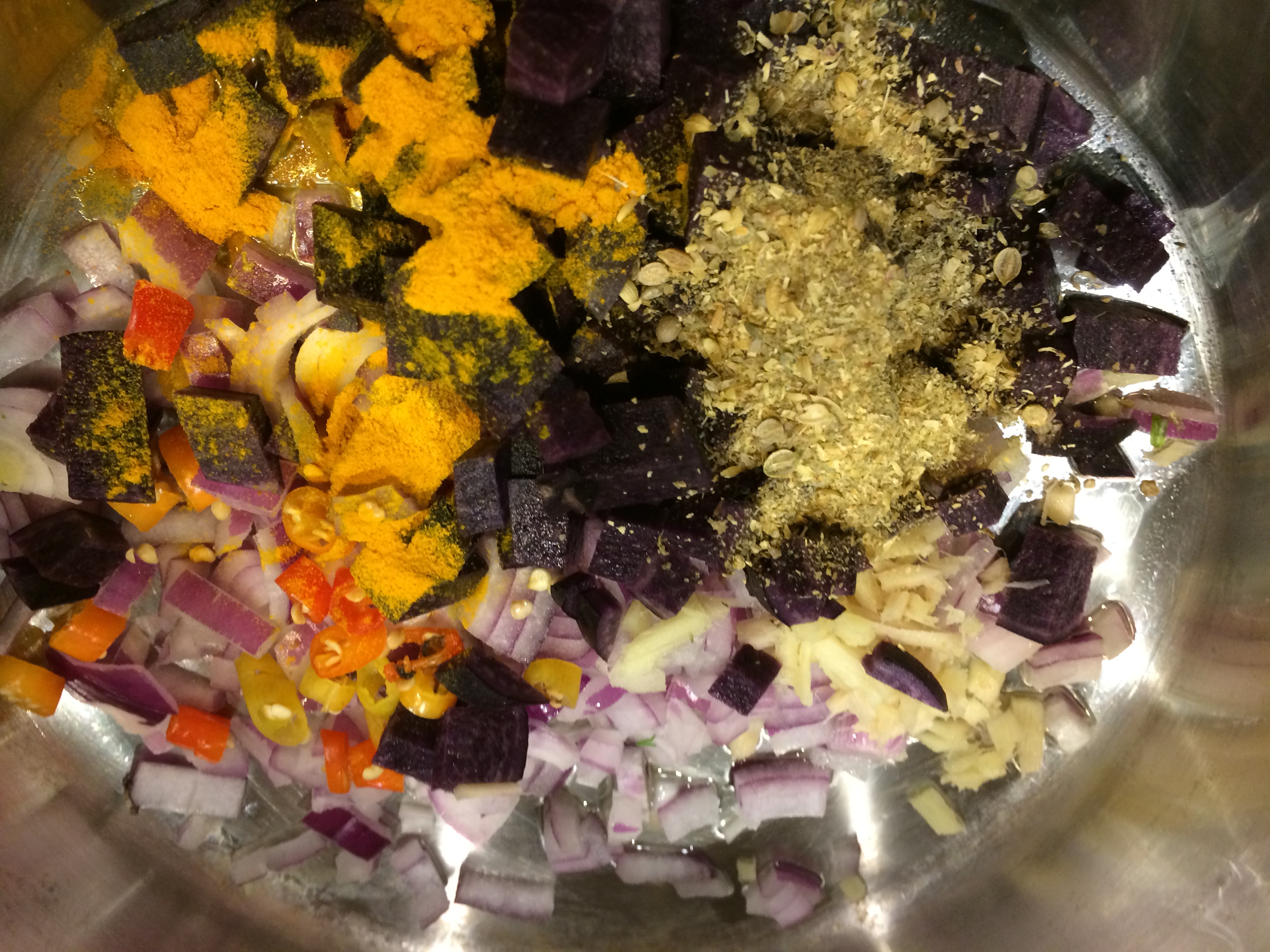
Now start layering the dish in a thick-bottomed pot with a well-fitting lid. First, the oil. Then, the onions, chili and ginger. Then, the potatoes, and the coriander and turmeric powders. Then about half the greens. Sandwiched between this and the other half of the greens throw in the drained channa dal. After the last of the greens, sprinkle the salt over, cover, and bring to a boil. The water from rinsing the greens should be enough to cook, or add about a quarter cup if it seems dry.

IMG_0164 IMG_0165 IMG_0166

Once it comes to a boil lower to a simmer and let it be, covered, simmering for about 45 to 50 minutes.

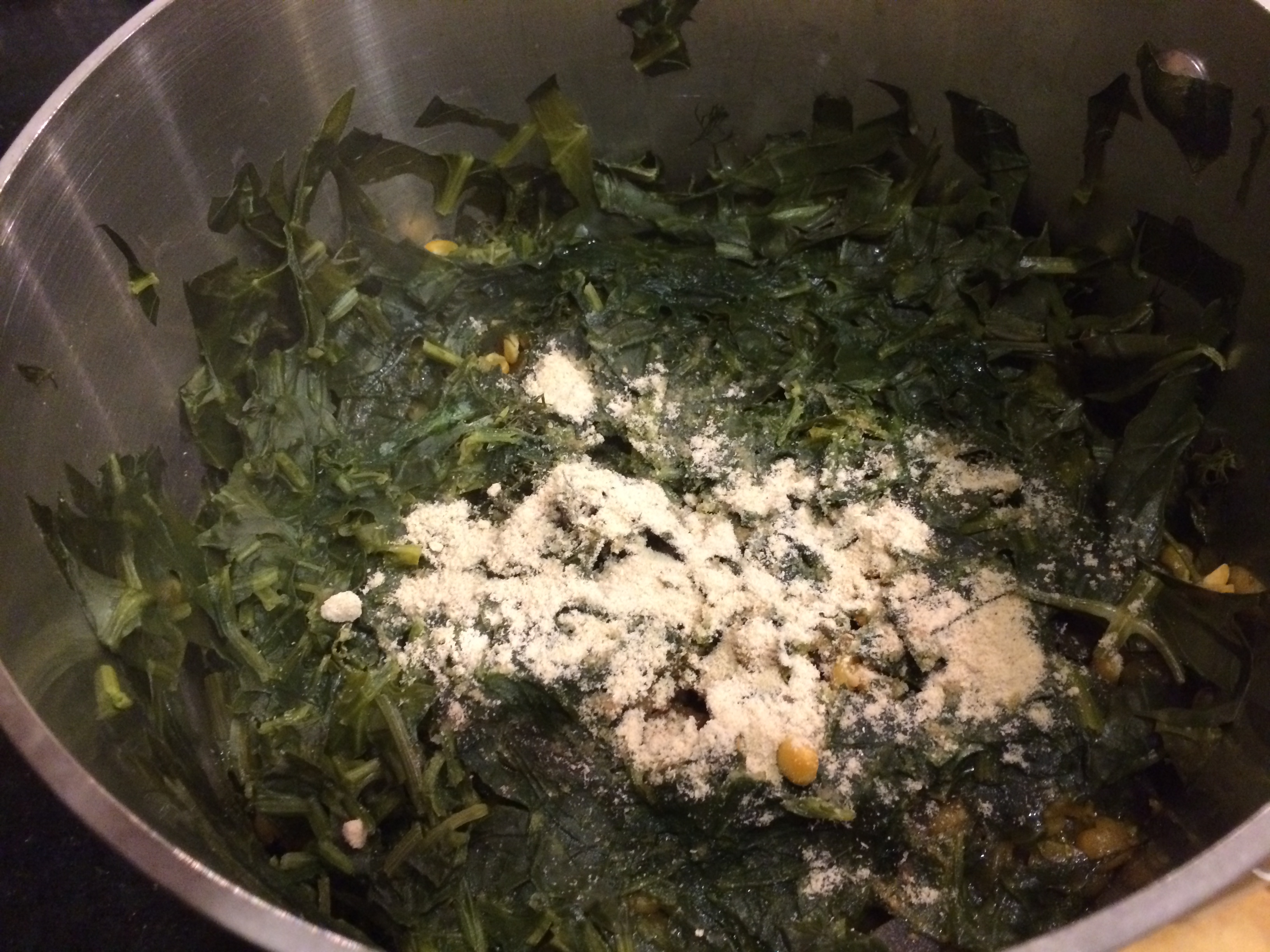
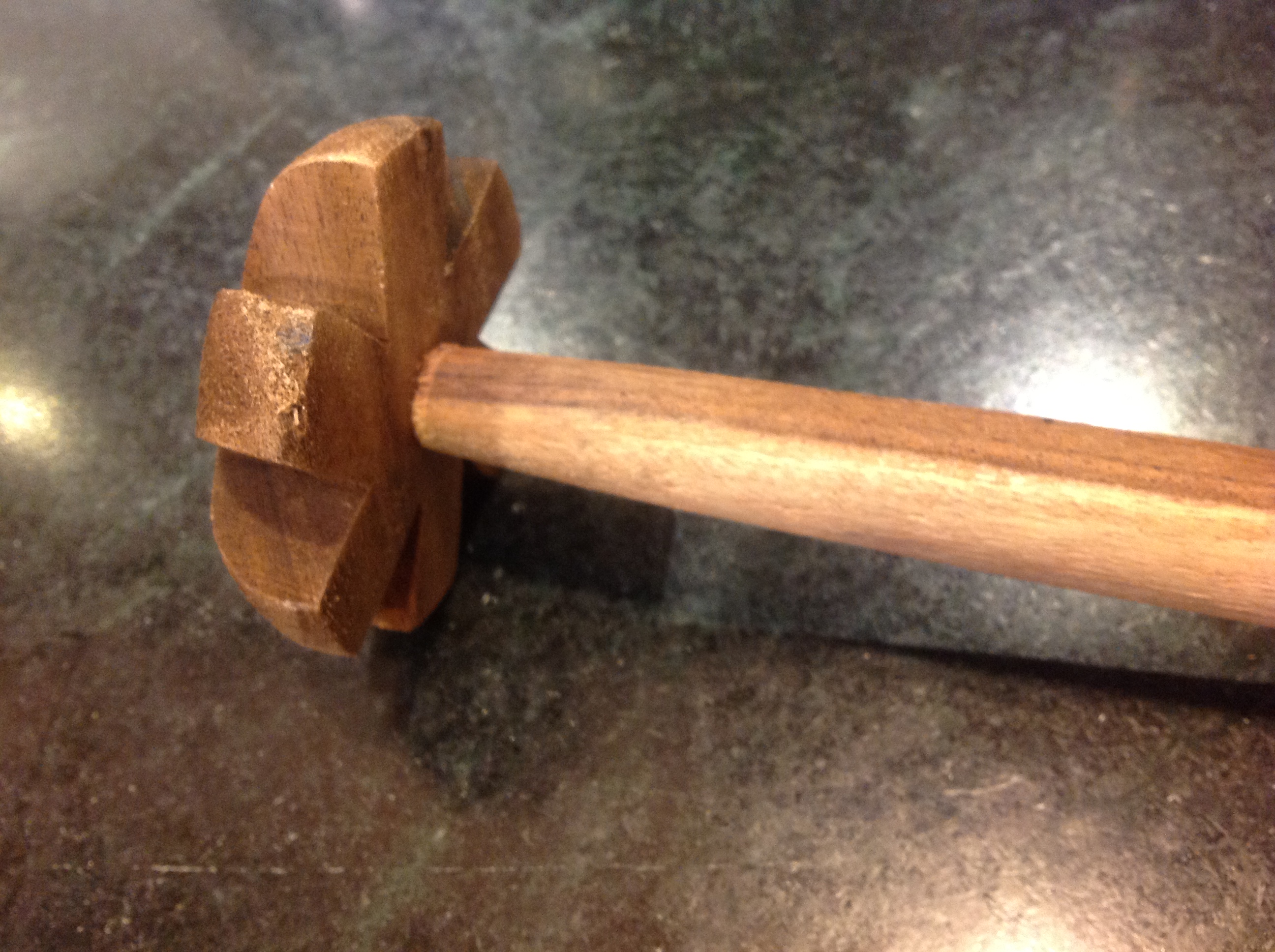
When you open the lid, the lentils should be softened and the greens cooked down a lot. Add the dry mango powder or lime/lemon juice, and mash it with a potato masher or the handy-dandy mandheera.

IMG_0172

mandheera

mandheera

IMG_0175

Warm it through before serving. This is generally eaten mixed with rice and plain yogurt. Three types of rice dishes work well: rice browned with onions, khichdi rice, or yellow garlic rice (recipe forthcoming).

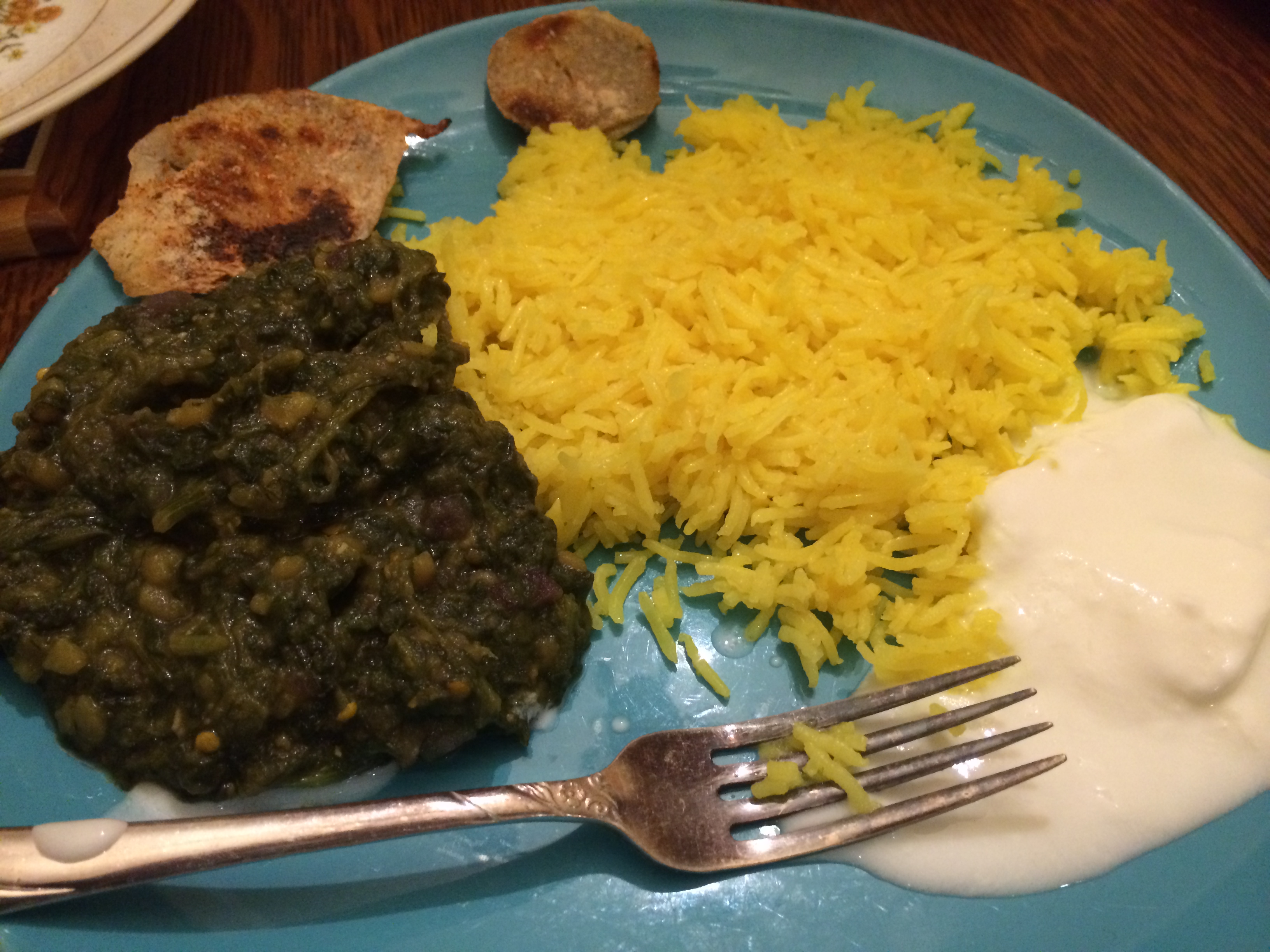
On my plate, I served sai bhaji, rice and yogurt in three neat sides, with some fried taro on the side. My husband however likes it all piled up, like this:

IMG_0176 IMG_0178

Far be it from me to dictate which way you choose to eat it, but you won’t be sorry you did.

What is this ‘sinfully delicious’ you speak of?

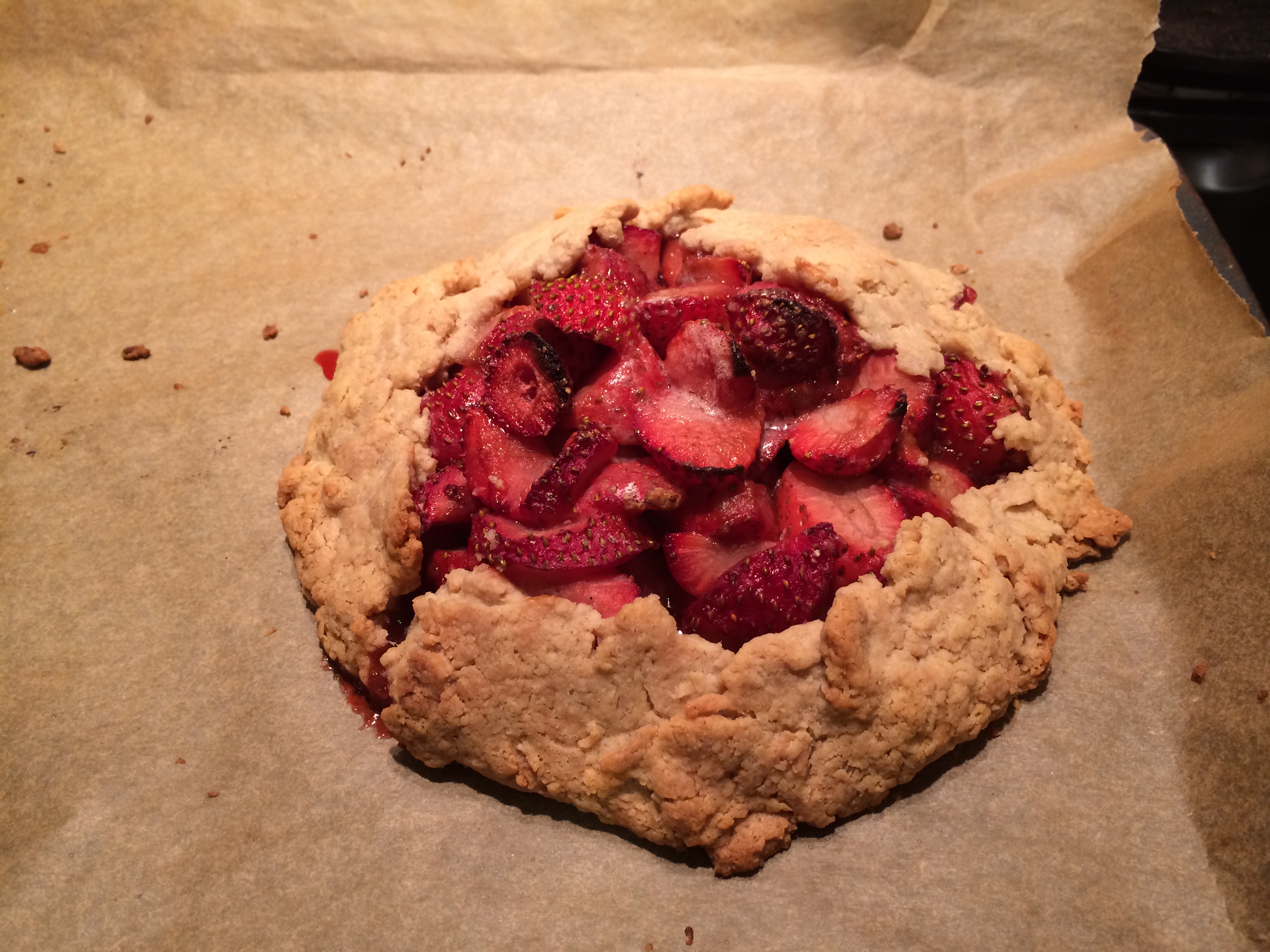
IMG_0138

Bear with me please, I certainly understand ‘delicious’ but am struggling to understand why something delicious should be sinful. Yes, even dessert! This rustic pie makes a few healthy choices along the way and ends up with as close to a tonic as you would find in the dessert kingdom. At the risk of chasing away my readers with shear tedium, I will give little sidebars on the healthy choices I made and why.

This recipe makes two tarts.

Rustic Strawberry Tart

Ingredients for pie crust:

  • 2.5 cups stone-ground white whole wheat
    Whole wheat flour includes the germ and the bran and that’s where the nutrients generally hide. “White” whole wheat is made from a softer, albino wheat, that lacks the tannins of the red bran of the regular wheat. That is why it has a milder flavor and is more appropriate for the non-bread uses of flour: what I call the flakey-cakey family. Stone-grinding ensures that the flour does not heat up excessively while grinding and lose nutrients.
  • One and quarter teaspoon salt
  • One cup (2 sticks) unsalted butter
    I recently read that — yes, I did a double-take too — there is no evidence that fat is fattening. Also that all those decades of advice telling us to avoid saturated fat were based on very flimsy evidence. So let us rejoice in butter and lard, people. And please do not scorn the wondrous coconut. As a matter of fact the supposedly heart-healthy butter substitutes are way worse for you than butter itself, while also (coincidentally?) needing more processing than good old fashioned butter, and so just happen to line various pockets more.
  • I did not sweeten the crust at all.
    Most pie crust recipes ask for a tablespoon or more of sugar. I desist. I don’t see the point: the filling is sweet, and I like the contrast with the crust. Sugar is metabolized by the liver and this makes it especially bad — worse than an equal amount of any other type of calories — for reasons I only dimly understand. Yes, worse than fat, the bogeyman from the last generation (Us Gen-X’ers would like our own bogeymen, please). But watch this or read this if you want to delve into it more.

Ingredients for filling:

  • 2 – 3 cups stemmed and chopped strawberries
  • 2 tablespoons raw organic demerera sugar
    In general, with sugar, the less refined the better. This kind of sugar has some of the molasses left in it. Clearly this is dessert so it is bound to have some sugar in it, but everything in moderation!
  • 1 tablespoon flour
  • 1 teaspoon butter

Method for the pie crust:

First, let us make the crust. A good flaky pie crust uses the following principles: First, you handle the flour as little as possible to avoid gluten from building up. Second, you keep things cold, for a similar reason; so you avoid touching with flour with your hands and their warmth. Third, you ‘cut’ the fat in, rather than knead it in, and leave it in little pea-sized bits till the end, because while cooking those bits will melt and leave holes in the pastry, and your client will go — mmm, flaky!

So bread-making is all about developing the gluten while pie crust is all about NOT developing the gluten. One is spongy and the other is flaky. This is how a single word can hide whole reams of tradition and science.

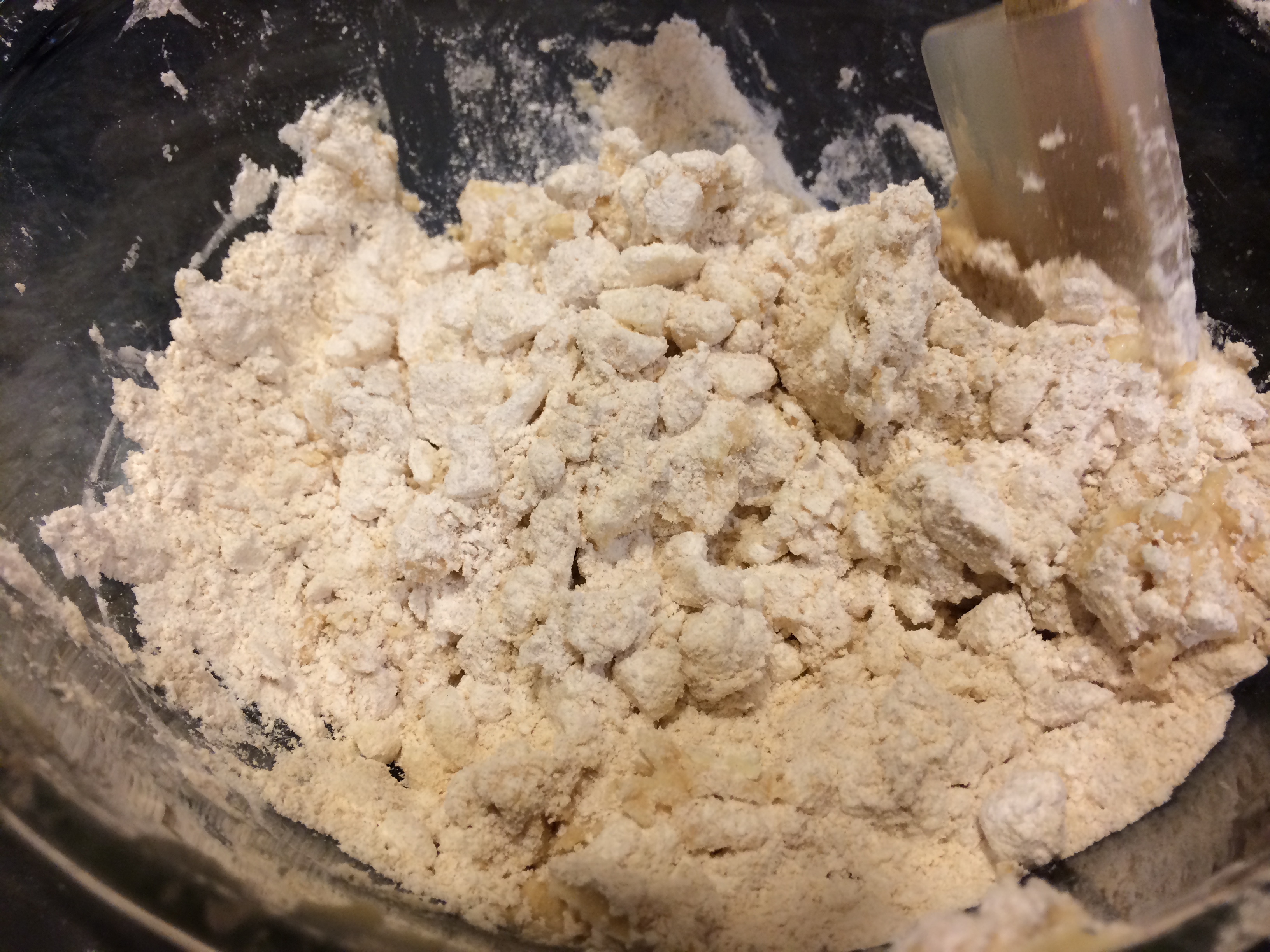
Start with all the flour and the salt generally mixed in in a large bowl. Get your stick of butter out of the fridge, and unwrap it only partially, so that you are holding it by means of the waxed paper wrapping, and keeping things cool. Using a paring knife, slice off bits of butter into the flour until the entire stick has been sliced off. Stir the butter bits around to coat with the flour. Then start cutting at the butter bits with a knife. This process can take about 10 minutes, but when you are done, the flour should all be touching butter or touching flour that is touching butter. Sorry that is the best way to describe it. It certainly does not look wet nor gathered together at all. The largest butter piece should be about the size of a pea.

IMG_0115 IMG_0118

Now add 2 tablespoons of refrigerated water sprinkled over the top. Using a spatula start moistening the flour and pressing it together into a mass. Remember, no touching and no kneading! The flour will readily press together as soon as it is moistened, but will remain rather shaggy. Collect it all in a sheet of plastic wrap or waxed paper, and using those flaps, press it together some more, until you can wrap it up into a parcel and put it into the fridge to chill.

IMG_0120 IMG_0122 IMG_0124

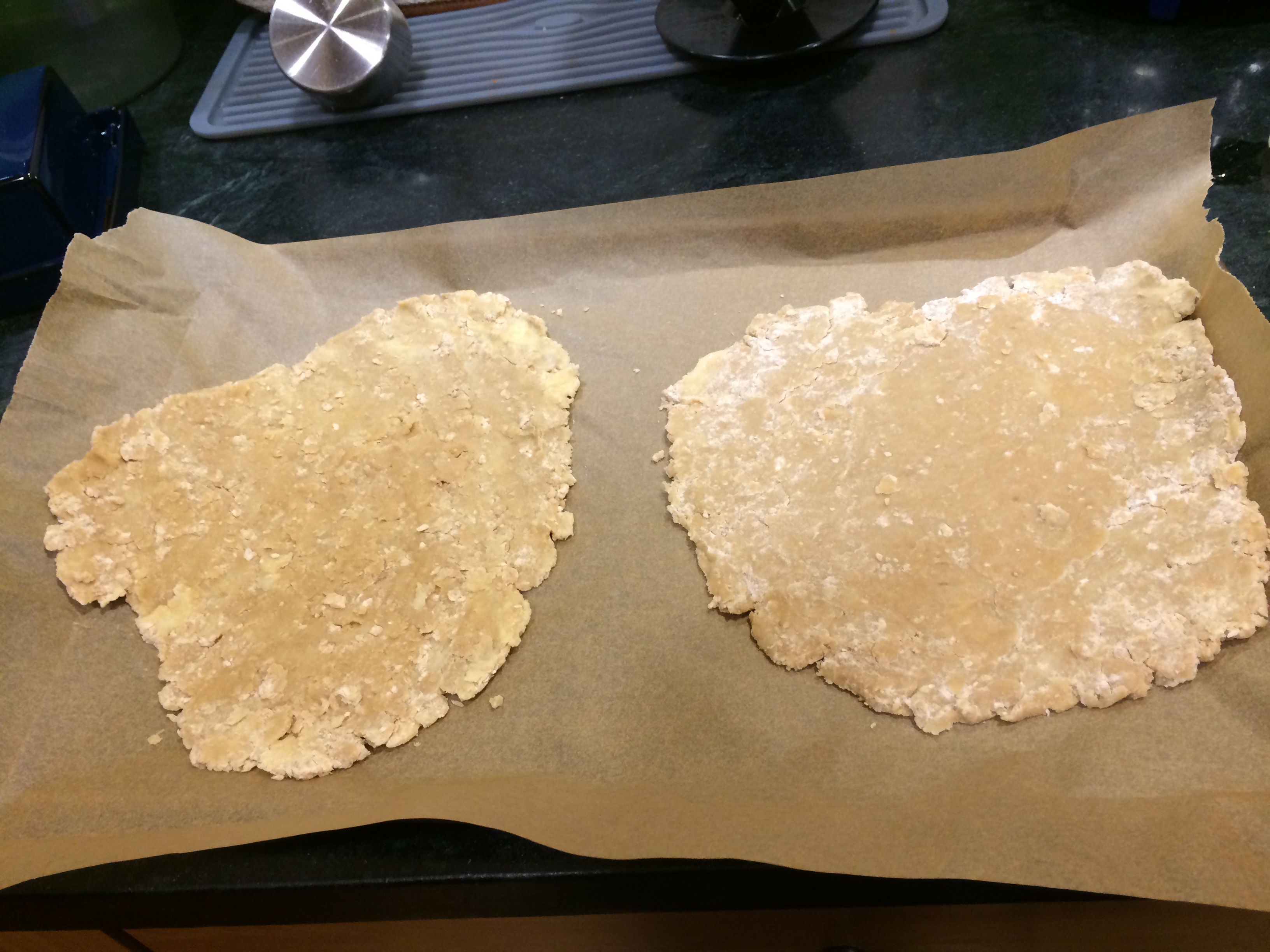
Great. Now the dough is chilled and hard and impossible to roll, now what? Before rolling, leave it out for about half hour. Cleanly slice it into two halves, then start rolling each into a rough circle.

The major, major problem with rolling this type dough is that it is sticky and squelchy with the butter bits. Two techniques come to our rescue: one, try rolling it between two sheets of waxed paper or plastic wrap. Two, sprinkle dry flour on the surface where necessary but do this sparingly.

All right, now you have two rough circles. Lay them out on a cookie sheet.

IMG_0131

Method for assembling the pie:

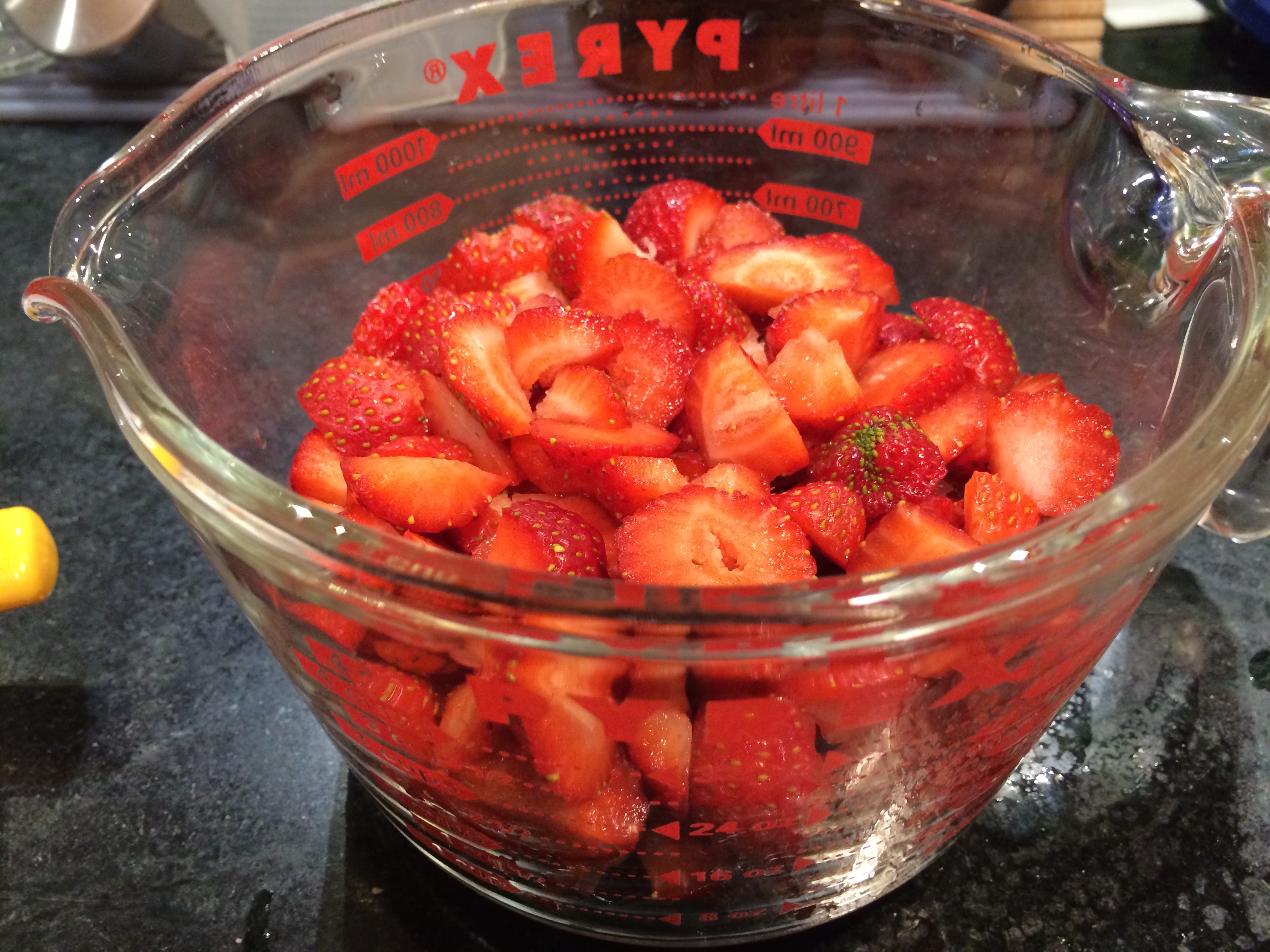
Rinse, de-stem and slice the strawberries.

Since I am doing a strawberry pie I clearly didn’t exactly ‘choose’ strawberries. But strawberries are an incredibly healthy fruit with a number of antioxidants, second only to other berries and walnuts.

Gently mix with the sugar and the flour. Now pile them in the rough center of each of the pie crusts. Fold the edges over the pile of strawberries to partially cover them. Dot each open center with a dab of butter.

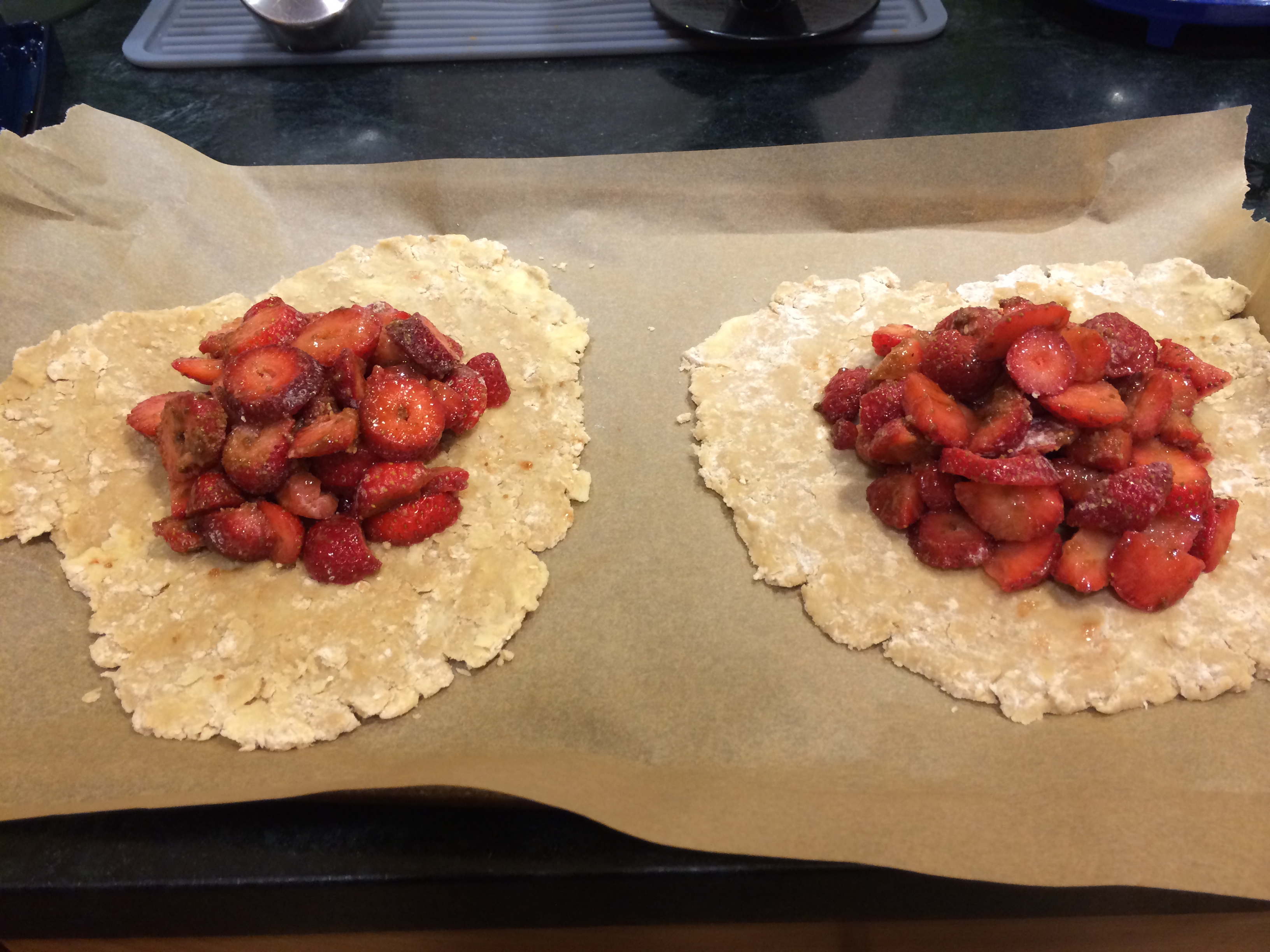
IMG_0129 IMG_0132 IMG_0133 IMG_0135

Now bake as they are in a 400 F oven for 25 minutes or until the edges are browned.

IMG_0137

Pallid halibut. Pallibutt.

It has taken me a long time to get used to American food. And I don’t mean those paragons of American cultural invasion — the pizzas and the hamburgers. I mean the food that actual, real-life Americans eat in their homes; the food that mothers, and increasingly, fathers, cook to feed their families. You know, the protein, vegetable and starch trifecta that graces dinner plates across the nation at 6:30pm, with a basket of rolls by the side. The meal that is etched in my mind in a multiplicity of images: a little sandy-haired boy wearing shorts, leaning over the dining table with his elbows, pushing peas around with his fork. The bright, skirted wife/mother carrying a big roasted bird on a tray. The suit-wearing father with his pipe, wearing a frilly apron as a joke, handing rolls around the table.

An American family at the dinner table

An American family at the dinner table

I don’t know where these images come from (probably from America’s giant lifestyle industry), but you catch my drift.

It has taken me a long time to get used to this type of meal. Being Indian, I could not understand how meat could be eaten without a lot of spices, or how starch could be eaten just by itself — without mixing in a lot of spicy gravy. And what kind of a way is it to cook vegetables anyway — just steaming? Meat cooked in a plain way is the most challenging — after a few bites, it feels like rubber. This, for example, is what I was used to for the first 24 years of my life:

Indian food image from Wikimedia Commons

Indian food image from Wikimedia Commons

Yes, I have had my challenges with the American meal. But since I married an American he has learned about my cuisine and I have learned about his. Now I can appreciate how the simplest of ingredients, unadorned, can please.

Hence this.

Halibut, cooked with a simple poaching. In milk. Turning it paler than pale. Pleasing my American husband immensely. And — can I admit it? Me too.

Pallid Halibut

Ingredients:

  • 3/4 pound halibut fillet
  • 1 cup milk
  • half an onion, minced
  • 4 green cardamom pods
  • 10 or so whole black pepper
  • 1 bay leaf
  • salt to taste

Method:

Collect the whole spices and minced onion in a pan. Pour milk over and bring to a simmer. Sprinkle salt over the fish and lay into the simmering milk; salt some of the surrounding milk as well. Keep ladling some of the milk over the fish along with the spices and onion once in a while. In about 15 to 20 minutes, while you keep the milk at a simmer, it should be done.

IMG_0068 IMG_0071

So — about done-ness. This is a concept that was new to me from Western cooking. The simplest way to check is to use a Thermapen thermometer to check the internal temperature of the fish — it should reach around 140 F. Another method is just to use a fork to see if the fish flakes easily and is opaque all the way in. Of course, some people like it more translucent.

IMG_0072 IMG_0073

Here is my pallid hallibut, the center of our very American meal that evening.

IMG_0074