Solid citizen channa dal

IMG_0772

Channa dal is the dehusked, split version of the black chickpea or kala channa. Most people know chickpeas or garbanzo beans in their lighter, bigger form (and often from a can); this lighter chickpea (known as kabuli channa) is native to the middle east, and eaten all over India too.

The black chickpea on the other hand, looks like this:
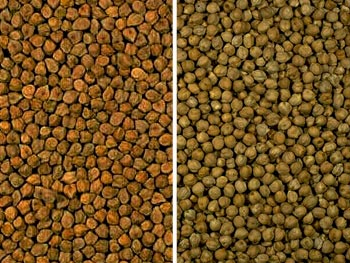
Black chickpea

Black chickpea

It is known as kala channa, and is a smaller, darker chickpea that is native to India (strongly resisting the urge to make a racial joke here). Kala channa is eaten whole often and someday The Odd Pantry will delve into that. But get its wrinkled brown husk off, and split it into its two cotyledons, and you have yellow channa dal.

Channa dal

Channa dal

Among the dals, it is a mighty stubborn one and resists softening. It takes the longest soaking, and the longest cooking. Still, once you get there, the results are hard to beat.

I believe each dish must showcase the main ingredient’s essence; and since channa dal likes to keep its integrity, we will help it. What I mean by that is that we don’t cook it down to mush (as is the case with most split dals) but allow the channa dal to keep its shape. An initial saute step helps seal in the grain’s shape, so let’s get to it.

Solid citizen channa dal

Ingredients:

  • 3/4 cup channa dal, soaked for one to two hours
  • Half inch piece of ginger, minced
  • 1 – 4 serrano or bird’s eye or jalapeno chilies
  • Half a teaspoon turmeric powder
  • One teaspoon cumin seeds
  • Half a teaspoon of asafetida
  • Half a teaspoon of red chili powder
  • Dry mango powder (aamchur)
  • 2 tablespoons finely chopped cilantro
  • 2 tablespoons oil
  • 1 teaspoon salt or to taste

Method:

Once you have soaked the dal, its volume will have doubled. Drain it of the soaking water.

IMG_0756 IMG_0757

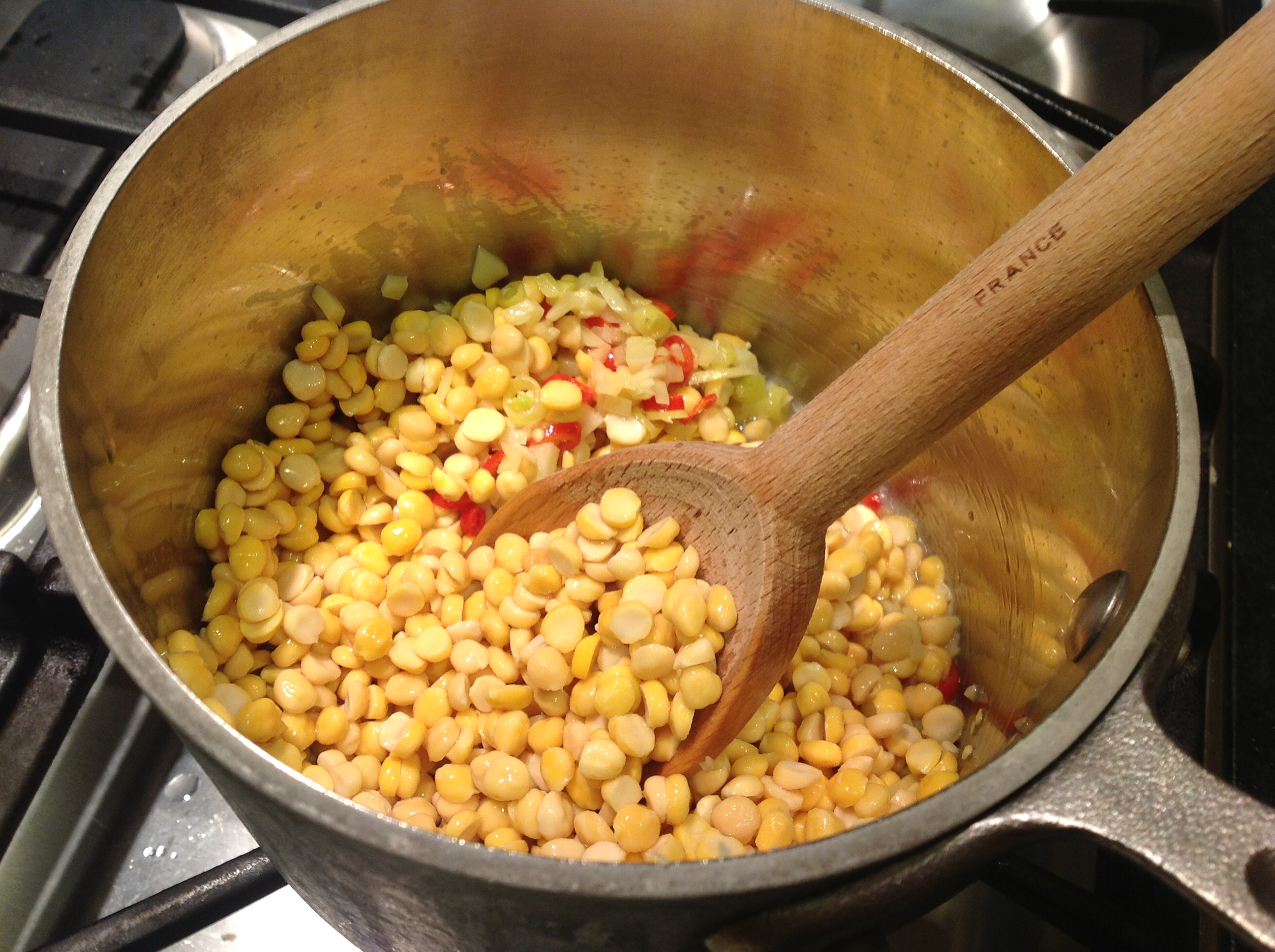
Heat half the oil in a thick-bottomed pot and when it shimmers, lightly saute the green chilies and ginger. Now put in the drained dal, and saute the grains on medium heat until the soaking water dries away; continue sauteing dal for another couple minutes or so. Now put in the turmeric and 2 cups water.

Bring to a boil with the lid off; once the water comes to a rolling boil and the foam subsides, lower the heat to a simmer, cover with a lid but leave a crack open for more foam to escape. The dal will take an hour and a half to soften.

Now add the salt and stir.
IMG_0769

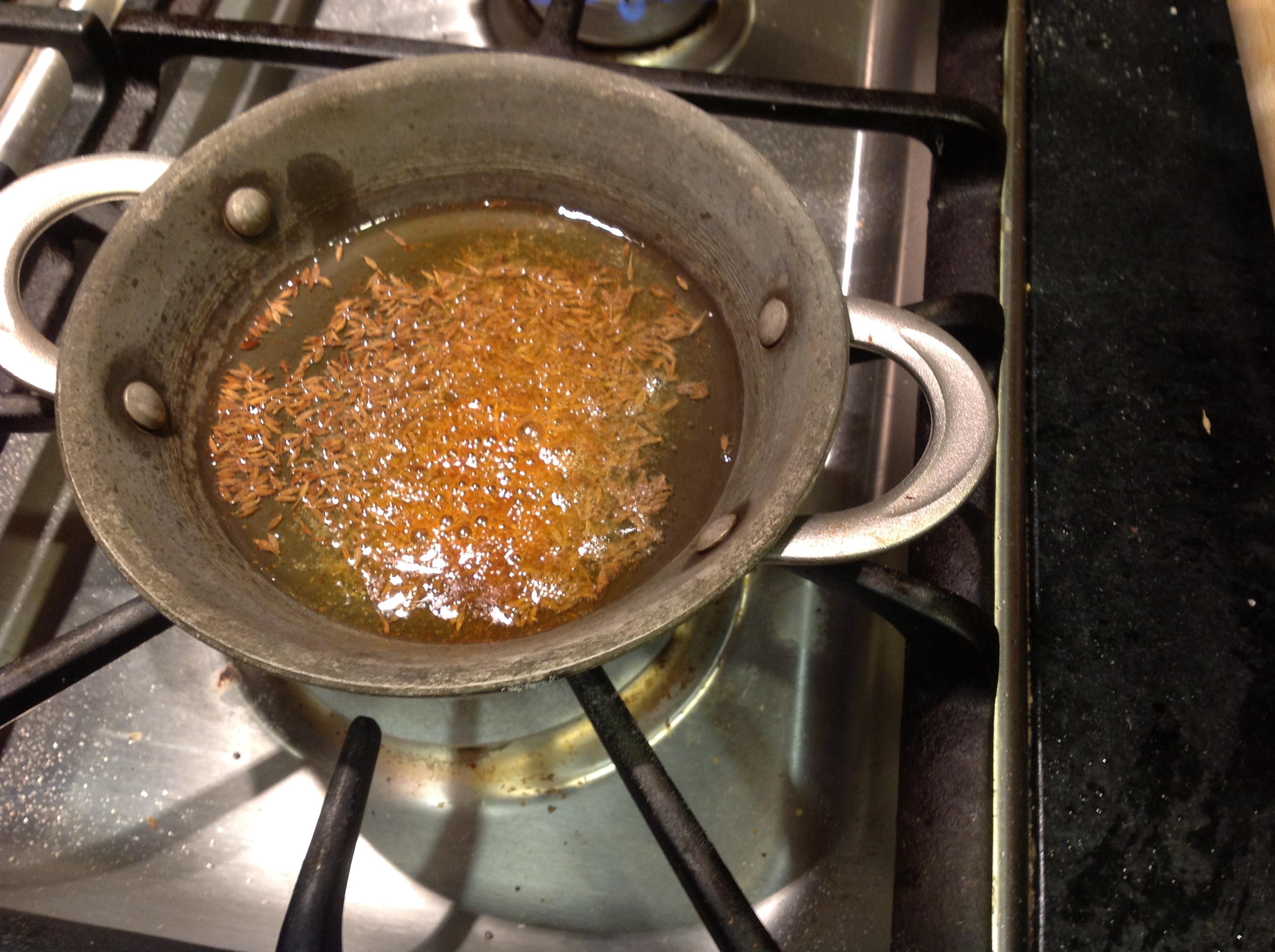
Heat the remaining oil in a small thick-bottomed pan. When it shimmers, add the asafetida and red chili powder. When they foam, add the cumin seeds. They will sizzle in a minute or two. Turn off the heat, add the oil and spices to the dal and stir once more. Also stir in the dry mango powder and the cilantro, leaving some for garnish.

Before serving, garnish with the dry mango powder and the cilantro to smarten it up.  I like this dal with roti/chapati or pooris, with perhaps a dash of lime juice if you like.

Knock-your-socks-off Northern style coconut chutney

Coconuts

Coconuts

Coconut is a southern Indian ingredient, but adding some of it to this northern Indian style chutney is a fantastic idea.

It is a simple recipe that you can make by patching together a couple other recipes.

Break a coconut and collect about a sixth of the coconut’s white flesh. Chop it finely or grate it. This website has some really good tips for breaking coconuts and this website talks about how to pry out the flesh.

Make this cilantro chutney, using the following ingredients: cilantro, chilies, onion. Collect all those ingredients in a blender. To this, add 2 tablespoons of this tamarind chutney. To that, add the coconut. To that, add about a half teaspoon salt. Blend, blend, blend, push down with spatula, repeat until you have a chutney.

Coconut chutney northern style

Coconut chutney northern style

I tried a spoon of this to taste; and I had to hold on to the counter it was so good.

It would make a great accompaniment to dosas/idlis, spread on bread, with samosas; or a myriad other ways.

King Julienne

King Julien

King Julien

King Julien is a strange character in the Madagascar series of movies. The talented Sacha Baron Cohen does his voice, and gives him an Indian accent, even though he is a native of the Madagascar island. He is a fun-loving narcissist, a ring-tailed lemur who counts bush babies among his subjects.

Odd? Yes, he is very funny, and very odd, which makes him a good mascot for the odd pantry.

This recipe, which basically consists of a number of julienned vegetables (particularly cabbage) is in honor of King Julien. I guess since it features cabbage you could call it a coleslaw which derives from Dutch koolsla and basically means cabbage salad. The dressing here is not mayonnaise-based, which gives it a lot more sharpness than the usual coleslaw.

Oddly sharp coleslaw

Ingredients

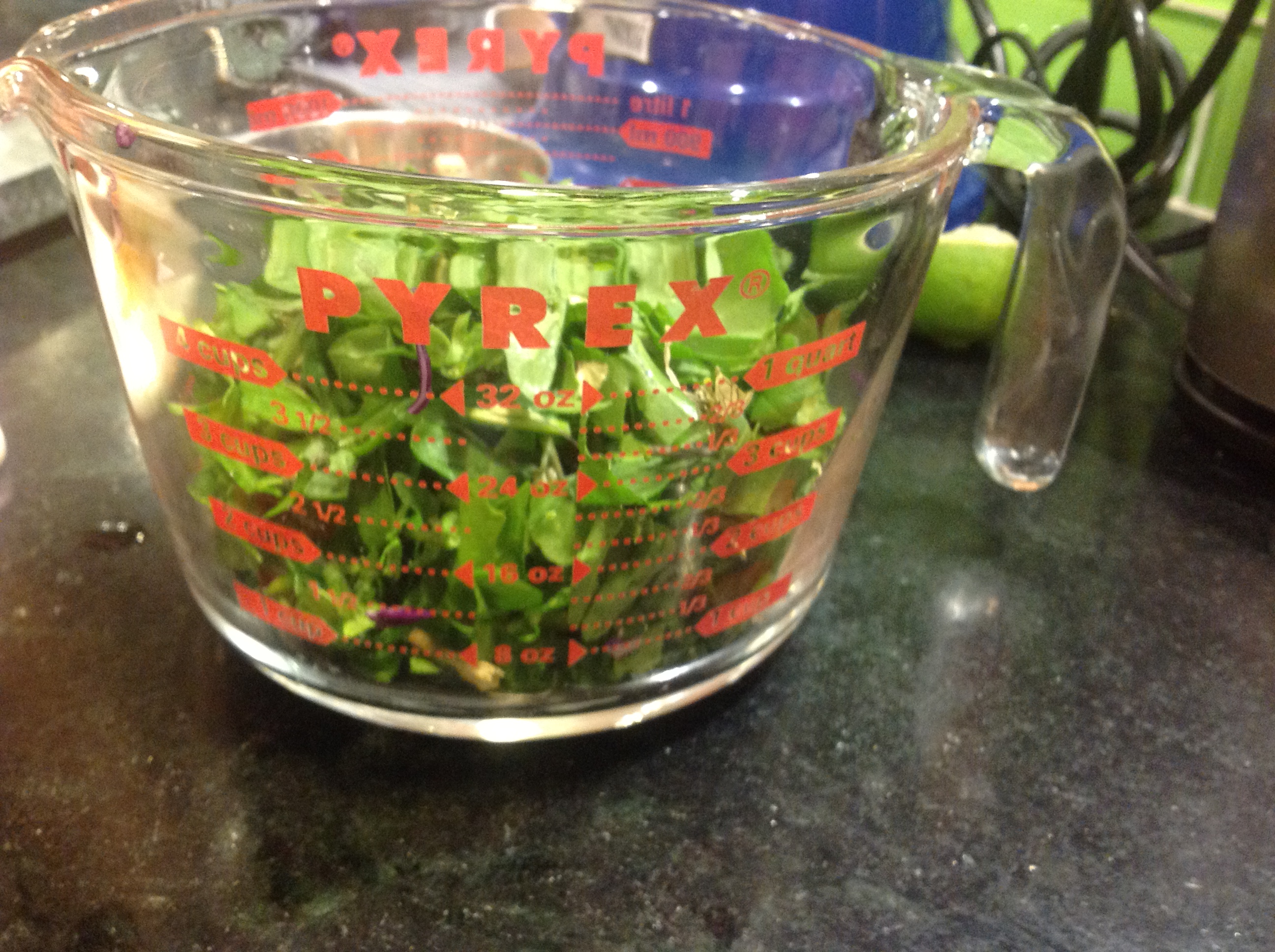
  • A scant 4 cups of shredded purple cabbage
  • A scant 4 cups of shredded arugula, loosely packed
  • Half a cup of green beans, microwaved or blanched, and julliened
  • Half a cup of firm apple, julliened
  • 1 tablespoon pinenuts
  • 1 tablespoon julliened ginger (Optional. This makes it really sharp, and if you are into that, you will love it)
  • Salt to taste
  • Half a teaspoon crumbled oregano
  • 3 – 4 tablespoon extra virgin olive oil
  • 1 tablespoon red wine vinegar or balsamic vinegar

Method:

IMG_0692 IMG_0695 IMG_0700 IMG_0698 IMG_0697 IMG_0693

Collect all the vegetable ingredients, nicely julliened. Toss them around in a large salad bowl. Add pinenuts, salt and oregano and toss some more. Now add olive oil and the vinegar and toss yet again.

You can eat it right away but the flavor does develop a little more if you wait fifteen minutes or so.

And you know here is a new idea…try eating it with chopsticks. Failing that, use your fingers.

Oddly sharp coleslaw

Oddly sharp coleslaw

Taro the terrible escapes again

Taro chaat

Taro chaat

…with some excellent results. I have before made note of taro root‘s scruffy appearance and its delectable nature. In this appetizer from my Sindhi childhood, taro shines with a few well-chosen accompaniments. This dish can go as a side with any Indian meal, or have it in the evening during a chaat and tea session.

Taro chaat

Ingredients:

  • 2 or so medium-sized taro tubers
  • 4 tablespoons tamarind chutney
  • 1 tablespoon finely chopped onion
  • 1 tablespoon minced cilantro leaves
  • Quarter teaspoon salt
  • Quarter teaspoon red chili powder
  • Half a teaspoon cumin seeds

Method

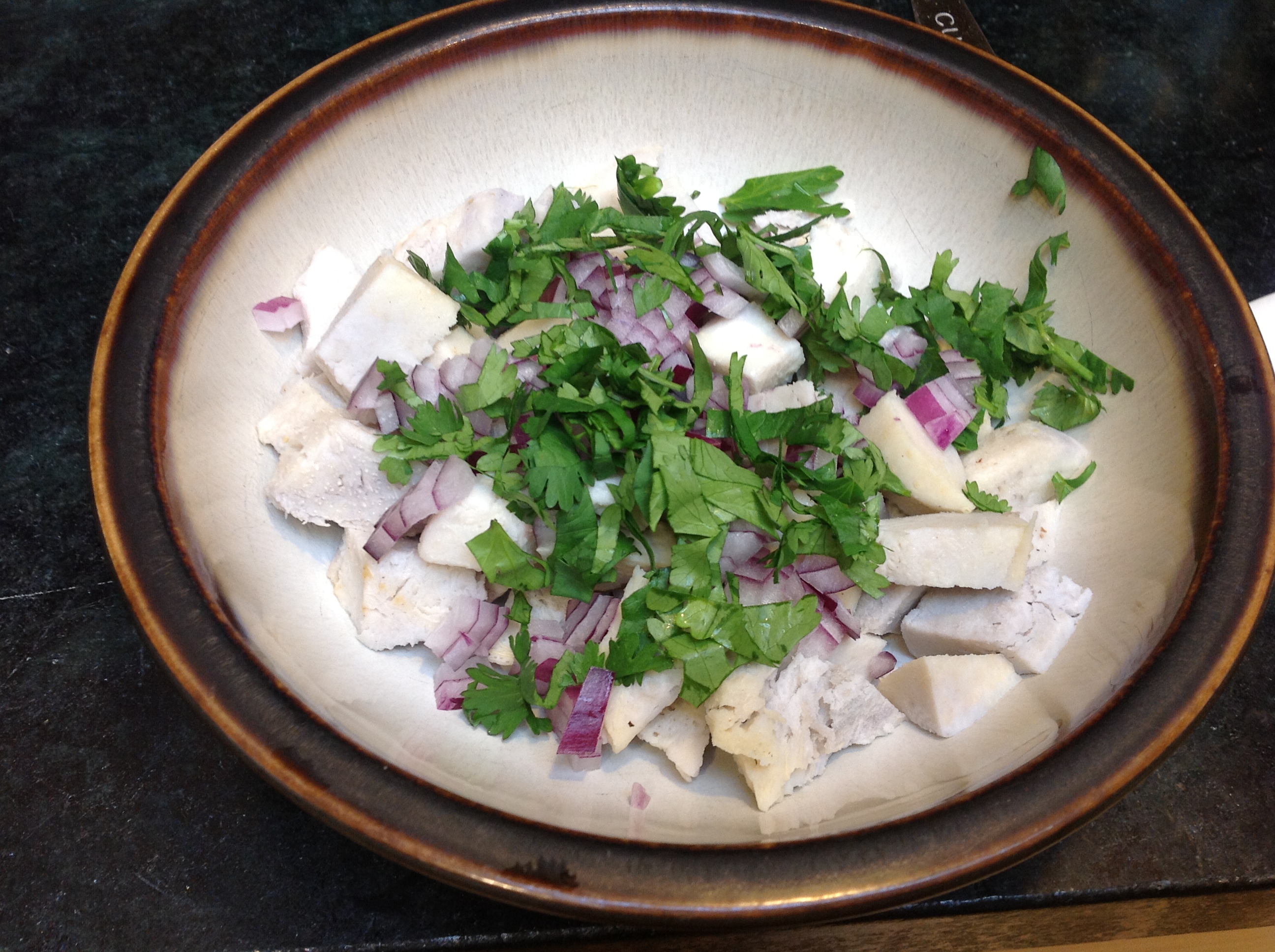
Rinse the taro and microwave it for about 5 minutes. Now it will be softened inside. When it cools, peel it to reveal the creamy white flesh. Cube it into quarter-inch wide cubes and save in a bowl.

Put in the cilantro and onion. And one is supposed to ‘layer the salt’ so go ahead, add enough salt for this amount of ingredients and stir. This will be about a quarter of a teaspoon but use your judgment.

IMG_0805

Now put in the prepared tamarind chutney. Now. A slight digression about tamarind chutney is forthcoming.

You can make tamarind chutney the easy or hard way. The hard way uses the dried pods of tamarind, either peeled and made into a block, or the pods themselves. Either way this method requires a lot of soaking and squeezing with your fingers to get the pulp out. So I tend to use a shortcut method — tamarind paste is the one thing I do buy prepared from the store. I use tamarind paste, and this is a good recipe for tamarind chutney using the paste. If you want, you can add a couple dried dates, chopped fine.

Roast the cumin seeds in a hot, dry pan for a minute or two, till they turn a shade darker, and grind to a rough powder in a clean coffee grinder or a mortar and pestle.

Top the tamarind with the red chili powder, and the cumin powder, stir well, and you are done.

This makes enough for one person as a largish side, but is easily multiplied. Oh — and if you don’t possess tamarind or have a special hatred for it, you could substitute with a similar amount of lime juice.

Wondrous bread

Dear Reader, I am aware that not all visitors to my blog are foodies. Some of you want your daily bread and water and to not be bothered to put all manner of unfamiliar pastes and blocks in your mouth (“just try one bite!”) I have non-foodies in my family, and I get you. I really do.

And when it comes to bread, the non-foodie likes the square sliced white bread. I do too! Sliced white bread is a neutral substrate for any kind of sandwich. Cube it and turn it into croutons. Toast it and butter it. Batter-fry it. Dip it in soup. The shape is predictable, even, easy to cut into little squares or triangles. This kind of bread is a workhorse.

In India we grew up with white bread of this variety:

WibsLogo

But as with many things, the primary innovation of making a square loaf, preslicing it and packaging it in waxed paper was American. It was a Wonder! And in case you need prodding to feel sufficiently celebratory, here, I will help:

It was a Wonder_Bread_logo.svg!

Sliced bread was invented in the 1920’s by a man named Otto Frederick Rohwedder. Not only did he come up with a bread slicer but also the idea of wrapping them in waxed paper to keep the slices fresh. After an initially doubtful populace, sliced bread began to fly off the shelves.

Pretty soon households were addicted to sliced white bread; that created its own problems. They became malnourished; the government had to insist that vitamins and minerals be added to the bread. Also, people began to forget what bread was supposed to taste like. Over the decades, the ‘bakeries’ where the bread was made turned into ‘factories’: the taste suffered, but nobody noticed. The product still flew off the shelves; ever more convenient, ever cheaper to make, sell, buy; it lasted longer and longer in our pantries. Until we ended up with this:

Wonder bread ingredients from http://theysmell.com

Wonder bread ingredients from http://theysmell.com

But never forget that the original soft white sandwich loaf really is wondrous. Easy to slice — not so crusty that the knife sends bread shards shooting into your eye. Not so soft that the knife mangles it with one gash. Easy to use for any kind of sandwich. And delicious.
Wondrous Bread

This recipe is from King Arthur Flour: Classic White Sandwich Bread. You should click the link for instructions and background but I’m repeating the entire recipe here.

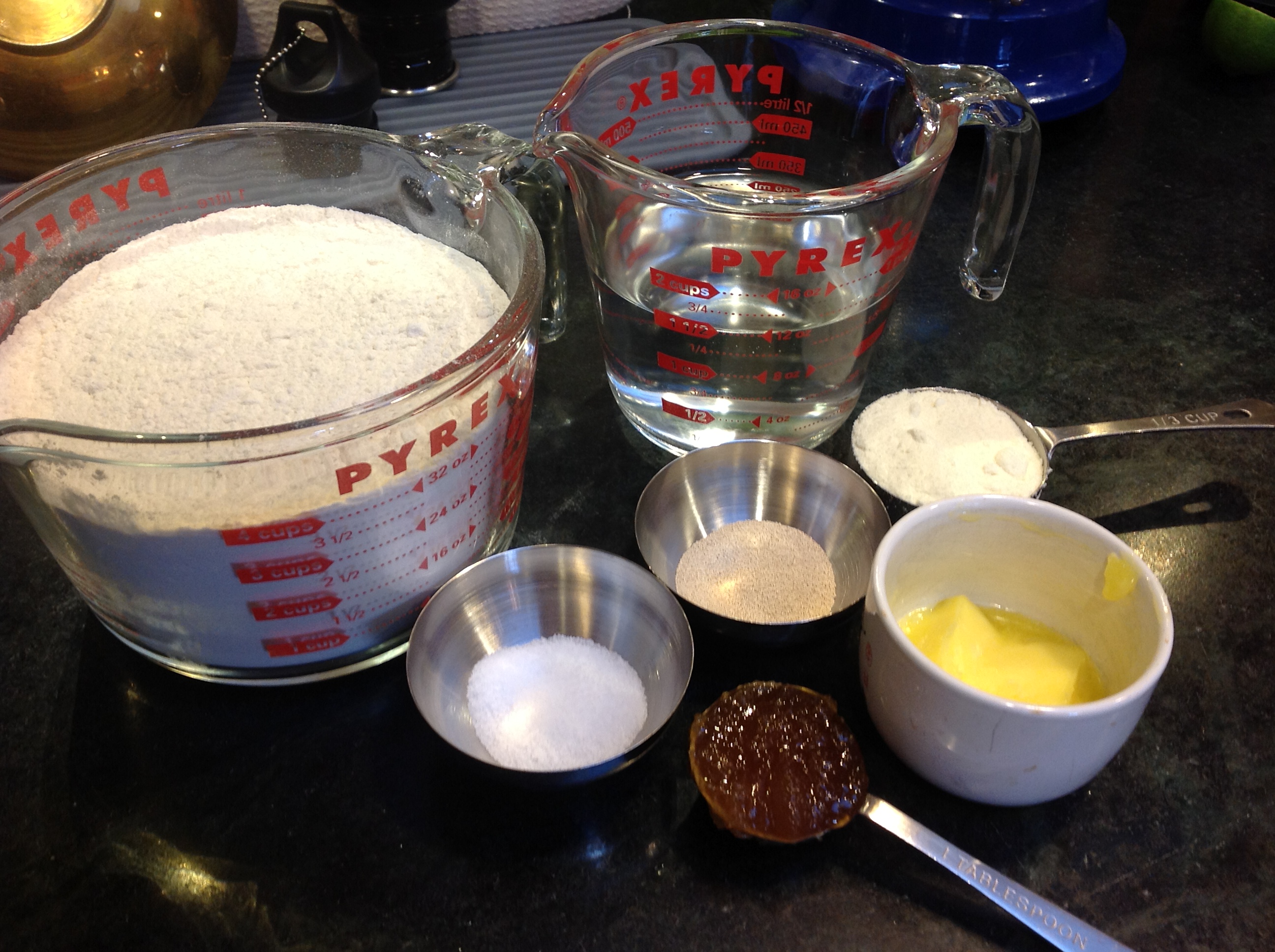
Dry Ingredients:

  • 4 cups unbleached all purpose flour
  • 1/3 cup dry milk powder (unsweetened)
  • 2 1/4 teaspoon instant yeast

Wet Ingredients:

  • 1 tablespoon honey
  • 1 3/4 teaspoon salt
  •  2 tablespoons soft butter
  • 1 1/2 cup water

IMG_0639

Method:

Mix the dry ingredients in the bowl of a stand mixer with a dough hook attachment. Mix the wet ingredients separately (no need to get it super combined). Make a well in the dry ingredients and pour the wet stuff in.

IMG_0641 IMG_0643

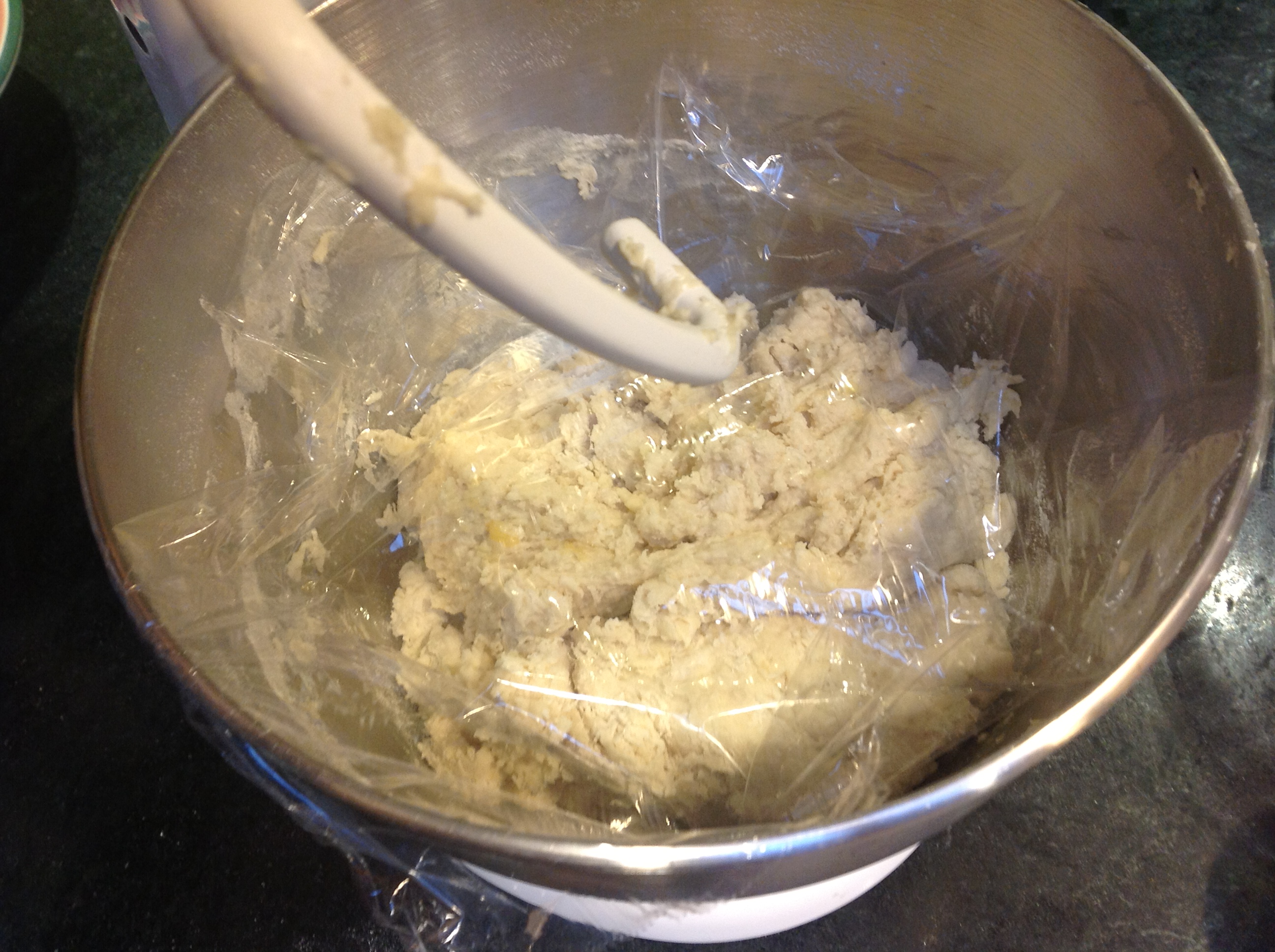
Stir with a dough hook until it sort of comes together in a shaggy mass. Cover with plastic wrap and leave it aside for about 10 minutes. Come back, run the mixer at this point for about 5 minutes until it comes together into a rough dough, like this:

IMG_0647

At this point, I like to finish kneading by hand, until it becomes a smooth dough like this:

IMG_0648

How do you know when you have kneaded enough? This is a trick I learnt from the book The Bread Baker’s Apprentice by Peter Reinhart. Take a little marble-sized ball of dough. Spread it as thin as you can into a little sheet, gently. If you are able to tease the dough into a translucent sheet (light should be able to shine through) without breaking it, you are there. If it breaks off into chunks rather than become a translucent sheet, you are not there and need to knead further. This is called the windowpane test.

Windowpane test

Windowpane test

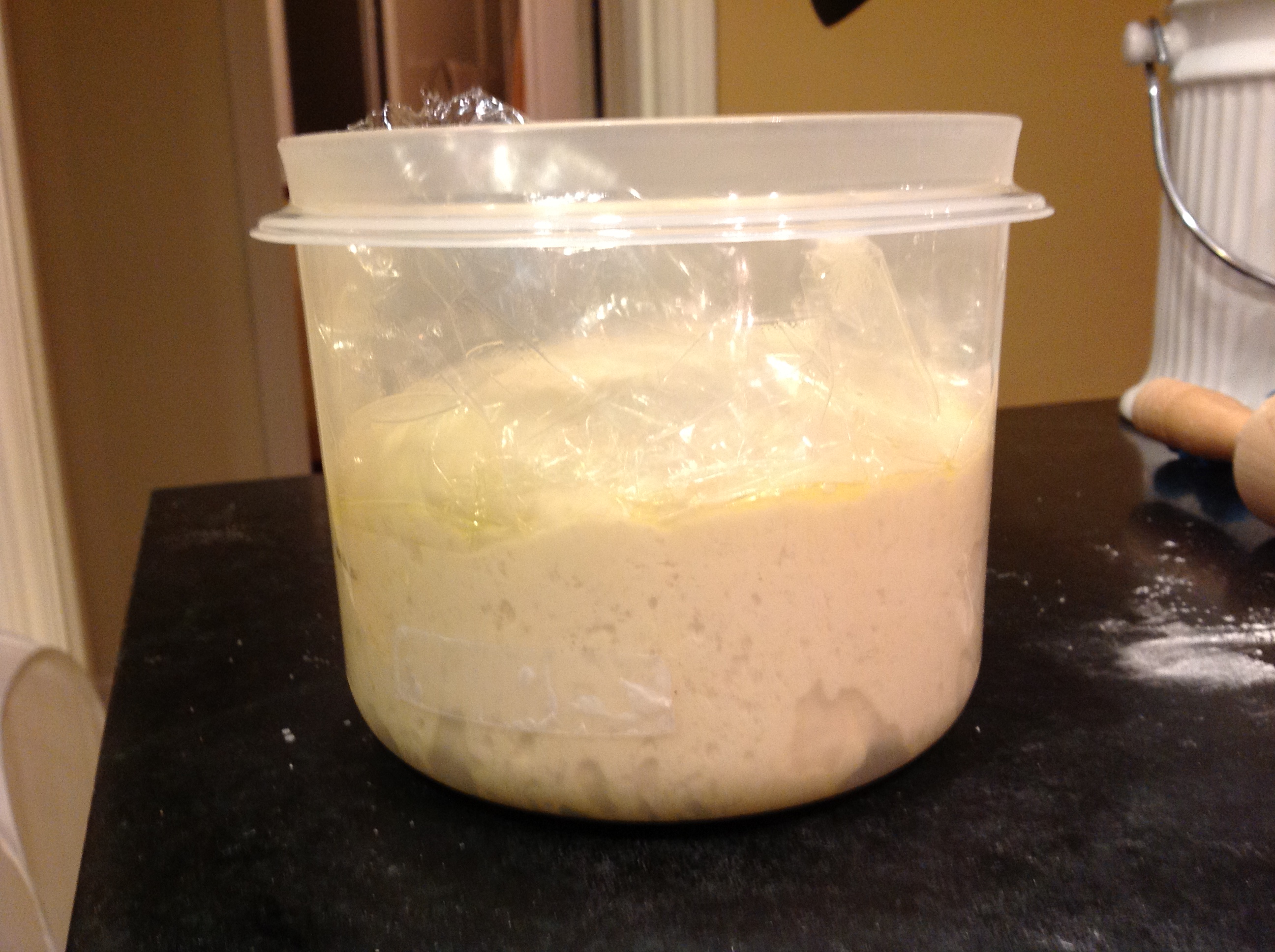
OK. Oil the dough to keep it from drying out and put it in a large container to rise. I usually mark the level at which it is with a sticky tape. Leave it at room temperature until it doubles. This will take about 2 hours.

IMG_0656 IMG_0660

Now comes the shaping. The loaf needs to go into a 9″ by 5″ loaf pan. Form the dough into a rough rectangle, and start rolling it into a log from the long side, gently pressing the seam closed as you go. Take care to tuck in the ends as you roll. The shaped loaf should have its seam closed everywhere, almost like a zipped up sleeping bag.

IMG_0662 IMG_0664

Place it into a greased loaf pan and cover with a plastic wrap. In an hour or 90 minutes the loaf will have risen to an inch above the rim. Now it is ready to go into an oven.

IMG_0669 IMG_0667

Preheat the oven to 350 F. When it comes to temperature the loaf pan goes in (without the plastic wrap, please!)  Bake the bread for 35 – 40 minutes. Around the middle of the cooking time, turn the pan 180 to allow it to cook evenly on all sides, and, tent it with aluminium foil to prevent it from browning too much.

IMG_0671 IMG_0674

When it is done, allow it to cool in the pan with some airflow under it, then take it out and slice it. There! sliced white bread.

IMG_0678 IMG_0675

A case of two mistaken identities and some yumminess

When I first came to this country I saw this fruit:

Kiwi

Fruit No. 1

And I thought it was this fruit:

chickoo

Fruit No. 2

Ha! I was wrong. Fruit No. 2 is actually the chikoo, also known as sapodilla, also known as — bear with me while I blind you with science — Manilkara zapota. It is native to Central America but grows in great quantities in India. It looks like this inside:

chickooCut

and the flesh tastes like a dryish banana. To eat it, you peel off the thin brown skin and eat the brown flesh. Not bad to taste, but my mom made me eat them a lot and I still recoil from the poor chickoo for that reason. Don’t let me dissuade you from trying this excellent fruit, though; it will lower your cholesterol and blood sugar while being the cause of some yumminess. Do yourself a favor and buy some if you see them being sold anywhere, but I do have to warn you, the seeds look suspiciously like cockroaches.

OK. On we go.

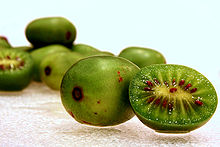
The other day I saw this berry-like fruit being sold at farmer’s market:

kiwiberry6oz

Berry No. 1

I thought it was an unripe version of this berry. Naturally I bought it:

Berry No. 2

Berry No. 2

Ha! Wrong again. Berry No. 2 is Jamun. I know jamun well. It terrorized my tongue many a time with its tingly astringency. I never thought I would ever crave that nasty fellow, but I do now — now that I can’t have it. Jamun’s correct name is Syzigium cumini. It is native to India but has become a weed in various places such as Hawaii and Florida. Apparently it has also spread around Brazil, and Brazilian birds have developed a taste for it; I think it is because they don’t have much of a tongue to terrorize.

That leaves Fruit No. 1 and Berry No. 1. First clue — they are cousins.

Clearly Fruit No. 1 is no mystery. It is the kiwi. We usually identify it with Australia (perhaps the name has something to do with it?) but the kiwi is actually native to China. It is rather new to the wider world, having just become known around the twentieth century; since then it had a rash of branding and re-branding — a problem that only a modern fruit could have. It went from being known as yang tao, to Chinese Gooseberry, to Melonette, to Kiwi.

Kiwifruit has brown fuzzy skin and looks, yes, quite melony inside, like this:

KiwiCut

So what the heck is Berry No. 1? Inside, it looks like this:

kiwi berry

kiwi berry

That’s right! Berry No. 2 is a kiwi berry. Fruit No. 1 and Berry No. 1 are close cousins. Both belong to the Actinidia genus. This is closer than belonging to the same family; in other words, the kiwi and the kiwi berry are about as closely related as the lion and the tiger to each other (both belong to the Panthera genus).

Eating the kiwi berry was a satisfyingly schizophrenic experience. Tastes just like a kiwi inside, but there is no need to peel it, the skin is edible and remains so when it ripens fully. A wash-and-wear kiwi! Excellent.

The doofus

Somebody stop me I feel a thesis coming on. It is about this vegetable:

Kaddoo

Kaddoo

This is not the kind of vegetable that one expects paens to be written about. It is found anywhere that vegetables are sold in India; and being India, that could be a basket at a railway platform or a sheet laid out on the sidewalk:

vegetable market

vegetable market selling kaddoo and other things

A vendor sorts vegetables next to a railway track as a train passes by, in Dhaka on September 10, 2012. (Andrew Biraj/Reuters)

A vendor sorts vegetables next to a railway track as a train passes by, in Dhaka on September 10, 2012. (Andrew Biraj/Reuters)

Sidewalk vegetable seller from suvisworld.wordpress.com/

Sidewalk vegetable seller from suvisworld.wordpress.com

It is known to me and other Sindhis as ‘kaddoo’. It is so devoid of glamour that if you call someone a ‘kaddoo’ you may as well call them a doofus. But don’t underestimate it, because the kaddoo has mystique. For one thing, it is one of the oldest cultivated plants in the world. Humans have been eating it for ten thousand years. Recently some stands of wild kaddoo were discovered in Zimbabwe, which is probably where it originated. News of the cultivated kaddoo seems to have spread like wildfire, from Africa to Asia to the Americas; the kaddoo discovered America before Columbus.

Check out its pretty flower:

Kaddoo flower

Kaddoo flower

Like other plants from the Cucurbitacae family (squashes, melons and gourds), it is a vine and climbs by means of tendrils. Kaddoo flesh is pale, watery and very mild. Some would say boring. It cooks down to become squishy and somewhat gelatinous. The skin is thin and pale green, but one does have to peel it before cooking. The seeds of the young fruit are quite edible.

Calabash

Calabash

So where is the mystique? I knew that kaddoo is also known as lauki, bottle gourd, opo or dhoodhi, but I didn’t know that it also goes by the romantic name of Calabash. In India we mostly eat this as a young vegetable, when its peel and seeds are rather soft. But apparently when it ages, the peel hardens, the flesh dries up, leaving a sort of bottle behind; In this form, it is called a calabash. It has been used by old cultures as a vessel, or even as a musical instrument. Apparently the fact that the size of these gourds roughly matches the size of the human head gives it its resonant qualities.

Sitar parts

Sitar parts

SitarKaddoo

Musical instruments, hmm…what kind? Some tribal folksy thing no doubt, that street performers play and bystanders throw change at? Sure…but also, think Ravi Shankar and the sitar. The calabash is used for the shell of the deeply buzzy and resonant sitar…the main resonating chamber of which is called…wait for it…the kaddoo.

QED.

Kaddoo koftas in gravy.

kaddoo koftas

kaddoo koftas

Ingredients:

  • One large kaddoo, peeled, quartered and seeded
  • Quarter cup besan
  • Half a teaspoon coriander powder
  • Some sprinkles red chili powder
  • One teaspoon aamchur
  • Salt to taste
  • 4 – 5 tablespoons oil
  • One recipe of browned onion tomato gravy

Method

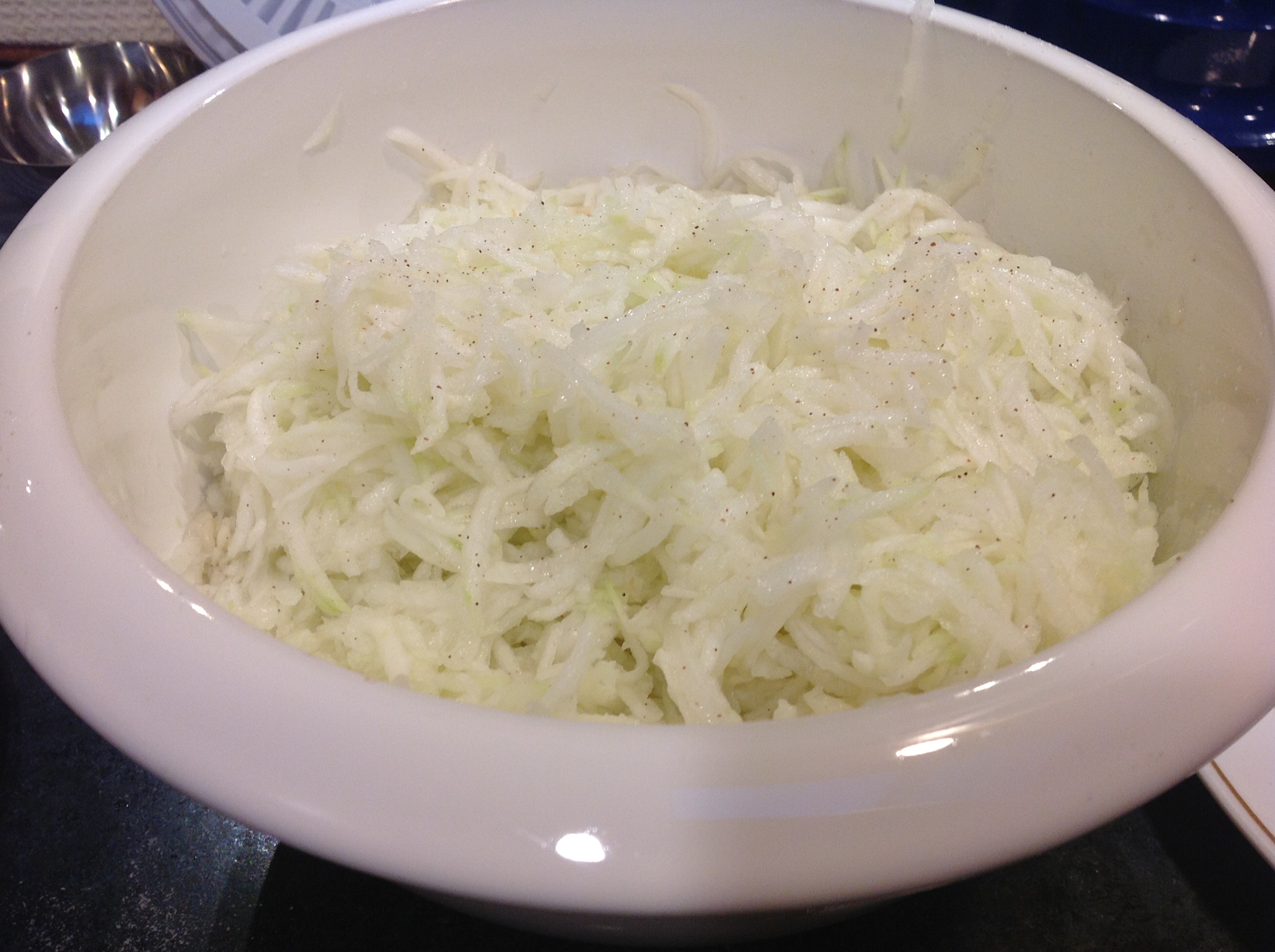
Grate the kaddoo quarters. Salt it with about a teaspoon of salt and mix it with your fingers. Leave the grated kaddoo aside for about half an hour; during this time the salt will draw out most of the moisture.

IMG_0618 IMG_0619

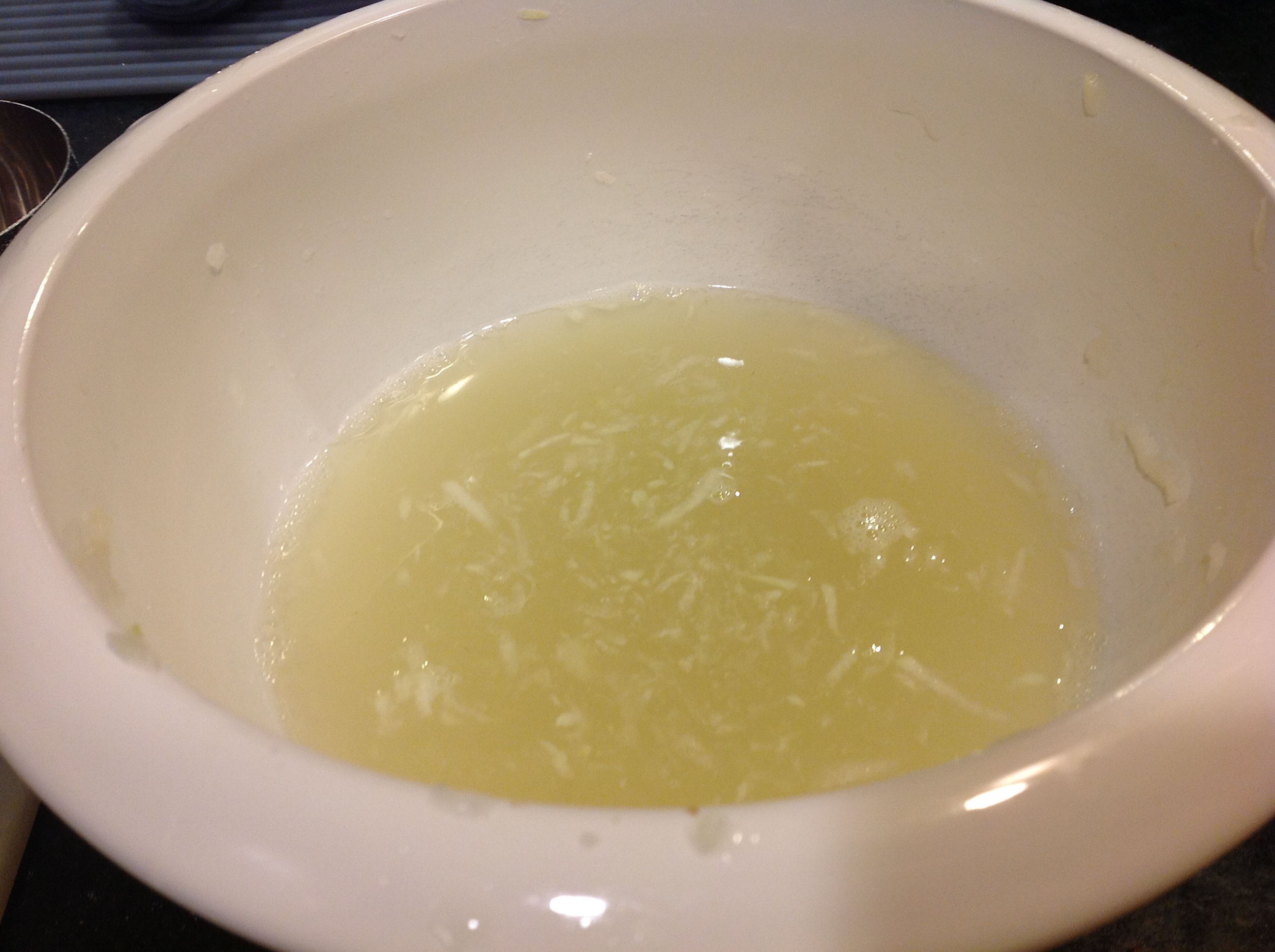
Now you can do the rather tedious task of squeezing out the water from fistfuls of kaddoo my means of your hands. Save the water, it has some kaddoo-ness and we will use it later.
IMG_0629 IMG_0630

Meanwhile start off the process of making the browned onion tomato gravy. When it calls for water (at the end) use the kaddoo water, would you please? Lets not waste it.

The volume of the grated kaddoo will have much reduced, and it will be dry. Put in the besan and the dry spices. You do not need more salt. Mix it with your oiled fingers; it should now be amenable to form patties. Form about 6 patties and leave them side by side on a plate.

IMG_0633 IMG_0635

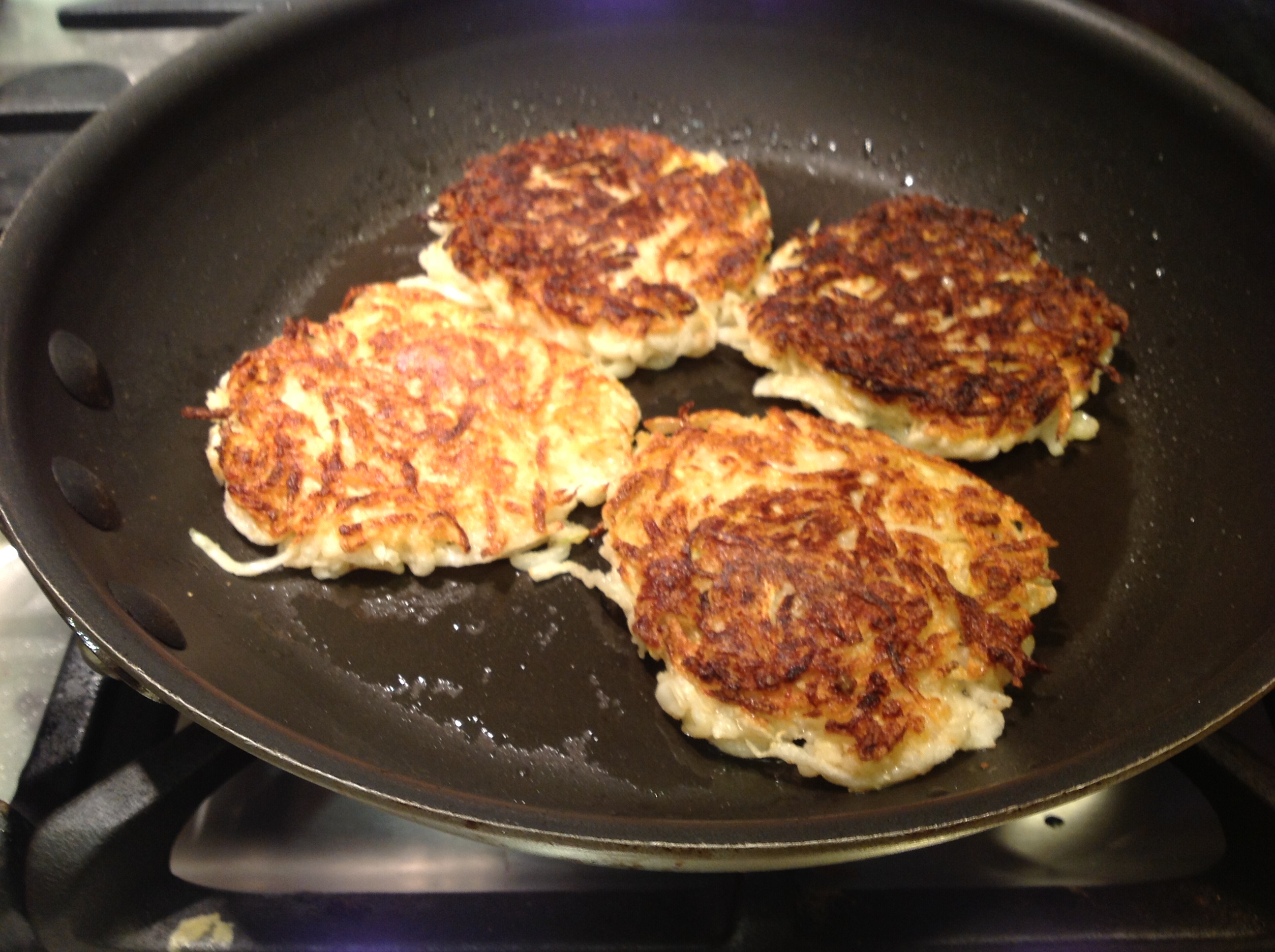
Panfrying them is next. Heat a non-stick pan with oil about an eighth of an inch deep. When nice and hot, put in the patties with liberal gaps around, and sort of flatten them. Let them cook for 5 – 7 minutes or until they brown at the bottom; flip them, some more oil perhaps, and cook for another 5 minutes.

The patties are ready, all that is needed is to slip them into a nicely simmering pot of the browned onion gravy.

IMG_0636 IMG_0637

And you are done. This dish goes very well with rotis/chapatis.

Browned onion-tomato gravy — let’s get this over with

Browned onion tomato gravy

Browned onion tomato gravy

Sindhi food has a ton of recipes that start with first making a browned onion-tomato gravy, then putting in whatever edible goodies you find in the fridge that day.

Browned onion gravy can make anything taste good. Those left over hard-boiled eggs from a week ago? Throw them in. The unidentifiable pulpy vegetable with the brown spots? Cut out the brown spots, throw it in, heat it through, and gloat. Lentils, beans of all descriptions, chicken, dumplings that are fried, dumplings that are boiled, in they go. Call them meatballs or call them koftas, throw them in. You could make a giant batch of the gravy, freeze it in meal-sized portions, thaw and add stuff to it — there you go, your main meal for dinner.

In fact this gravy is such a magician that it is a bit of a cop-out for an aspiring master chef, and makes me reluctant to use it too often. Think about it — if you are a doctor, how respected would you be if your advice for every ailment is — ‘take two aspirin and call me in the morning’? It might work but it is too easy. But this is still an indispensable skill to have in your Indian cooking repertoire, so let us take our two aspirin and learn to do this right.

Browned Onion-tomato gravy

Start with reading this recipe — how to caramelize onions. That is going to be our first step. This recipe makes enough for a base for the main meal for 2 – 4 people.

Ingredients:

  • One medium-large onion, chopped fine, or sliced thin.
  • One large or two small tomatoes, roughly chopped.
  • 3 – 4 large cloves garlic, minced
  • Half inch piece of ginger, minced
  • 1 – 4 serrano chilies to your heat tolerance, sliced
  • Half a teaspoon whole cumin seeds
  • Half a teaspoon coriander powder
  • Quarter teaspoon turmeric
  • Half a teaspoon salt
  • 2 – 3 tablespoons oil

Method:

Heat oil in a wide thick-bottomed pan. When it shimmers put in the cumin seed; when that sizzles, the onion and caramelize it.

Onions, garlic, IMG_0622 IMG_0623 IMG_0624

At this point add the ginger, garlic, chili, and let them cook on medium heat for a couple minutes. Now put in the tomato. Sprinkle some salt over. The thing about the tomato is that is has to liquefy, then mostly dry up. First, the combination of the heat and the salt will make it release its liquid. Then, cook some more on that wide-open pan of yours, and the liquid will evaporate. The remains of the tomato will combine with the caramelized onion to create a rough paste.

IMG_0627 IMG_0628

Browned onion tomato gravy

Browned onion tomato gravy

At this point the dry powders can go in. Give them a stir, and then put in some water; the amount depends on what you are trying to use the gravy for, anywhere from half a cup to a cup.

Bring the water to a boil, and let it simmer for about 5 – 7 minutes.

The gravy is basically done. But you can take it into multiple directions from here:

  • run it through a blender to get a smoother sauce
  • add some cream or milk to make it creamy
  • or add a cashew puree to make it creamy that way
  • add garam masala, extra chili in the form of red chili powder, cumin powder, or other spice mixture of your choice
  • or use it as is.

Soap chutney

Green chutney

Green chutney

Only after I first came to these foreign lands as an adult did I realize that there existed people who hated cilantro. I could not conceive of this. In India this deeply cut leaf of the coriander plant tops each meal and many spice pastes are centered around it. It is so commonplace that you would have to stop eating to avoid it. It is commonplace as water. Perhaps not that much. It is as common as…ah, say, soap?

Soap.

Yes, soap. People who intensely dislike cilantro all agree that it reminds them of soap. This is incredible to me. I’m a reasonably clean person, people, and I have had many close encounters with soap. Daily, you might even say. I have eaten cilantro by the fistful. At no time have I had the urge to rub the leaves onto my hands, nor to bite into the bar in the shower.

Soap? What to make of this?

Just to be complete, let us first consider the possibility that there is a secret society of cilantro haters who have secret meetings where they collude on what smell they will all agree cilantro reminds them of. That is a definite possibility, but I’m missing what the motive might be here.

The other possibility is that yes, indeed, cilantro has a secret life where it dabbles in cosmetics.  Because the few people who don’t mention soap, say that cilantro reminds them of lotion.

There is a scientific basis for this. There are fragments of fat molecules called aldehydes; the ones found in soap are same or similar to the ones found in cilantro. As this New York Times article by Harold McGee explains, people from cultures that are used to cilantro have learnt from an early age to tamp down the soapiness of cilantro in favor of the herbal and pungent smells.

Which brings us to cilantro chutney. I for one, adore the smell of cilantro so much that the question for me is: how much cilantro flavor can I pack into each cubic inch? The simplest way to do this is by making a paste.

Green Chutney

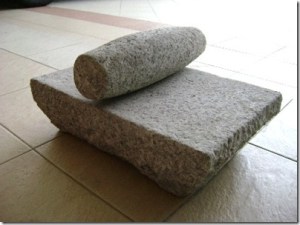
Green chutney was a staple in my household. There was always a steel tin of this condiment in the fridge. In earlier days our cook used a grinding stone, something like this:

Stone grinder

Stone grinder

Then the Industrial Age dawned in our household and then we used a blender, the picture of which I do not need to show you.

This chutney is great as a spread on bread, or as a side to all kinds of Indian snacks.

Ingredients:

IMG_0613 IMG_0611

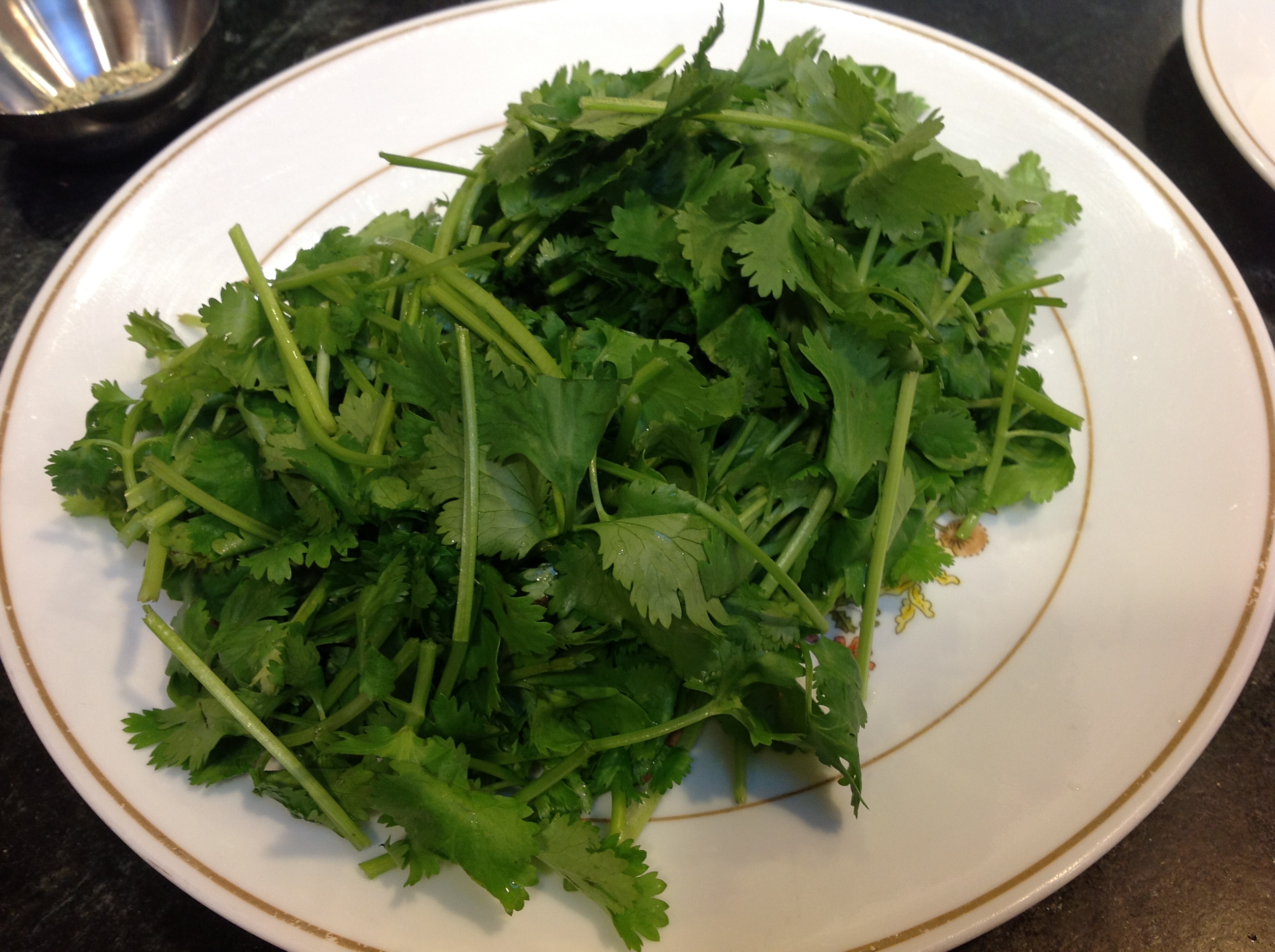
  • 1 bunch of cilantro, rinsed and roughly chopped, including soft stems
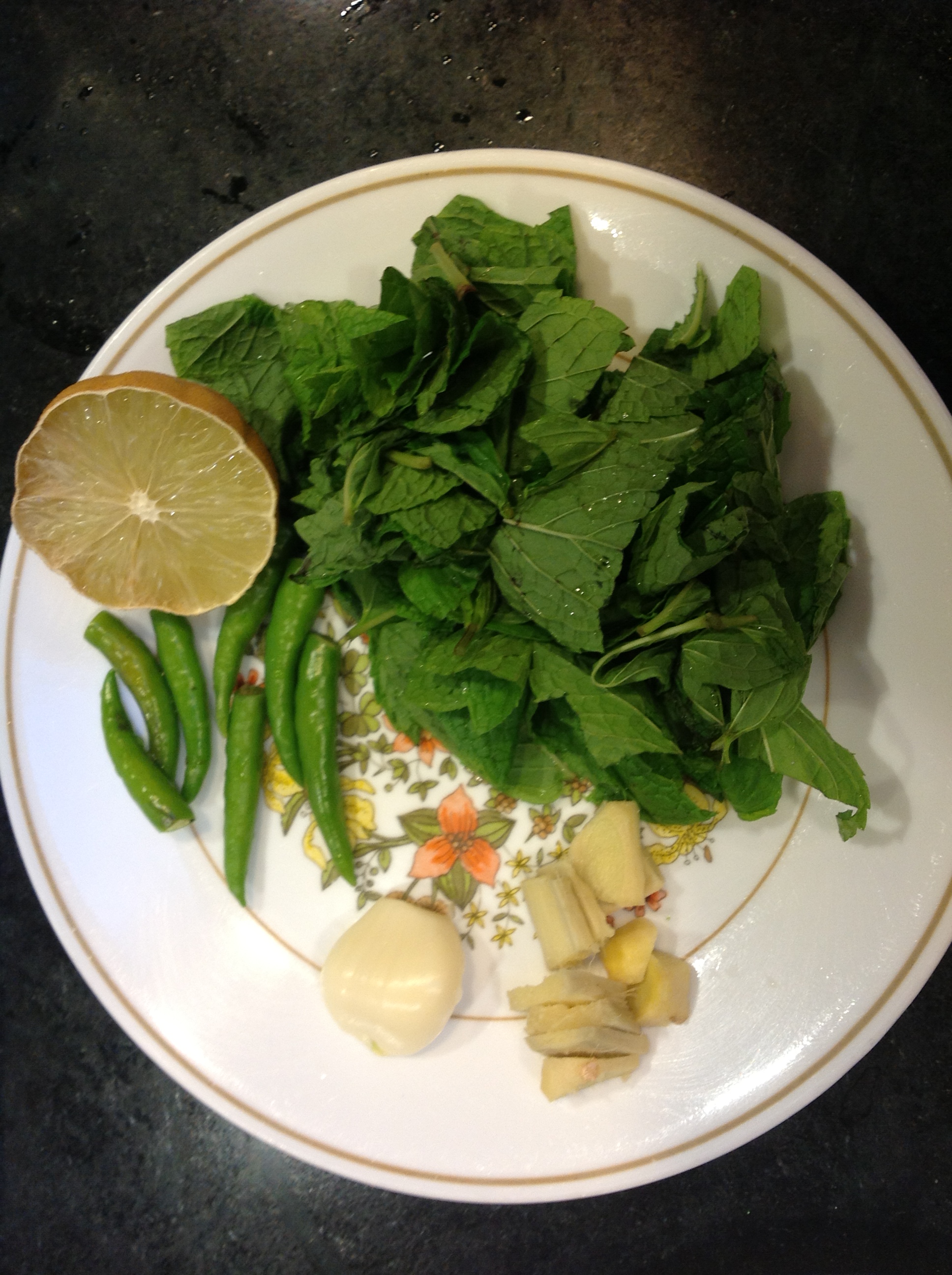
  • Anywhere from 1 to 8 serrano chilies, depending on your heat tolerence
  • Half a teaspoon salt or to taste
  • For sourness, 2 teaspoons of lime juice or 1 teaspoon tamarind paste (optional)
  • Half a bunch fresh mint, leaves only (optional)
  • 1 – 2 cloves garlic (optional)
  • Half an inch piece of ginger, peeled and sliced (optional)
  • A cubic inch of onion (optional)
  • Half a teaspoon sugar (optional)

Method:

As you might have noticed there are a number of optional ingredients. Just the first three will give you a serviceable green chutney, but the addition of the others will enhance the flavor in their own unique ways. I particularly recommend adding onion, because onion has this unique characteristic (like salt) to bring out the flavor of the other ingredients, while not overstating its own. A good team player, is our onion.

Put everything into a blender with only the water that clings to the leaves from rinsing, and hit go. Maybe add a tablespoon more water but limit this. You might need to stop, stir, and go a few times, but eventually the blades will catch; and you will have your green chutney.

The Tahoe gratin

Tahoe Gratin

Tahoe Gratin

We spent labor day in a rented cabin in the Tahoe region. We had a state of the art kitchen at our disposal, a warm cozy evening for dining in, a few vegetables in the fridge, but no spices whatsoever. What’s an Indian cook to do?

Gratin!

I love gratins — the creamy cheesy crusty casseroles. I was first introduced to gratins in an strange fashion — a pure vegetarian Gujarati restaurant in Bombay had a ‘Vegetable Au Gratin’ on the menu and it was delicious. Restaurants in India have this strange quirk where the advertised cuisine hardly matters — a South Indian dosa restaurant will have an entire Indian Chinese menu, and throw in a club sandwich as well. They don’t seem to believe in specialization of cuisine.

Sort of like the proprietor here at The Odd Pantry you say? Hmm.

At any rate, this is a pure vegetarian gratin, and it is built in layers of potato, cauliflower and corn…all vegetables with distinct flavors that nevertheless that have a certain savoriness that unites them.

The Tahoe gratin

Ingredients:

  • 1 large red potato or 2 medium
  • Half a head of cauliflower
  • Half a pound bag of frozen corn kernels
  • One and half cup milk
  • 1 – 2 tablespoons butter
  • 1 – 2 tablespoons whole wheat flour (same amount as butter)
  • salt to taste
  • A 2″ by 2″ by 2″ block of good sharp cheddar cheese

Method:

In this dish I precook all the vegetables to minimize and equalize the gratin baking time. The other principle I follow is to salt each layer on its own.

First, the potatoes. Slice the potato as thin as you can get them (eighth of an inch). Put them in a pyrex container, add salt enough for the potatoes, and submerge them in half a cup milk. Microwave for 2 – 3 minutes and then set aside.

IMG_0578 IMG_0579

Next the cauliflower. Slice the florets into quarter inch thick slices, put them in a bowl, add some salt, and once again, microwave for 2 – 3 minutes and set aside.

IMG_0580

Next the corn. Same routine — put in a bowl, add salt enough for the corn, and microwave. With the frozen corn all we are trying to do is thaw them.

Vegetables are ready. Let’s make the bechamel sauce. Heat the butter in a small pot. When it melts, add the flour and stir, stir, stir on gentle heat. It will foam and bubble and perhaps turn a shade darker. Now put in the milk. Stir with your wooden spoon for dear life as you slowly pour the milk in. You may need to resort to a whisk, the idea is we are trying to not have any lumps. Keep the heat gentle. You can also pour in any extra milk from the potato cooking bowl. Once all the milk has gone in, and the mixture is smooth, you can up the heat and bring to a boil. Add salt enough for this sauce.

IMG_0581 IMG_0582 IMG_0584

Once it comes to a boil, turn it off after a minute. We are ready to compose the layers. In a flat baking dish, first layer in the potato slices, trying to keep even thickness. Next put on the cauliflower florets in a layer. Next the corn. Now pour the bechamel sauce all over the vegetables, pushing and prying with a spatula to get it everywhere.

IMG_0583

Cut the cheese up into tiny cubes. Cover the top of the casserole with cheese. Cover with foil and bake for 45 minutes at 425 F. In the last 10 minutes, take the foil off to get it to brown. If you want more of a brown crust, stick it under the broiler for 5 extra minutes.

IMG_0585 IMG_0587


Here are some other ideas for other vegetables to add to the mix: peas, leeks, roasted zucchini.