Tomato-garlic gravy or bust

Tomato-garlic gravy with purple potatoes and peas

Tomato-garlic gravy with purple potatoes and peas

So I’m a pretty laid-back person generally but for this recipe I am absolutely a stickler. I am a tyrant. This must be made with these ingredients — no, don’t throw in ginger, don’t throw in cumin. Leave that onion out, you will ruin it. I realize that canned tomatoes will make your life easier but this recipe calls for fresh ones, and what recipe wants, recipe gets.

Don’t leave anything out either. I realize that curry leaves are not easily available everywhere. If you don’t find them, I guess you must leave them out. But please, do so with regret. And don’t go substituting it with something else.

However even though I am so particular about the gravy itself, on the subject of what you put in it — the floaters — my laid-back self reasserts itself. Put anything in it — anything. Potatoes? Yes, diced. Peas? Yes, sure, no need to thaw. Paneer — cube it, pop it in. Cauliflower? Certainly, deflowered. No, I mean, floreted. Green beans, bell peppers, eggplant, name it — use it. Even tofu, why not? Use your imagination, I encourage you every step of the way.

Presenting the:

Tomato-garlic gravy

A very simple way to zest up your basic vegetables for weeknight eating. Potatoes go specially well, diced. This makes enough for a dinner for two. Goes with chapati or other flatbread. Made more liquid, can go with rice.

Ingredients:

  • 3 – 4 large cloves of garlic, sliced
  • 1 – 3 serrano or other green chilies, depends on your preference
  • 6 – 7 curry leaves
  • 1 teaspoon mustard seeds
  • 1/4 teaspoon turmeric powder
  • 1 teaspoon coriander powder
  • 2 medium tomatoes (I used roma / plum tomatoes)
  • 1 – 2 tablespoons oil
  • 1 teaspoon salt
  • 1.5 cups of chopped vegetables, see above.

Method:

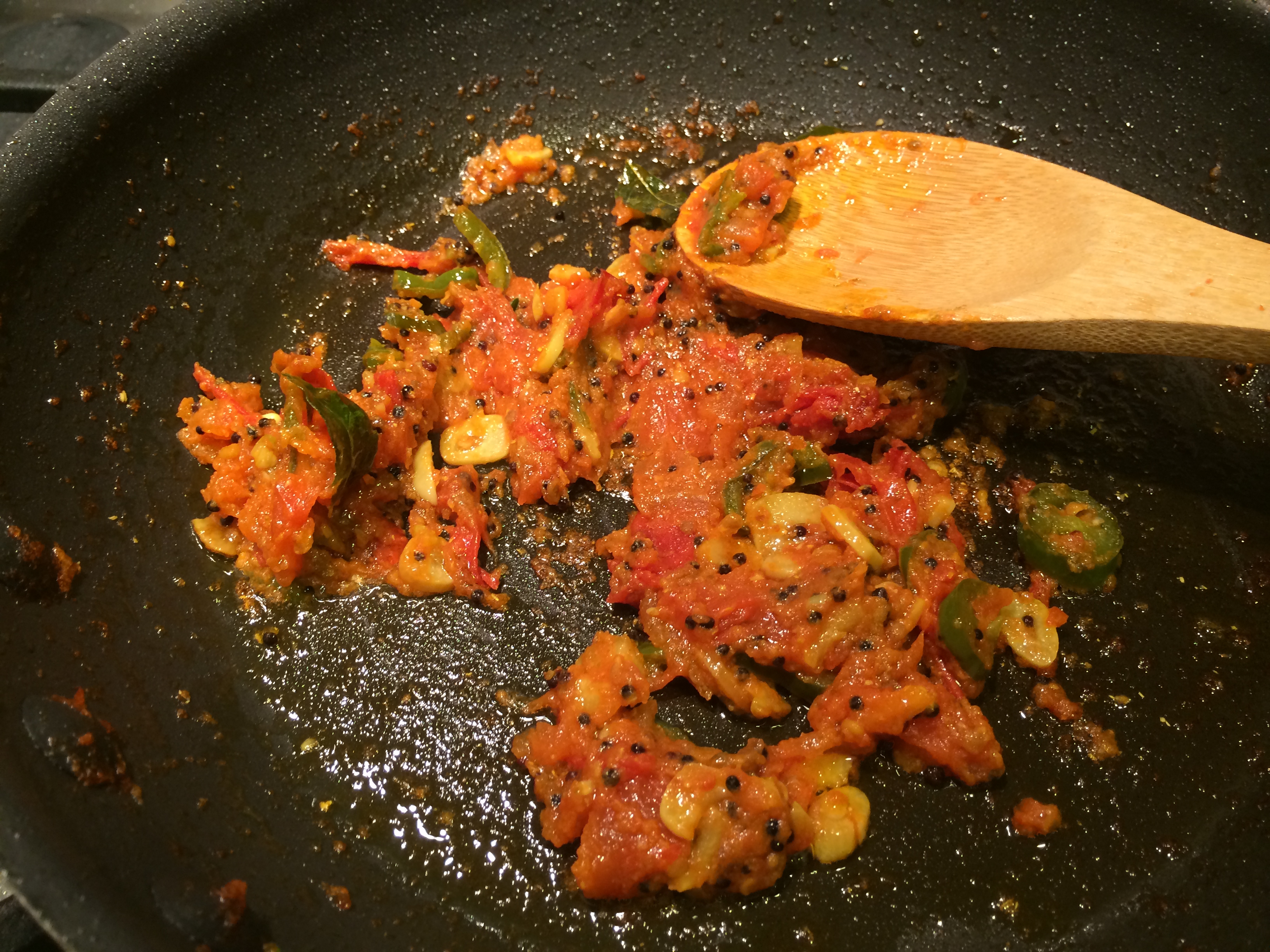
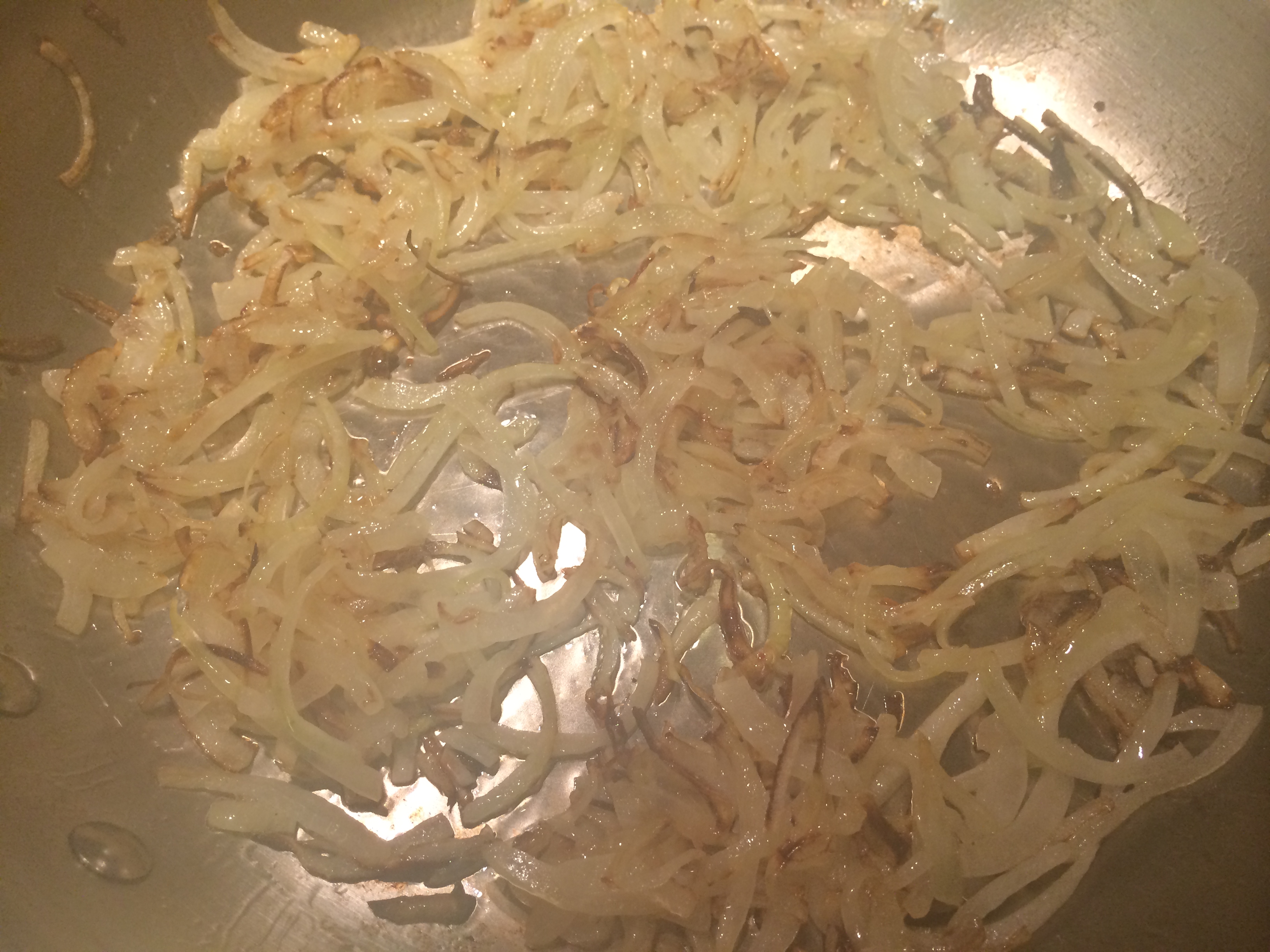
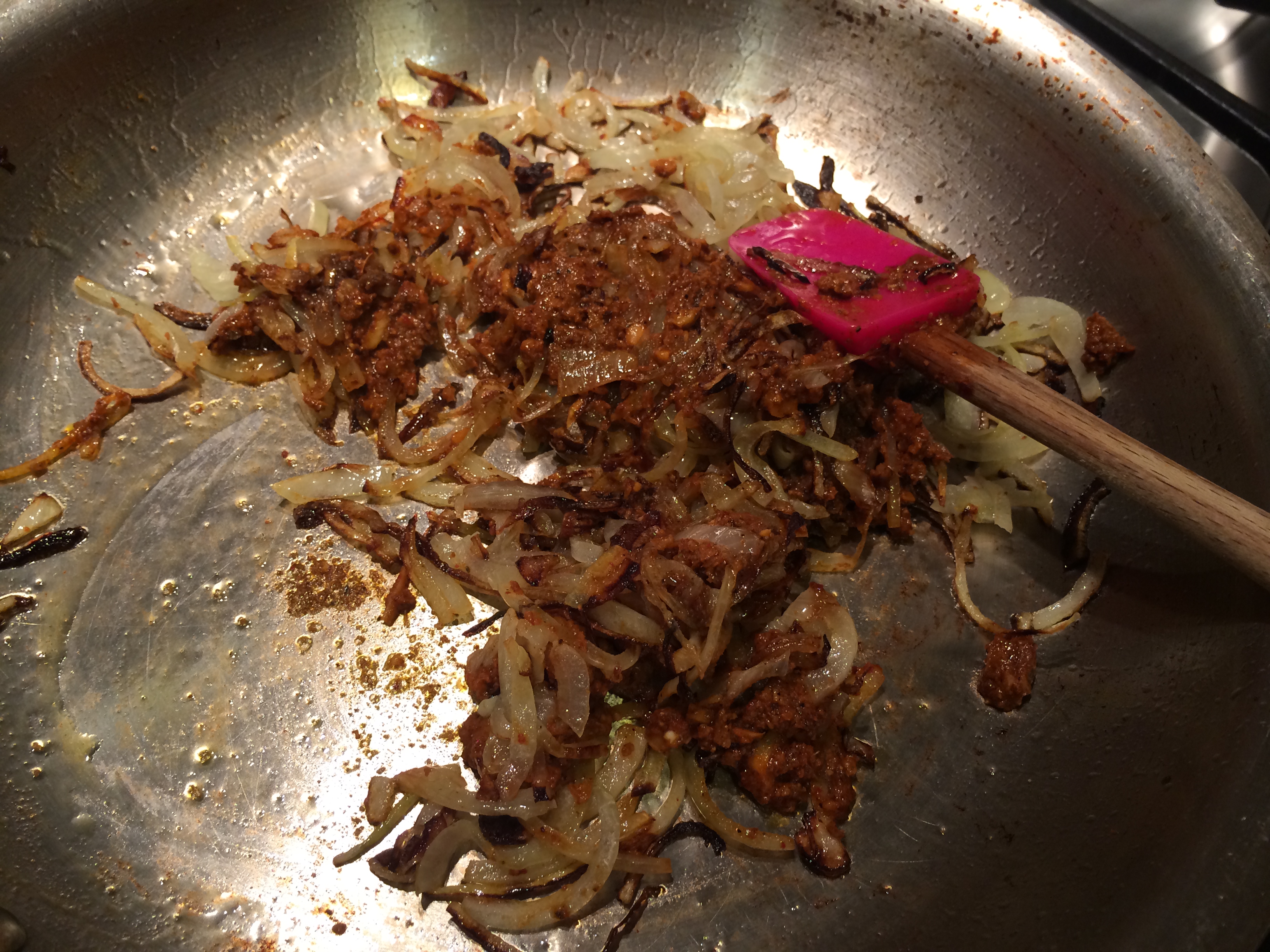
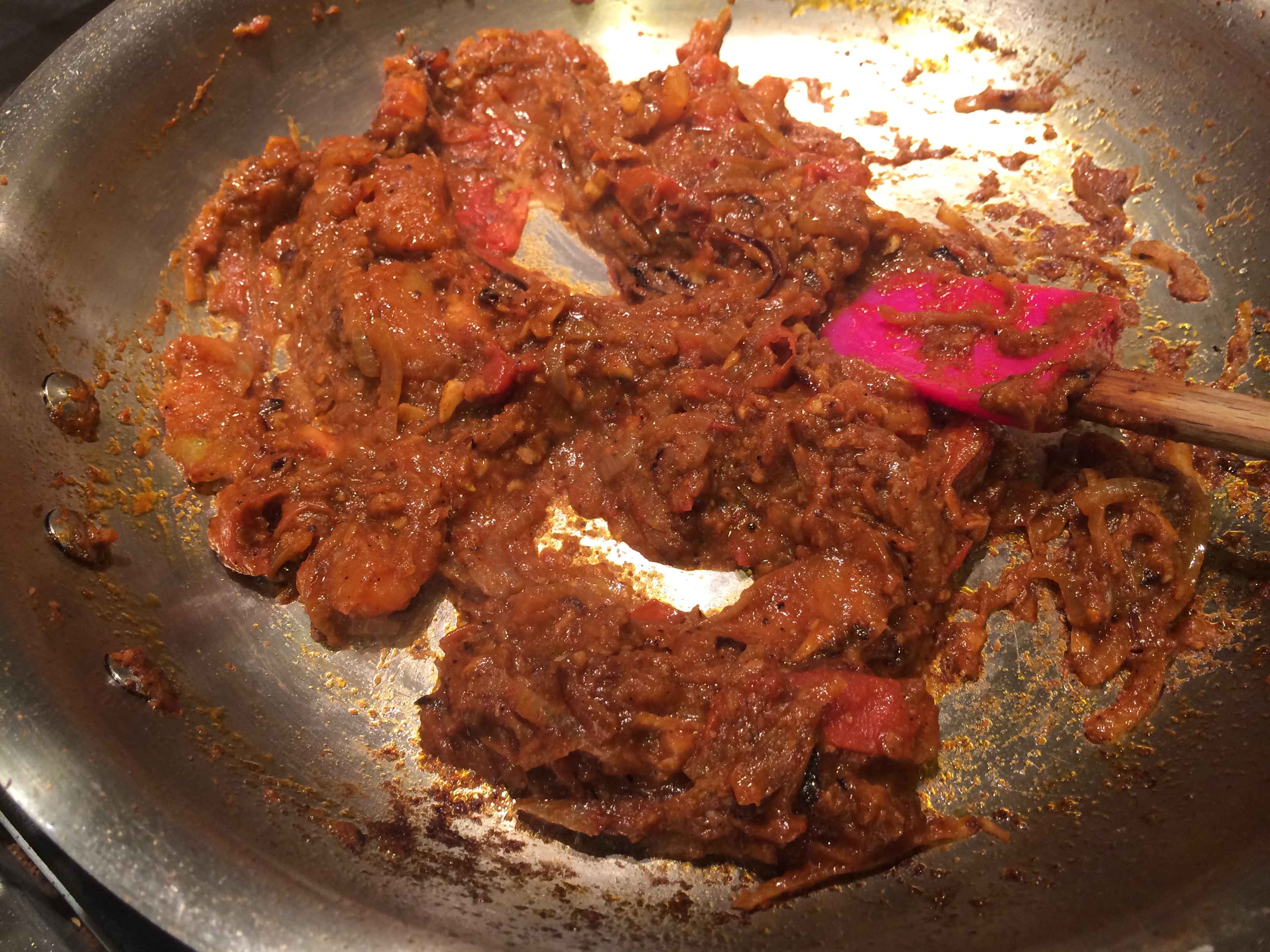
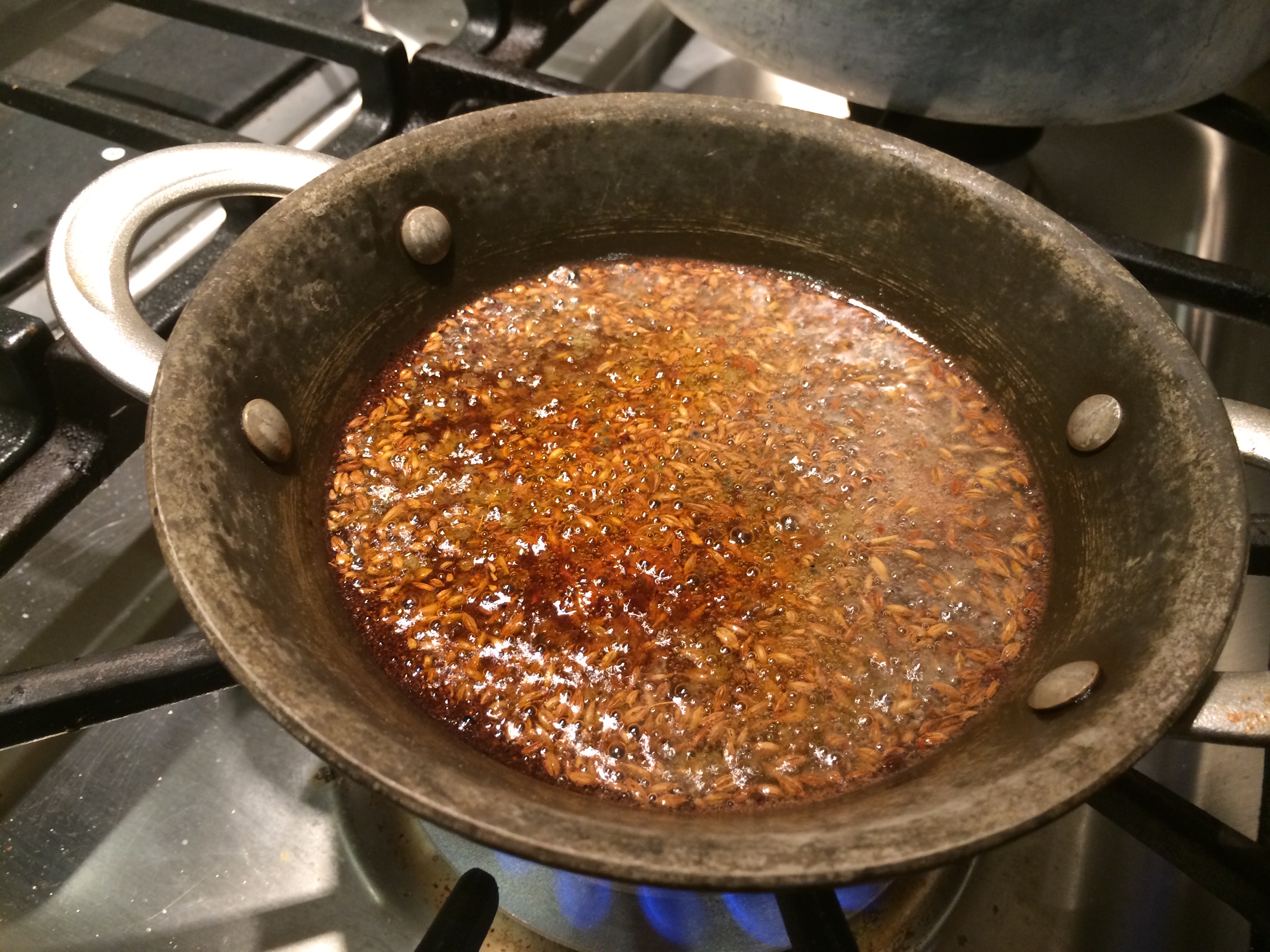
Chop the garlic, slice the chilies. Dice the tomatoes. Heat the oil in a thick-bottomed pot on medium-high heat. When it shimmers, throw in the mustard seeds. When they start to pop, the garlic, chili and curry leaves. The will sizzle and start to shrivel. Now is the time to put the tomatoes in. Stir to coat with oil and spices. Now let it cook for ten minutes or more on medium. No need for lid. First they will liquefy, then boil off the liquid, till they become pasty.

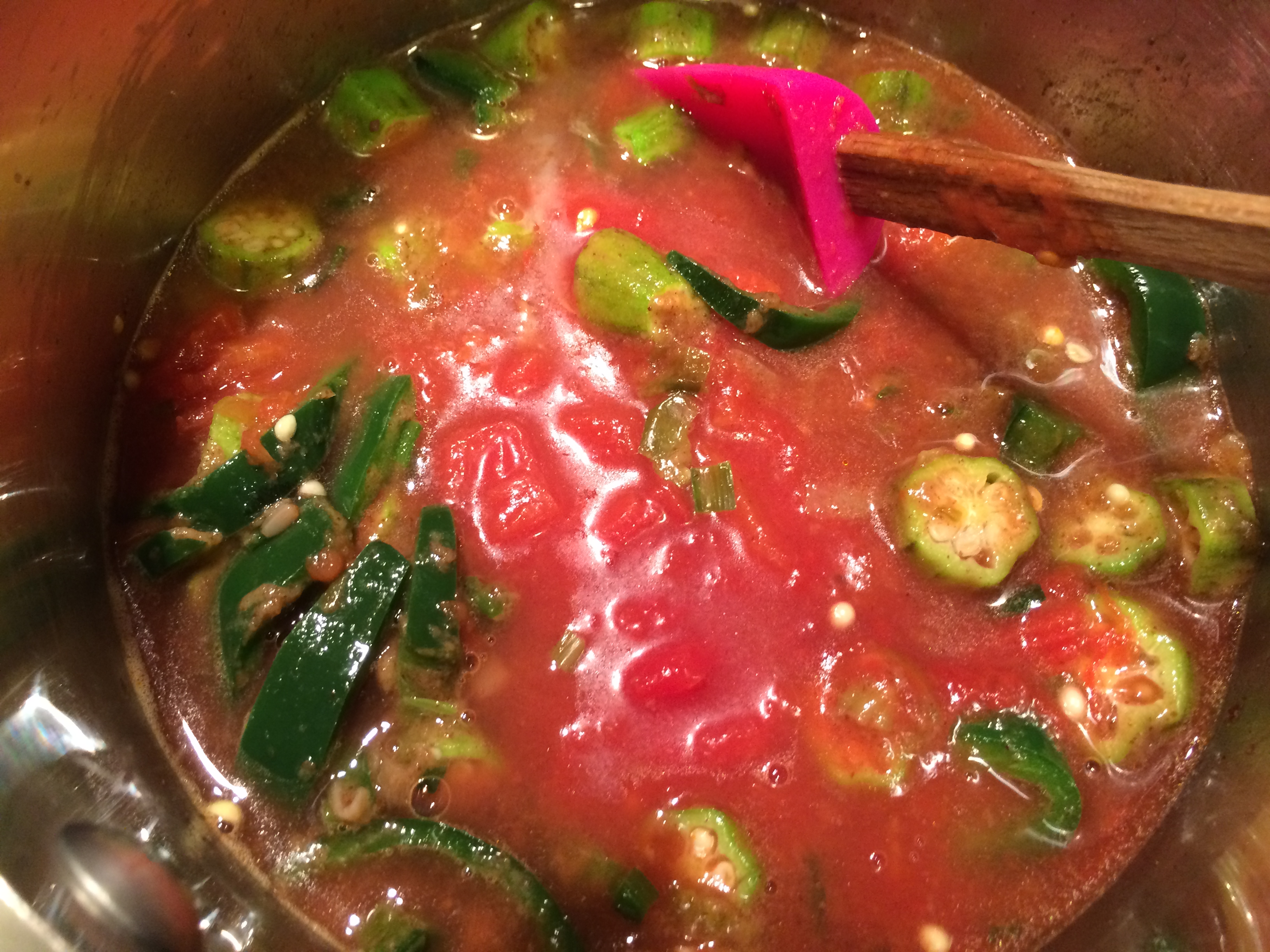
IMG_1066 IMG_1068 IMG_1069 IMG_1071

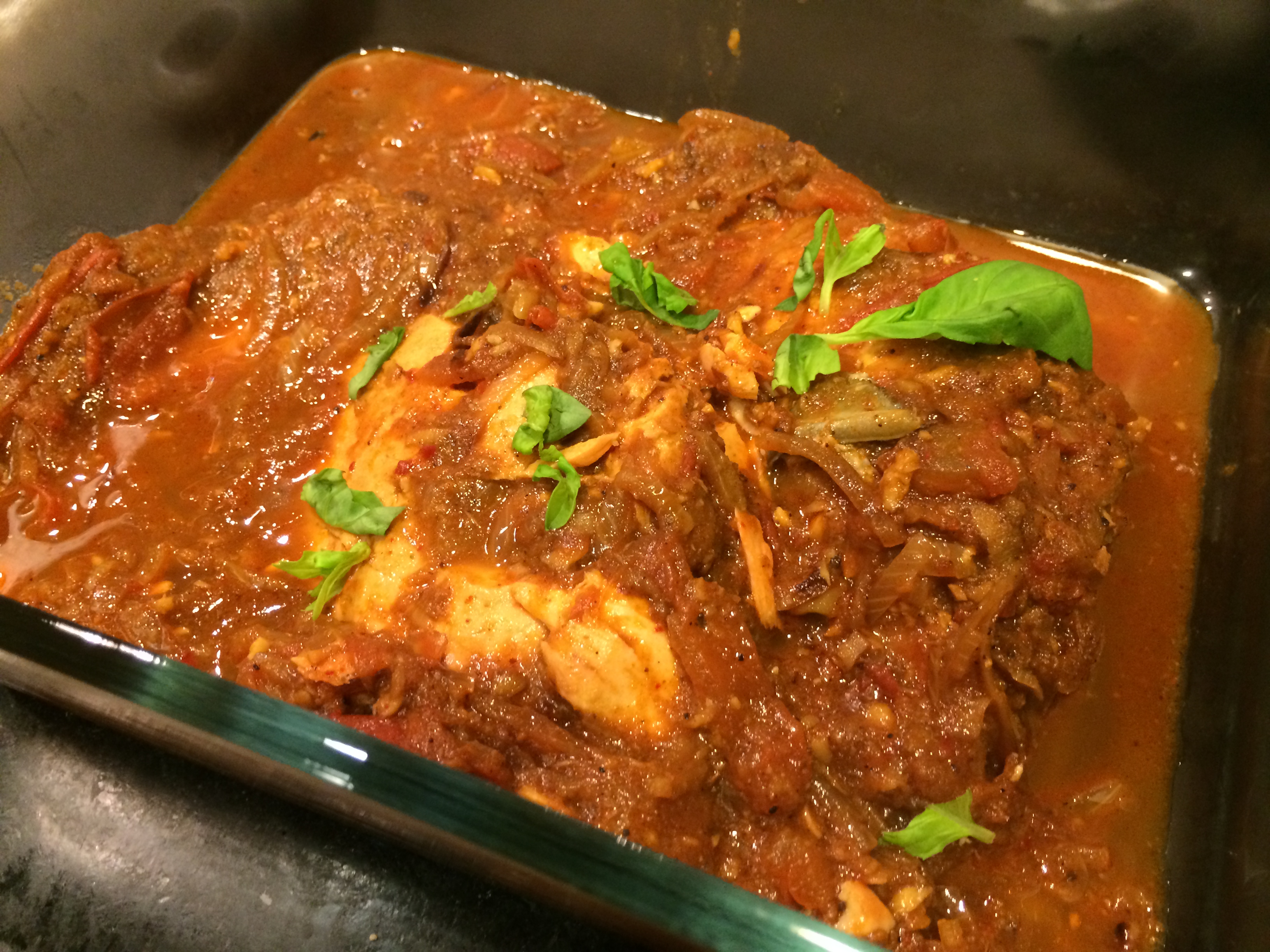
This is how you know when the tomatoes have cooked enough — you see bits of the peel separated from the flesh, rolled up into little sticks. If you look carefully at the completed dish picture you will see them.

Add the dry spices, stir for a minute. Put in about a half cup to a cup of hot water, depending on how wet you want the final result. Let the water come to a boil, simmer for 5 minutes.

The floaters go next…each vegetable must cook for its specific length of time…so this must happen in a choreographed way. Potatoes take about 15 minutes; cauliflowers too; green beans about 10, frozen peas just need to thaw and they are done. So use your judgment on the timing.

This dish is great with chapatis with some moong dal on the side. Cilantro works for garnish.

IMG_1072

Exploring the vegetarian gumbo

Vegetarian gumbo

Vegetarian gumbo

I met a lady from Louisiana over Thanksgiving at my in-laws’ place. Of course, I asked her about gumbo, it being the only thing I know about Louisiana, other than that Louisianians are sometimes inclined to place their banjos on their knees. Well, I’m glad I asked. In her lovely Louisiana accent, she related the story of a dish amalgamated from three different cultures, that has become one of the touchpoints of Cajun people. One browns the flour in grease for hours and hours, constantly stirring, she told me in a faintly challenging tone of voice; of course this made me want to try making it right away.

(By the way — you know how a couple posts ago I threw out this thing about American food not needing a lot of slaving over the hot stove? I knew not whereof I spoke. Because, well, there’s gumbo.)

What is gumbo? People often call it a soup, but from what I can tell it is more of a stew, and eaten with rice. Sometimes seafood is cooked in it, other times meat — never both. But I’m not a huge fan of meat, and the hubby doesn’t much care for seafood. Lucky for us, there is a long tradition of vegetarian gumbos as well, either from the rustic cuisine of people who could not afford meat, or the six-week period of Lent when meat is to be abstained from.

The most interesting thing about gumbo is that each of the peoples that has lived around the Gulf has left their mark on it.

Filé

The Choctaw people have lived around there since the days of the mastodon, which they hunted. If that sounds rather prehistoric, well, it technically is — the mastodon became extinct 12,000 years ago. The Choctaw were intimately familiar with the native plant and animal life around their region; one of the things they contributed to the gumbo is their use of sassafras leaves. This plant (the root of which is the one that gives ‘root beer’ its name) is distantly related to other aromatics such as bay leaf and cinnamon. Sassafras leaves are ground up to make filé, which is used to flavor and thicken gumbo.

Roux

Ten thousand years of sheer Choctaw-ism and then the Europeans show up. What concerns us here, through all the sturm und drang of the European settlement, is the effect it had on gumbo: the small population of French Canadians that were exiled here brought with them some notions of French cooking. This includes roux — the cooking of flour in fat that many French sauces are based on. French cooking tends to use butter, but then the French roux seems to be mostly left pale; for gumbo the roux is cooked for hours till browned, and in that situation the butter would burn, so for gumbo, oils or lard are used instead.

Interesting tidbit — the word ‘Cajun‘ is a corruption of the word ‘Acadian’ — Acadia, Canada being the place that the French Canadians were exiled from.

The holy trinity

Cooking aromatics into the base of the stew is another common European method. The French call it mirepoix and the Spanish call it sofrito. The standard set used in gumbo is called the holy trinity and is made up of equal amounts of onion, celery and green bell pepper (capsicum). This particular set clearly shows the Spanish influence on the region.

Okra and rice

Another set of cultural influences arrived with the Africans brought over through the slave trade. Now once again, many tears and blood have been spilled over this, but what concerns us for gumbo is that the Africans brought over a couple of my old friends to America — my slimy old pal the okra (bhindi) that I have loved since childhood, and rice. West African stews often cook down okra into it with onions and meat: the okra gives off its glutinous slime (I say that with love) to make the whole stew have integrity. Hello, okra. And rice has become the traditional accompaniment to gumbo; there are other rice-based dishes in Cajun cuisine as well (like jambalaya).

Three types of vegetarian gumbo

Now a lot of veteran gumbo-eaters will probably click away as soon as they hear the word ‘vegetarian’ spoken before gumbo. But for the rest of you, here are three that I made. Since this was my first time making gumbo, I tried to keep it very simple, and not add too many flavorings; at the risk of sacrificing flavor, perhaps, but all the better to learn the basic palate of these few key ingredients. I also used whole wheat instead of white flour, because I am a bit of a fanatic. The only difference it made is that I believe the final result was a bit grittier than it would be with white flour.

The Gumbo base

The amounts specified here can form up to four separate gumbo meals for two.

Ingredients:

  • 1/3 cup fat (oil or ghee or lard — I used lard)
  • 1/2 cup whole wheat flour
  • 1 medium onion
  • 2 sticks celery
  • 1 medium green bell pepper (capsicum)
  • 1/2 teaspoon salt

Method:

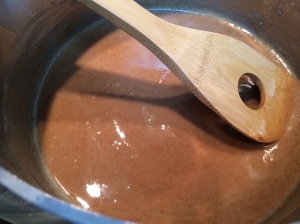
Heat the fat in a thick-bottomed pot and when it melts, put in the flour. Stir to combine into a paste. There, the roux is underway. Now the idea is that it has to go from a blond color to a dark chocolate brown. For me, this took about two hours, because I had the heat on medium to medium-low, which made it so that I could stir it every minute or so. If you are willing to stir it every ten seconds or so, you can have the heat higher and it will be done faster.

So in about two hours I went from this to this. Remember I started with whole wheat flour so it was already brownish from the beginning.
IMG_1034 IMG_1039

Now chop up the vegetables into little dice and put it into the pot along with the salt. Even if the roux had been calmly cooking away, you will notice that upon entry the vegetables will immediately sizzle, showing how hot the fat really is. In about 20 minutes of cooking, the vegetables soften down and the gumbo base is done.

IMG_1035 IMG_1037 IMG_1040 IMG_1041

I divided the gumbo base into 4 quarters to store. Each quarter can be used to make an entire gumbo meal for two people. Each quarter will take about 2-3 cups of additional liquid (water, stock, milk); so using that hint you can make any gumbo dish. The resulting meal, once the base is done, is very quick and can be easily put together on a weeknight.

1. Greens-okra Gumbo

Greens and okra gumbo

Greens and okra gumbo

In this gumbo, okra is cooked into the stew and greens are added later. I love the earthiness that okra adds here. Instead of pureeing the greens as is often done, I left them in ribbons, and enjoyed that textural variation. A little vinegar is added at the end for some brightness.

Ingredients: 

  • 2 quarters of the gumbo base from above
  • 1/2 pound okra, destemmed and sliced
  • 1/2 teaspoon paprika
  • 1 bay leaf
  • 1 teaspoon salt
  • half a bunch mix of greens, sliced into ribbons (mustard, kale, spinach, chard, etc.)
  • 1 tablespoon white vinegar

Method:

Heat the gumbo base in a pot. Once it is hot, add about 5 cups of hot water, little at a time, after each time stirring the roux into a paste. This is the classic French method of making béchamel sauce, except that the liquid in that case is milk. Once all the water has been incorporated — this will take a few minutes — bring to a low boil. Add the okra, the paprika, bay leaf and salt. Boil for half hour to one hour on a low boil. Now add the greens. They only need to cook for ten minutes or so. Add the vinegar, taste for salt, and you are done.

IMG_1042 IMG_1044 IMG_1045

2. Cabbage Gumbo

Cabbage is found as an ingredient in some older recipes from the region and has lately gone out of style…why? Because — cabbage! Come on! Well I’m pretty déclassé myself so this recipe definitely attracts me. Milk is used as the liquid this time. Also this time I used filé powder at the time of serving; it thickens and adds a herbal something.

Ingredients:

  • Quarter of the gumbo base recipe from above
  • 1/3 head of cabbage, shredded
  • 1 serrano or jalapeno chili
  • 2 cups milk
  • 1/2 teaspoon salt
  • 1/2 teaspoon filé powder

Method:

Heat the gumbo base in a pot along with the serrano chili, sliced. Put in the milk in the style of béchamel sauce, stirring to combine into a paste each time, making sure that there are no lumps. Once all the milk has been added, bring to a low boil. Add the cabbage and salt. Let it cook until the cabbage is softened, about 20 minutes. Serve with rice and some filé powder, which is to be stirred in.
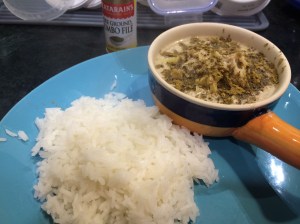
Cabbage gumbo

Cabbage gumbo

3. Tomato-okra Gumbo

Most of you won’t care one whit but I guess I am dipping my toe into controversy. Some people don’t consider that tomatoes belong in a gumbo at all, but then I find tons of tomato gumbo recipes on the interwebs. So here it is, for what it is worth. Authentic or not, it was delicious.

Ingredients:

  • Quarter portion of gumbo base from above
  • 1/4 cup dry red kidney beans
  • 3 – 4 cloves garlic (I used several sticks of wild garlic)
  • About a dozen pods okra, sliced
  • 1 pasilla pepper, sliced
  • 1 cup thick tomato purée
  • 1 teaspoon salt

Method:

Soak the red kidney beans overnight, or, in very hot water for an hour. Then put them in a pot with about a cup of water, bring to a boil, cover and simmer for half hour or so till softened.

IMG_1194

Put the gumbo base in a pot on medium heat. Once it is hot, sweat the three vegetables in it, one by one: first the garlic for a few minutes, then the pasilla peppers, and then the okra. Now in goes the tomato purée along with a cup and a half of extra water. If you had any water left over from cooking the beans, now is the time to add it. Add the salt. Bring to a boil, leave at a simmer for at least half hour, or as long as you want, until the vegetables are as softened as you like. In the last ten minutes of cooking, put in the kidney beans to meld its flavors together.

IMG_1193 IMG_1196

So what did my adventure with vegetarian gumbo teach me? It can be done with excellent results. My husband enjoyed all three gumbo meals; he never once asked ‘where’s the meat?’ But he is so spoiled with Indian food that he did ask — ‘where’s the masala?’ I guess that is a compliment?

Tomato Gumbo

Tomato Gumbo

I referred to several webby recipes for Gumbo. Here are some of them.

http://www.nola.com/food/index.ssf/2010/05/cabbage_gumbo.html

http://www.101cookbooks.com/archives/vegetarian-gumbo-recipe.html

http://www.gumbocooking.com/veggie-gumbo.html

Late breaking news:

Of course, the lard makes it not be vegetarian! Please use ghee for a ‘pure’ vegetarian experience. Or a good oil with a high smoke point. I used lard because I had some in the freezer, but then I’m not big on purity (of any sort!) I just like the taste of vegetables and am not keen on the taste of meat.

My Parathas turned Purple

IMG_0940

I have a huge amount of respect for nutrition scientists. But one can sense that in food, they have met a worthy adversary.

Carbohydrate, fat and protein

WHO Food pyramid

WHO Food pyramid

There were the days when they confidently issued proclamations about ‘food pyramids’ that could be rendered in the colors available in a child’s crayon pack. There was carbohydrate, fat, and protein. Various experiments were performed on unsuspecting dogs and rats that led them to believe that out of the three, protein was the one true nutrient.

Then came sailors and prisoners who were given protein enough, but were afflicted with swollen gums, purple spots, and finally, death. This disease was called scurvy. This disease had been known since the Roman times, and had often been treated with herbal cures such as lemon juice. Another time, a sailor stepped ashore and ate some cactus fruit, and found that it had curative properties too.

The vitamins

So what was it about lemon juice and cactus fruit that had the magical property to cure scurvy? Surely, they thought, since scurvy was a disease of ‘putridness’, whatever that means, and clearly, acid cuts ‘putridness’, it has got to be the acid in lemon juice that does the trick. So they began dosing sailors with diluted sulfuric acid and vinegar, to no avail. This acid treatment went on pointlessly for years, apparently, until a doctor named James Lind had a forehead-smacking moment and realized the sulfuric acid was doing more harm than good.

James Lind feeding citrus fruit to a scurvy-stricken sailor aboard HMS Salisbury in 1747 (Artist: Robert A Thom)

It was through such nightmarish means that scientists were forced to accept that the complexity of nutrition went beyond the big three of fat, carbohydrate and protein, and the ph dimension of alkaline and acid. By the early twentieth they had identified nutrients that were given the name ‘vitamins‘ which meant ‘force of life’, or something. Vitamin C cured scurvy while Vitamin B cured beri beri and pellagra; others were discovered too.

So food science climbed up the ladder of complexity, but you can tell how many nutrients they expected to find in food, because they started naming them after the alphabet. There may be ten, there may be twenty, surely it would not go beyond A through Z, right? They found 13 vitamins.

Phytonutrients

The farther one goes, the farther behind one gets. Now they have identified so many nutrients that this layperson (me) has lost all hope of catching up.

Phytonutrients‘ is the name used to describe all kinds of nutrients available only through plants. They help plants perform all their planty duties: fight germs, fight aging, fight toxins, stay alive, in other words. They give the plants their colors; their smells; their pungency. When we eat plants, we get the benefit of these chemicals too, for surprisingly similar functions.

Now there is a type of phytonutrient that is a pigment that gives plants a purple color (anthocyanins). There is tons of tantalizing research about how beneficial these pigments are for us. There is evidence from folk medicine — hibiscus has been used for liver dysfunction, while bilberry has been used to cure night-blindness. There is evidence from the test-tube that the purple pigment prevents the growth of cancer cells. There is evidence from tests on rats that the purple aids in cardiovascular health.

The pigments have antioxidant properties, so that is one reason why they might have so many benefits. But scientists are now alive to the dangers of accepting the simple explanation. These pigments belong to a set of 4000 other compounds called flavonoids; plants use all of them in concert to perform various functions through their lives. So it is not just this or that chemical that provides this or that benefit; it might be any of the 4000 thousand put together that does it. So it isn’t the purpleness itself; it is the army of its cousins working together in the plant.

That makes sense — plants do not live on vitamin supplements. They use whatever they’ve got in whatever combination they can, to do the things they need done. If we eat those plants, we ingest those chemical complexes and gain similar benefits.

We have come a long way from the time scientists dosed sailors with vinegar. Now one can imagine them shaking their fist and saying, ‘Just — just go eat purple food.’

Well, that’s easy.

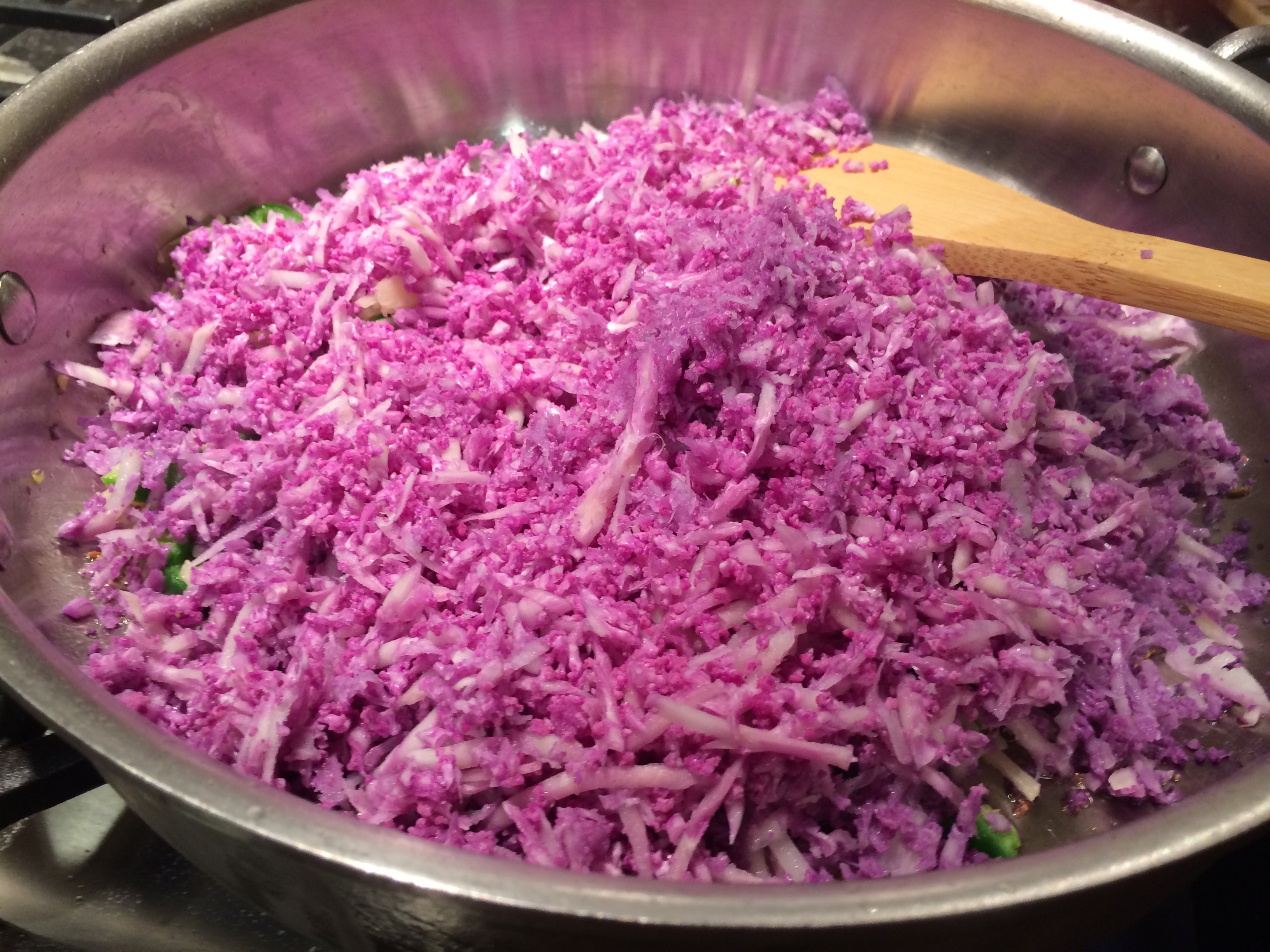
My purple parathas

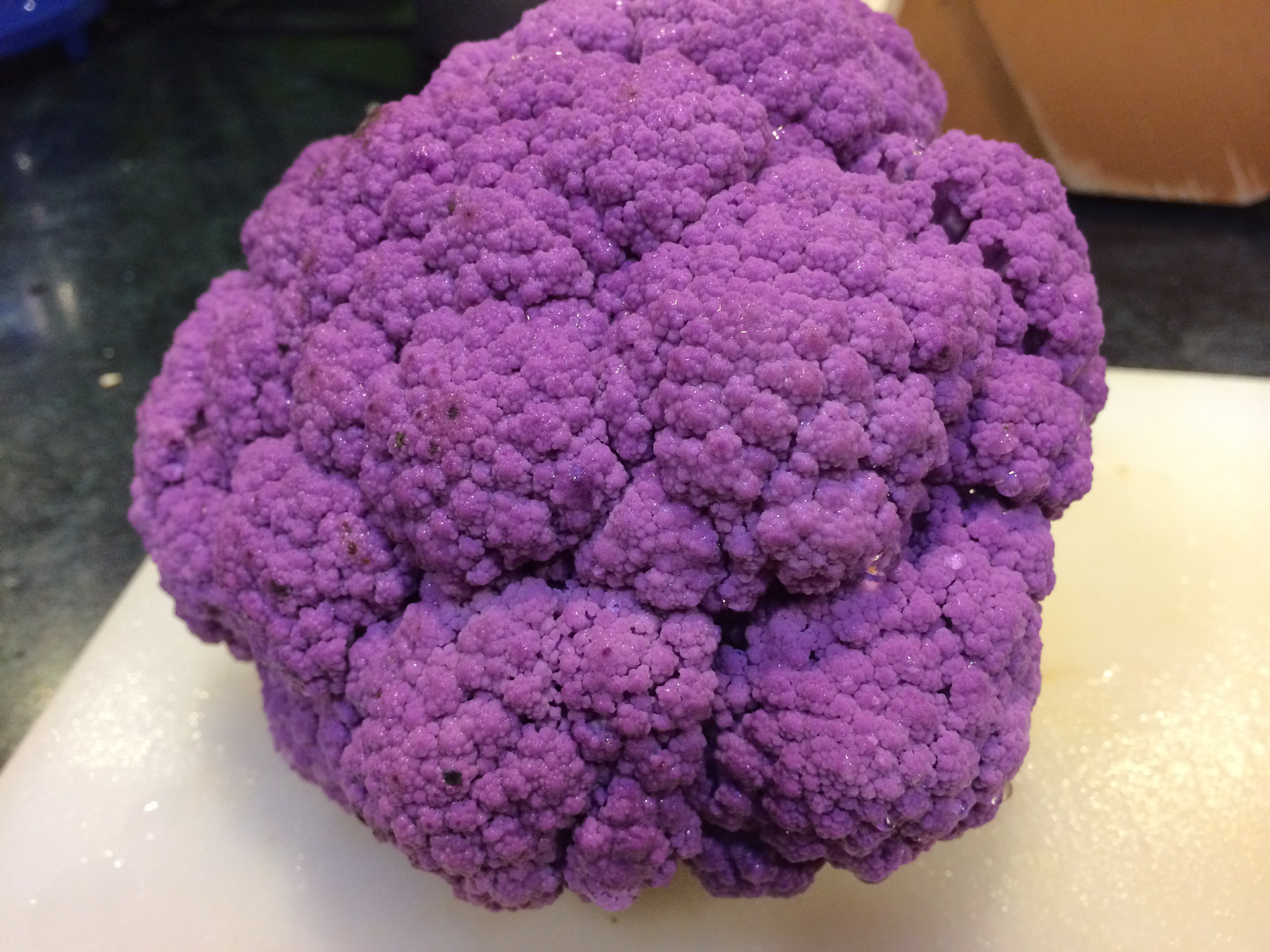
I love stuffing cauliflower or potato into rotis to make parathas. Eating them with plain yogurt is soul-satisfying. But on this day, I made them purple.

Ingredients for the roti:

  • Have a look at this recipe (Rolling the Roti) and make as much as you need. I made 2 potato parathas and 8 cauliflower ones = 10 rotis total.
  • Oil or ghee as needed.

Ingredients for potato filling (for 2 parathas):

  • 1 medium purple potato
  • 1 – 2 tablespoons finely chopped onion
  • 1 tablespoon finely minced cilantro
  • 1 small green chili sliced, or substitute with half a teaspoon red chili
  • 1 teaspoon chaat masala
  • Salt to taste

Ingredients for cauliflower filling (for 8 parathas):

  • About 4 cups purple cauliflower florets
  • An inch of ginger, minced fine
  • 1 – 2 green serrano chilies
  • 1 tablespoon oil
  • 2 – 3 teaspoons chaat masala
  • 3/4 teaspoon salt
  • Half a teaspoon cumin seeds (optional)
  • Sprinkle of asafetida (optional)

Method for potato filling:

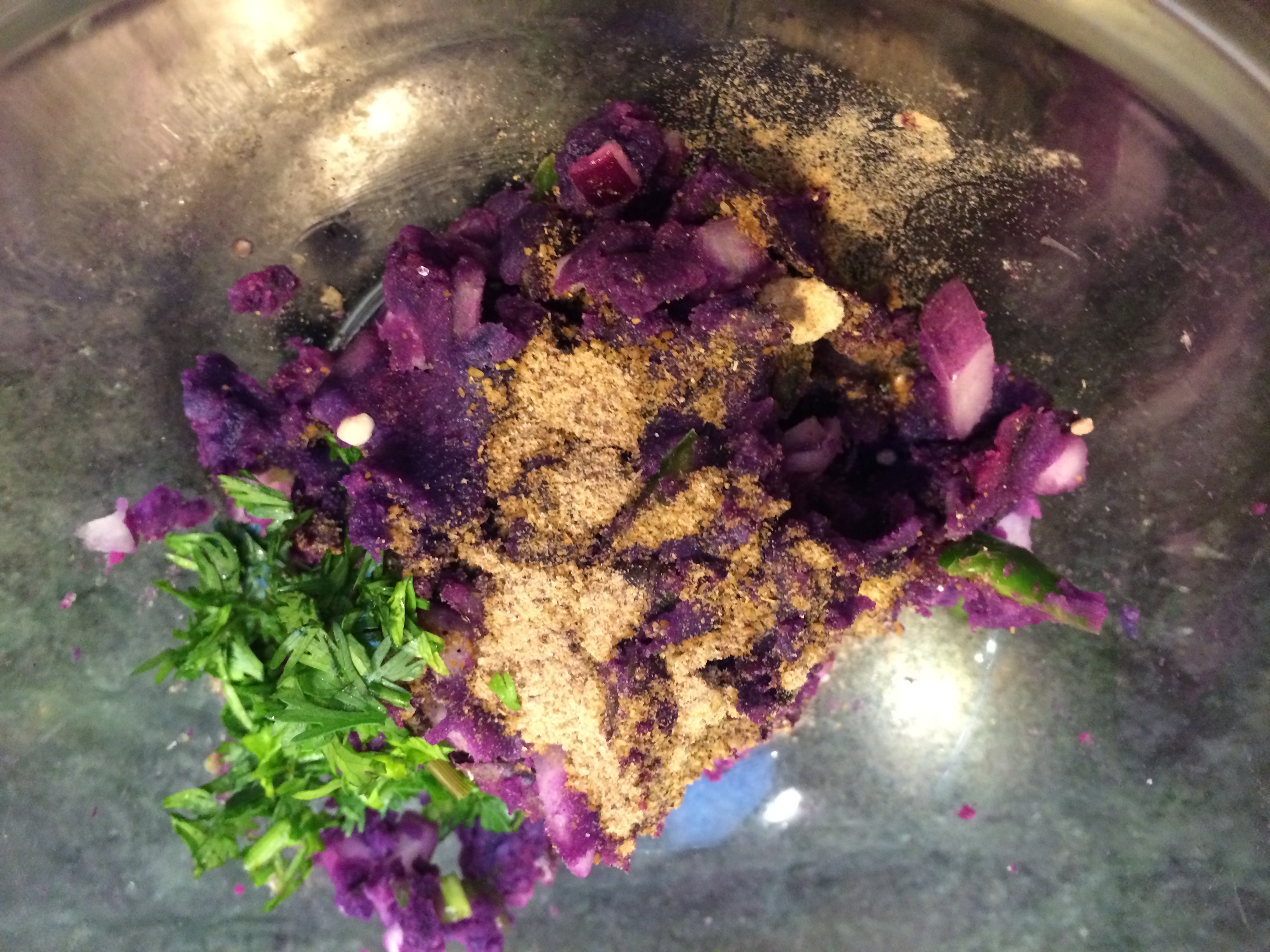
Microwave the potato until it is soft. Mash it, peel and all. Mix in the other ingredients, squeeze it into a sort of dough, and divide into two disks. The filling is ready, each disk will go into one paratha.

IMG_0932 IMG_0933

Method for cauliflower filling:

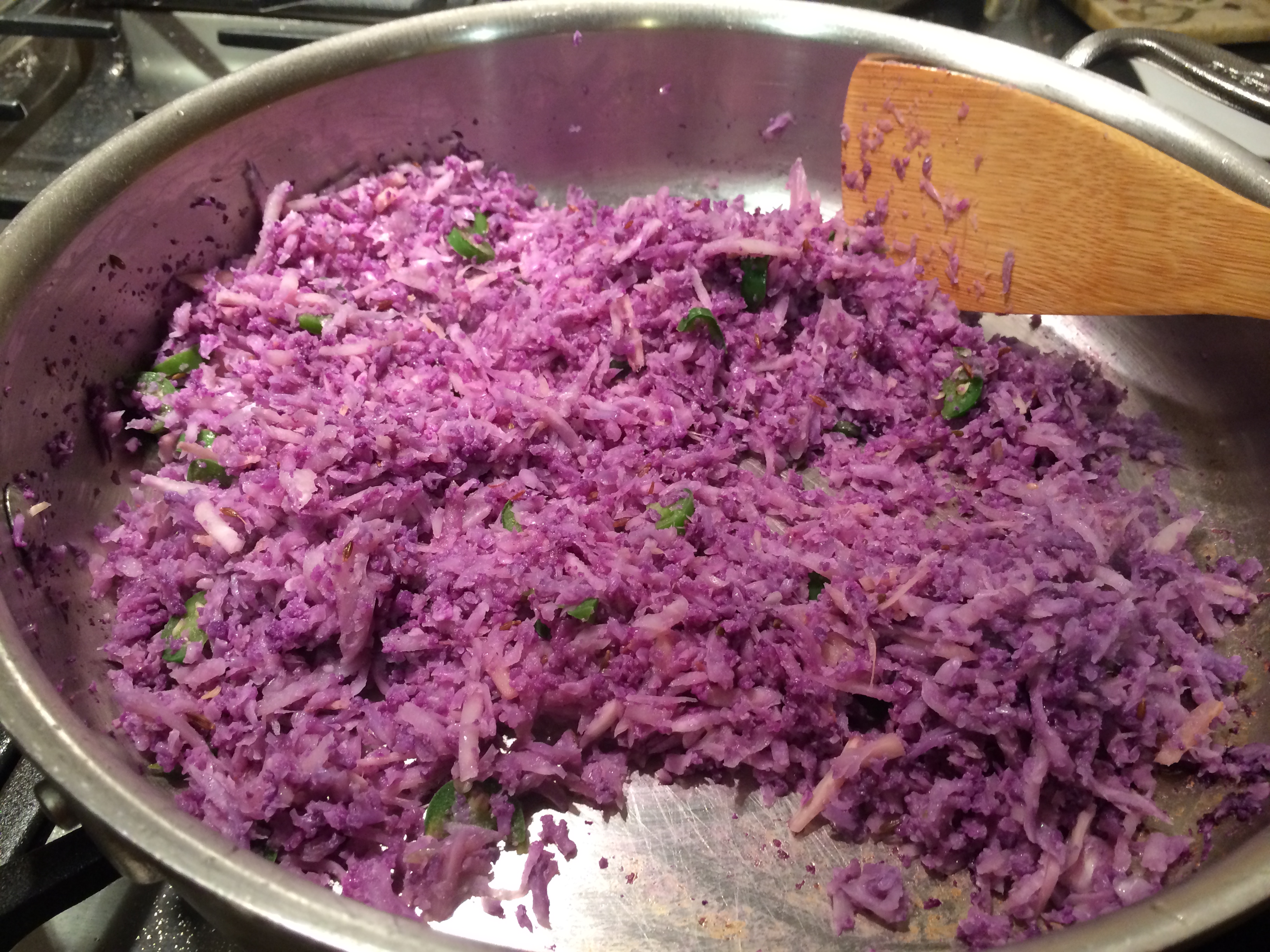
Grate the cauliflower, mince the ginger and chili. Heat the oil in a large thick-bottomed pan on medium heat. When it shimmers put in the asafetida and the cumin. When they sizzle put in the ginger, chili, and grated cauliflower. Stir to coat with oil. Add the salt and the chaat masala. Raise to heat to nicely dry the cauliflower. It is very important to get the cauliflower to be as dry as possible, or it will make your life hell while rolling out the parathas. When it is dry enough, turn off the heat and let it dry.

IMG_1022 IMG_1023 IMG_1024 IMG_1025 IMG_1026 IMG_1027

Method for composing the parathas:

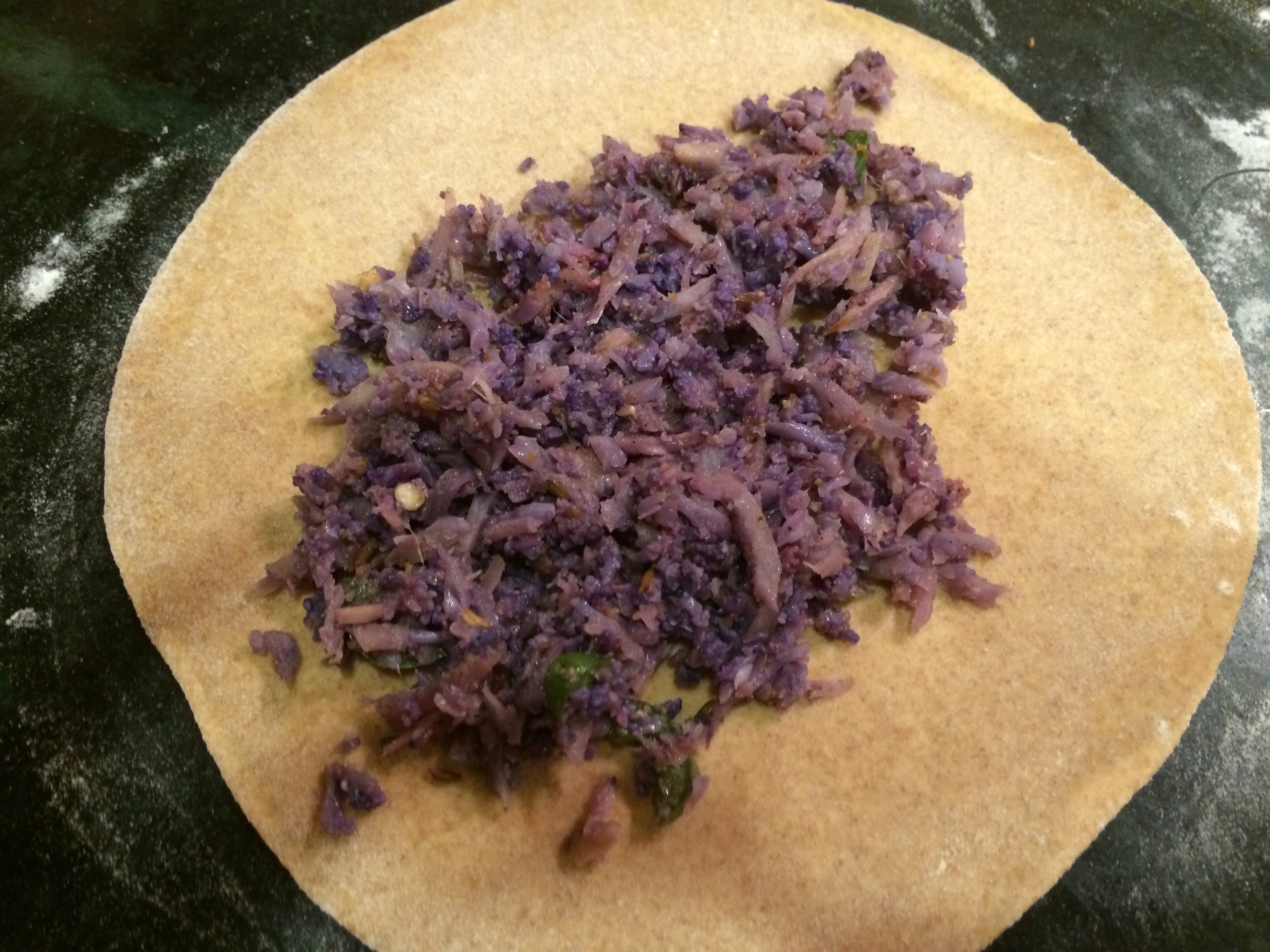
Roll out a roti about 6 inches in diameter. Place the right amount of filling in the center. For the cauliflower it is about 3 heaped tablespoons, for the potato filling it is about a 2 – 3 inch disk of potato. Gather up the edges of the roti and give it a squeeze. Flatten the pouch into a disk and start rolling it flat with the filling inside.

IMG_0934 IMG_1028 IMG_0935 IMG_0937

While rolling parathas the ever-present danger is that the filling will come squeezing out like toothpaste out of a tube. One must learn to avoid that. One way is to use a very gentle hand while rolling — you don’t want a few long, weighty rollings, instead many quick, darting, gentle rollings. Use dry flour as needed to patch up holes.

The ideal paratha, when rolled out, has such a thin roti cover that one can see the filling peeping out in various places, but it doesn’t actually fall out. Keep your eye on that ideal.

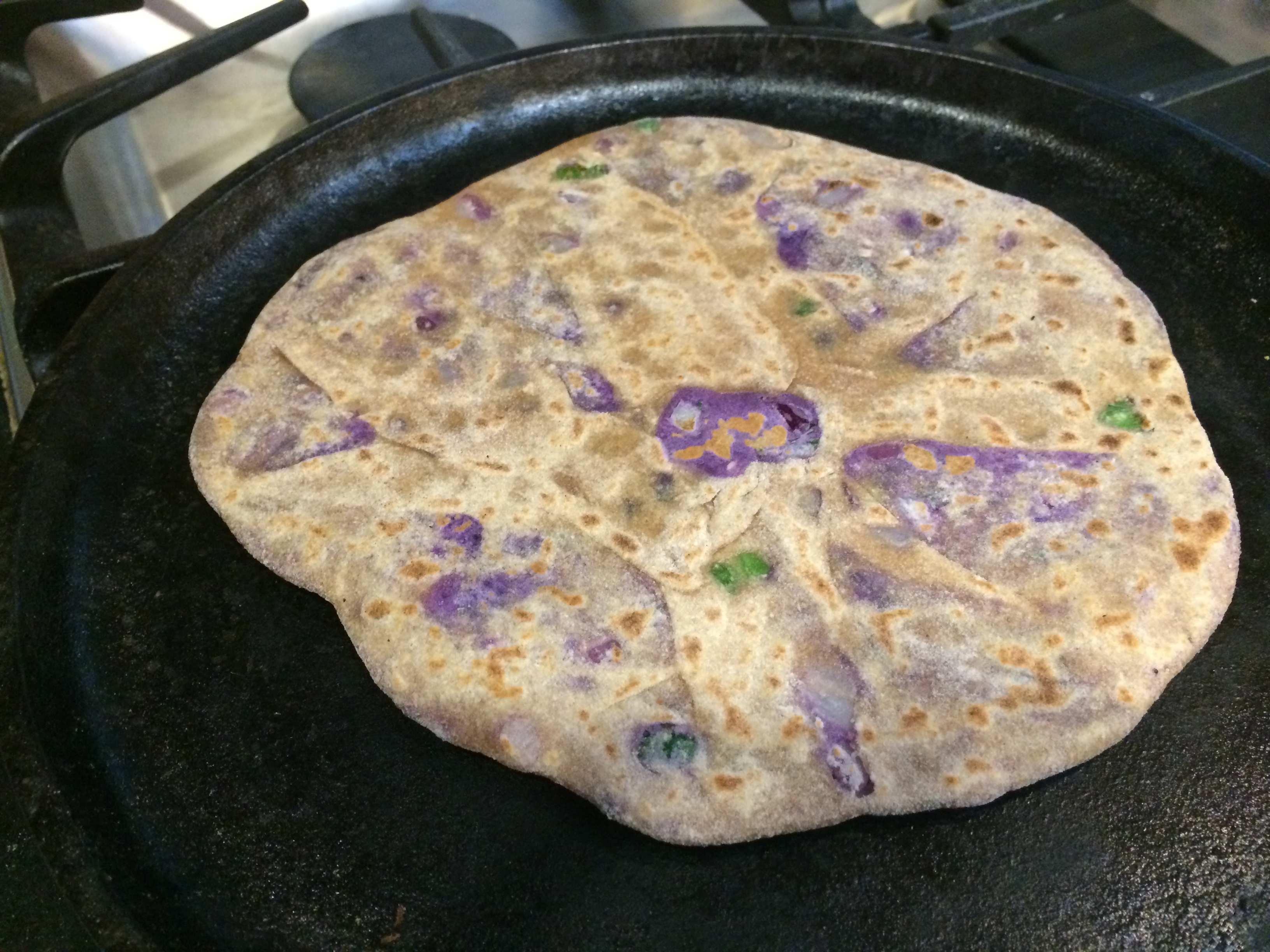
Meanwhile have a cast-iron griddle or tawa going on a medium-high flame. Slap a prepared paratha on. After 30 seconds, the top surface will seem a little set. Flip it over. Wait 30 seconds. Now spread a bit of oil or ghee over the top surface and flip it over for another 30 seconds. Repeat. In total, each side has been cooked dry twice, then cooked with oil twice.

IMG_0938 IMG_0939

While one paratha is cooking, did you think it was time to stand around and have a coffee break? No, my dear, get busy rolling out the next one. When one gets practiced one can have two griddles going at once.

IMG_1031

Have it with some plain yogurt on the side, nothing else is needed.

Malvani gravy with Salmon and a creepily Moving Finger

“The Moving Finger writes; and, having writ,
Moves on: nor all thy Piety nor Wit
Shall lure it back to cancel half a Line,
Nor all thy Tears wash out a Word of it.”

— Omar Khayyam

I call bullshit on that. We are in the interwebs, people, and the Moving Finger can do what it damn well pleases. So it did. I used my Malvani spice paste to make a nicely-flavored gravy in which I floated some salmon; but I also used the opportunity to tighten up my ingredients list for the spice paste itself. So a post from months ago has been updated with more precise amounts and, ahem, better formatting. Check it out. Take that, Omar.

IMG_1018

I also made another discovery — this spice paste that we had used at home forever, taught by our Malvani cook, is actually none other than the famous Goan Xacuti masala; which in turn is none other than the Portguese Chacuti — but apparently not the Portuguese from Portugal, but the Portuguese from Goa when it was colonized. Learn something everyday. Also enables me to correctly tag this post.

Malvani gravy with Salmon (Goan Salmon Xacuti)

Now anything can be put into this gravy; usually some kind of flesh; but I don’t see why vegetables or paneer or tofu might not belong either. I used salmon and this made enough for a dinner for two along with white rice.

Ingredients:

  • 3/4 pound salmon (steak or fillet)
  • 3 tablespoons Malvani masala
  • 1 small onion
  • 2 medium tomatoes
  • 2 tablespoons oil
  • 3/4 teaspoon salt

Method:

Slice the onions thinly and fry in the oil until somewhat browned. Read this for the proper method. Put in the Malvani masala at this point and stir and cook it on medium heat for a few minutes. Dice the tomatoes and put those in. Let them cook to the point they liquefy and dry up.

IMG_1009 IMG_1010 IMG_1012 IMG_1014 IMG_1015

Now this base must ‘lose its raw smell’ as my mother said; which means, must be boiled with about 3/4 cup water added in. Boil it on a simmer for about 5 to 7 minutes.

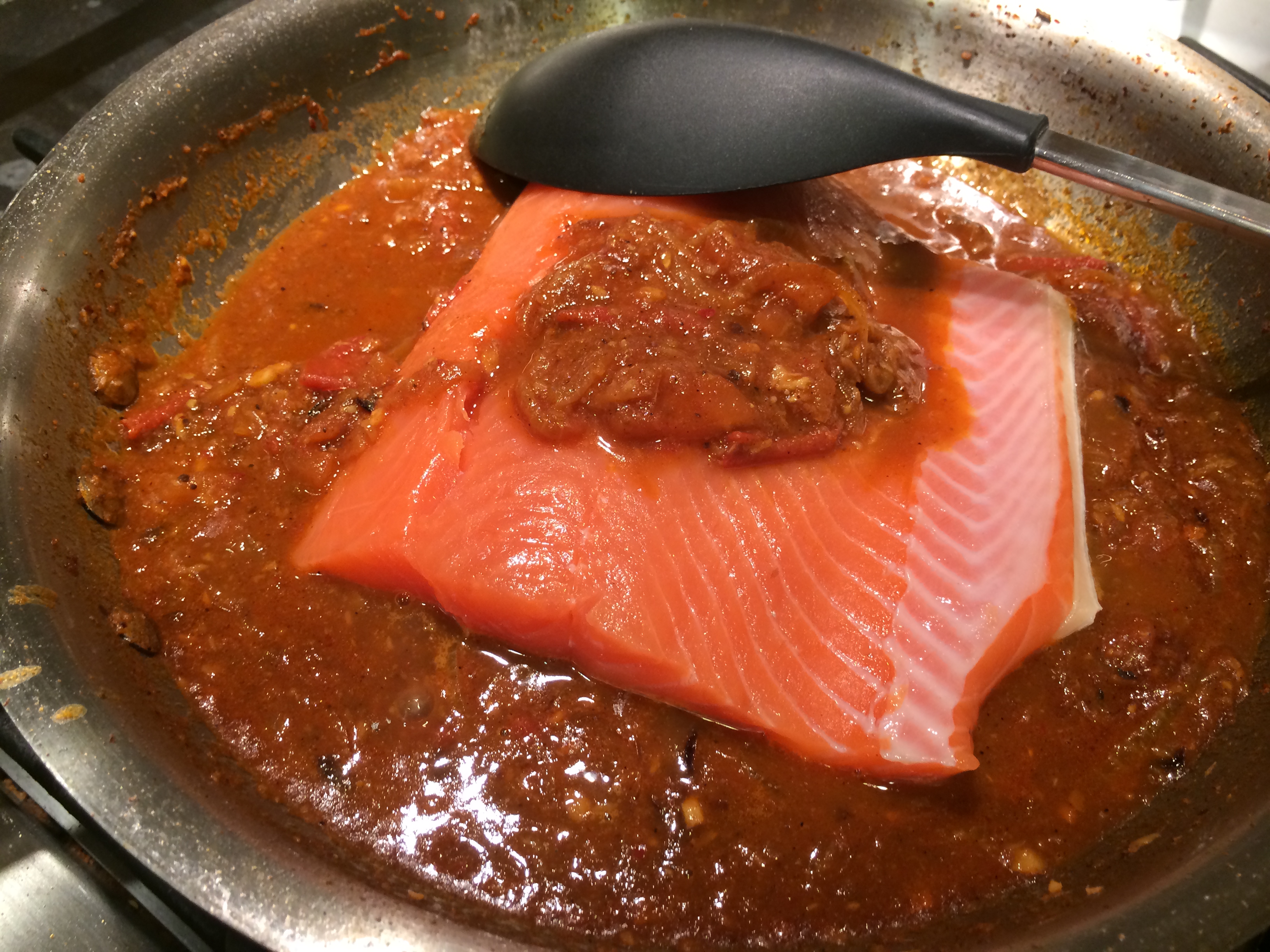
Now the salmon makes its entry. Sprinkle the salt over and cover with the gravy. Keep the gravy at a low simmer, cover and cook for about ten minutes.

Any greens might work for garnish but I used basil.

IMG_1016 IMG_1018

A meditation on tempering and a good-tempered moong dal

IMG_0824

Very little meat is eaten in India; many families are entirely vegetarian, but even the others (like mine) hardly got around to buying meat for the dinner table once or twice a month. I have met a lot of people in the United States who find that hard to believe. In this country all three meals are sometimes centered around meat. In addition to forming the main course, meat products are used to flavor the food: whether it is the use of chicken broth, or bacon cooked into the sauce base or thrown on salad, or ham hocks as a base for tough greens like collards.
Many modern cooks here are learning to leave aside the bacon in favor of aromatics like onion and garlic. In my mother-in-law’s generation people were a little afraid of these ‘strong’ and ‘aggressive’ flavors; nowadays, they generally lead to a flurry of swooning.

But what if you were to leave out the meat, leave out the eggs, then in a fit of pique throw out the onions and garlic too?

What would food taste like then? Is one supposed to develop a taste for grass? Well it turns out that this type of cuisine is one of the most flavorful in the world. Jain food, which is pretty much synonymous with the Sattvic or ‘pure’ food of Hinduism, leaves out any foods that might cause harm to other creatures; clearly this is an extremely high bar, but in practice, that means no meat, eggs, fish, onions or garlic.

That still leaves the wide world of vegetables (including my beloved cauliflower), all kinds of lentils (dals), grains from wheat and rice to millet and sorghum, the nutty fragrance of ghee, and of course what India is famous for, which is spices.

Tempering

My personal opinion — the ingredients are great and all. But really what sets apart Sattvic cuisine and Indian cuisine in general is the technique of tempering. Known by various names — tadka, chhaunk, bhagaar or vaghaar — this is the method of heating fat and throwing in whole spices until they release their essential oils.

Most non-Indian people ask me if I grind my own spice mixtures for Indian food. The answer is yes, I do. But for most everyday food, I don’t need to — because I just use them whole while tempering.

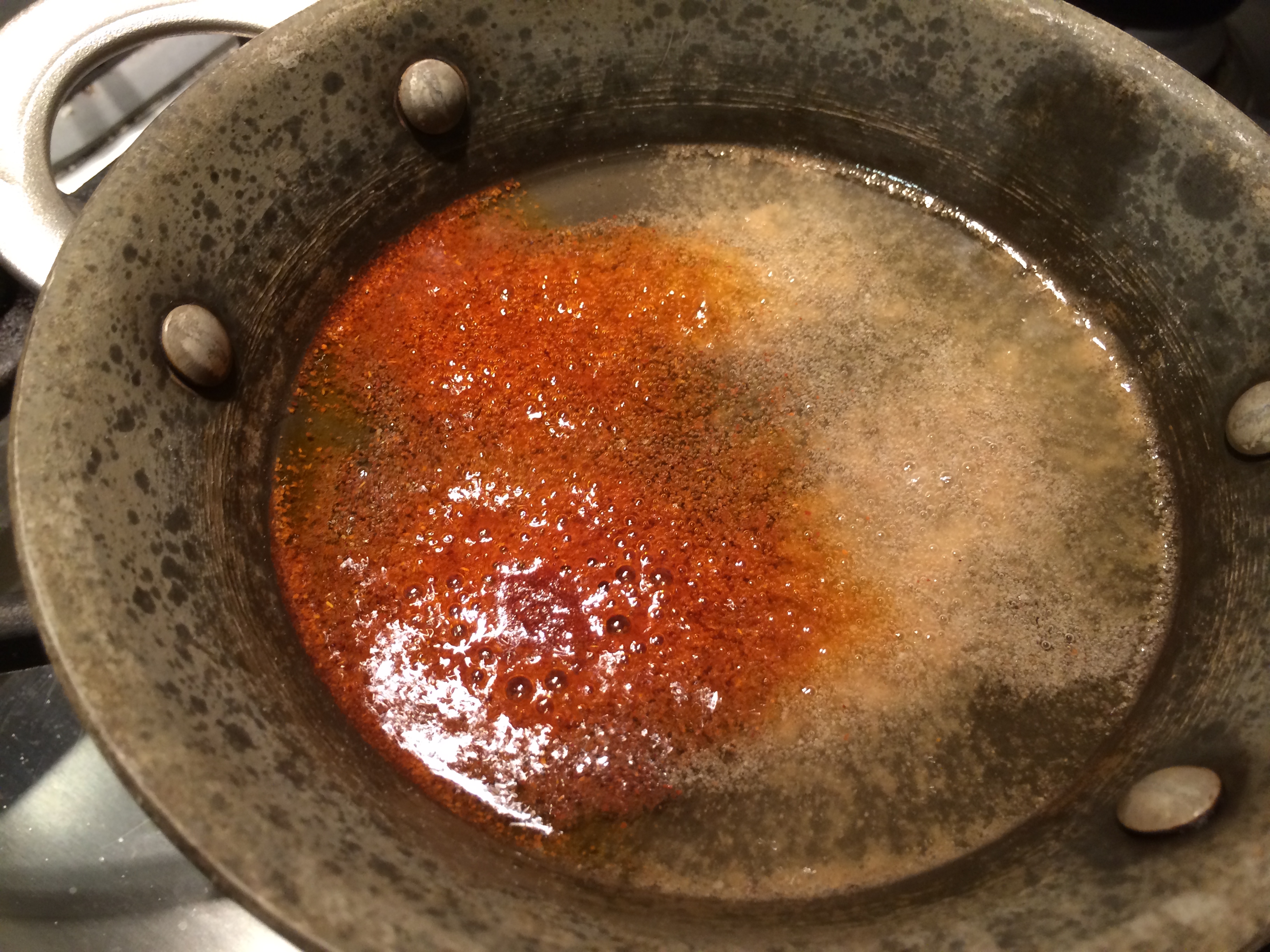
This is the basic process of tempering. Heat oil or ghee in a thick-bottomed small pan. When it shimmers (in case of ghee it should completely melt and a fragrance arise) the spices are put in. There is a certain sequence to the introduction of spices to the oil. There is, I admit, a bit of magic to this. Asafetida, if it is used, usually goes in first. Dry red chilies, if used, go in next. Mustard seeds (for me) usually go in last because they will pop with a vengeance. In between come the other whole seeds. Then in go the aromatic vegetables, such as garlic, ginger, chilies, onion, if any, that the recipe demands.

Tempering can be the first step of the recipe. Or it could be the last, as in the one below. The tempered oil is poured over the completed dish and stirred in.

Now spices are great even if you prepare them in the more well-known way — which is to grind them up into a mixture. I’m not going to run this method down (a classic of many cuisines, including Indian) but here is the difference from the tempering method. When you grind the spices, you are pulverizing every bit of them into the food. This includes the essential oils but also the fibrous seed-coating and other parts. Yes, there is a bit of the cardboard taste in most of the fibers. When you have a strongly flavored meal with onions or meat and so forth, you don’t notice this powderiness. But in a delicately flavored dish where the highlight is a lentil or a vegetable, the ideal method is to draw out the spice flavor into fat, leave the seeds whole where they add a bit of crunch, leaving the tastes pure.

And if you think about it, purity is what the Sattvic type of food is centered on.

Moong dal tempered with whole spices

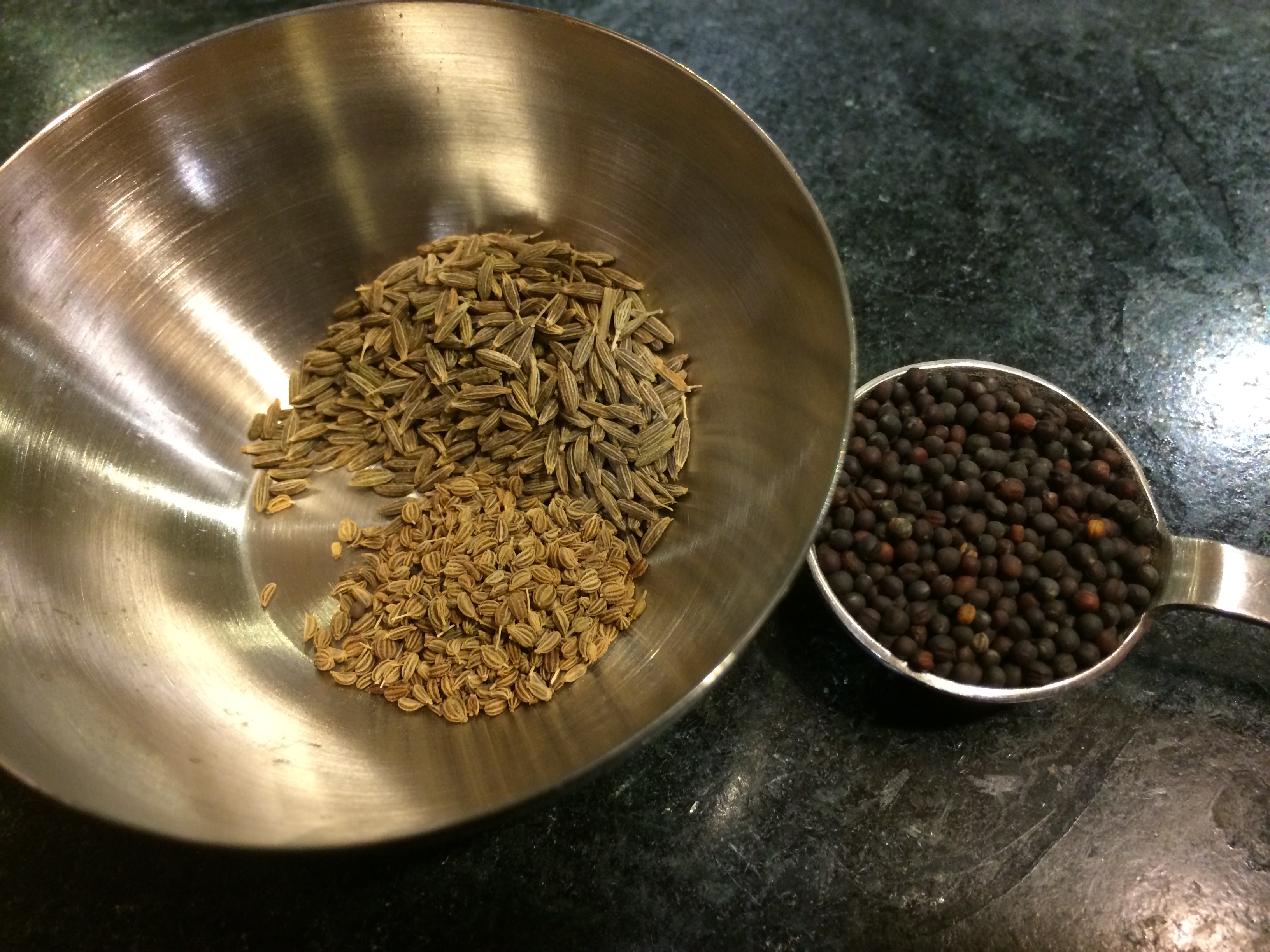
This dish uses a mix of the dehusked (yellow) moong dal and the split but skin on (green) moong dal. Moong dal, of course, is a synonym of mung bean. It is one of the fastest cooking dals and needs no pre-soaking. This makes enough for a dinner for two.

IMG_0811 IMG_0813

Ingredients:

  • 1/2  cup moong dal split and dehusked
  • 1/4 cup moong dal split but with skin on
  • 1/2 teaspoon turmeric
  • 1/2 teaspoon asafetida (hing)
  • 1/2 teaspoon red chili powder
  • 1/4 teaspoon ajwain (carom) seeds
  • 1 teaspoon cumin (jeera) seeds
  • 1 teaspoon black mustard (rai) seeds
  • 1 teaspoon salt
  • 2 tablespoons oil
  • 2 cups water
  • For garnish: dry mango powder or lemon juice, more red chili powder, minced cilantro.

Method:

Rinse and drain the mix of dals in plenty of water. Put the dal in a pot along with 2 cups water and the turmeric. Bring it to a boil with the lid off; once it foams up heartily you can lower the heat to a simmer, partially cover with a lid and leave it for 35 to 45 minutes. At this point it should be softened. Add the salt.

IMG_0814 IMG_0815 IMG_0816

Heat the oil in a thick-bottomed pan. When it shimmers add the asafetida and the red chili powder; when they foam add the cumin and the carom seeds; when they sizzle add the mustard seeds; when they pop turn off the heat and pour the oil into the dal.

IMG_0817 IMG_0818 IMG_0819 IMG_0820

Stir and taste for salt. At this point your dal is ready, all that is left is the garnish. I have suggested some but feel free to experiment!

IMG_0822

Salmon in a package

salmoninpackage

I admit that nothing sounds less appetizing than salmon cooked in a package. It arouses images of cardboard boxes bound with duct tape, spiders crawling all over it while it is left on the doorstep. Perhaps I should name this recipe Salmon a la Amazon?

But I assure you, no other process is as frugal with flavors as this method. If it makes you feel better think of it the French way:  ‘salmon en papillote’ is what they call it. Whether or not the French make better food, they have certainly cornered the market on making it sound better.

In this method, the salmon or the thing being cooked is wrapped in a package made of foil or parchment paper. Here’s the thing about it:

One, since it is paper, one can wrap the thing being cooked rather tight, and the thing can be very snug indeed. Most vessels are going to have a rather large air space around the thing being cooked — which means, the aromas emanating from it, which one ideally wants to conserve as much as possible of — have a large air space in which to escape to. In contrast when you cook it in a package the aromas stay close to your food, deep inside the package, forming a sort of aroma bomb, waiting to explode when the package is unwrapped at the table. A good sort of bomb, that is.

Two — these are the type of stiff papers than one can crimp into a rough air seal. So not only are the aromas staying close by your food, they aren’t leaking out either. The evidence of that? Most of the time when you have salmon or something baking in the oven, your kitchen gets quite suffused with the smells. Normally one swoons over this, but, as the ‘package’ method of cooking sternly reprimands us — the more suffusing into your kitchen that is going on, the less the aromas are sticking around where they belong — right by your food.

Three — it is not just the aromas, it is the natural steam that leaves the food as it cooks. Normally this creeps out into the aforementioned large air space, drying out the food stuff; but if you cook in a package, the steam is imprisoned inside, and perforce has to suffuse the food, which then remains moist.

Sorry about the analysis but it is nice to know why one does what one does. Or, we could just say ‘en papillote’ and consider the point made.

Cross-section of salmon cooking in a package

Salmon en papillote

In this recipe, I allow the flavors of onion, garlic and basil to combine with that of salmon. These items are tightly wrapped together so they have nowhere to go except into each others’ arms. This recipe makes enough for a dinner for two.

Ingredients:

  • 2 salmon fillets — total about 3/4 lb.
  • half a teaspoon of salt
  • 1/3 cup finely chopped onion
  • 2 cloves garlic, sliced or minced, your preference
  • A few large leaves basil, rolled up and sliced to chiffonade
  • 1 – 2 tablespoons lemon juice
  • 2 tablespoons olive oil

Method:

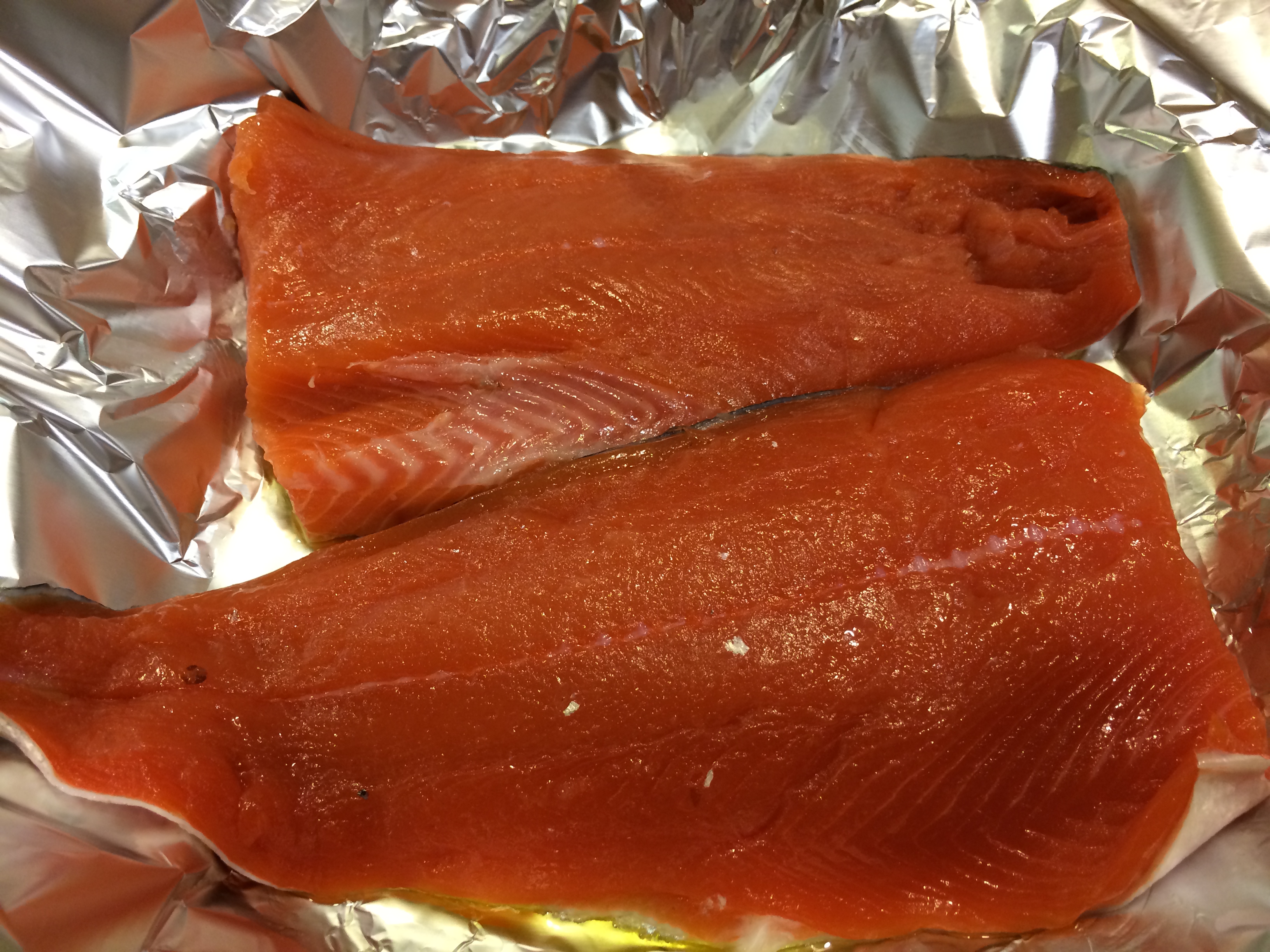
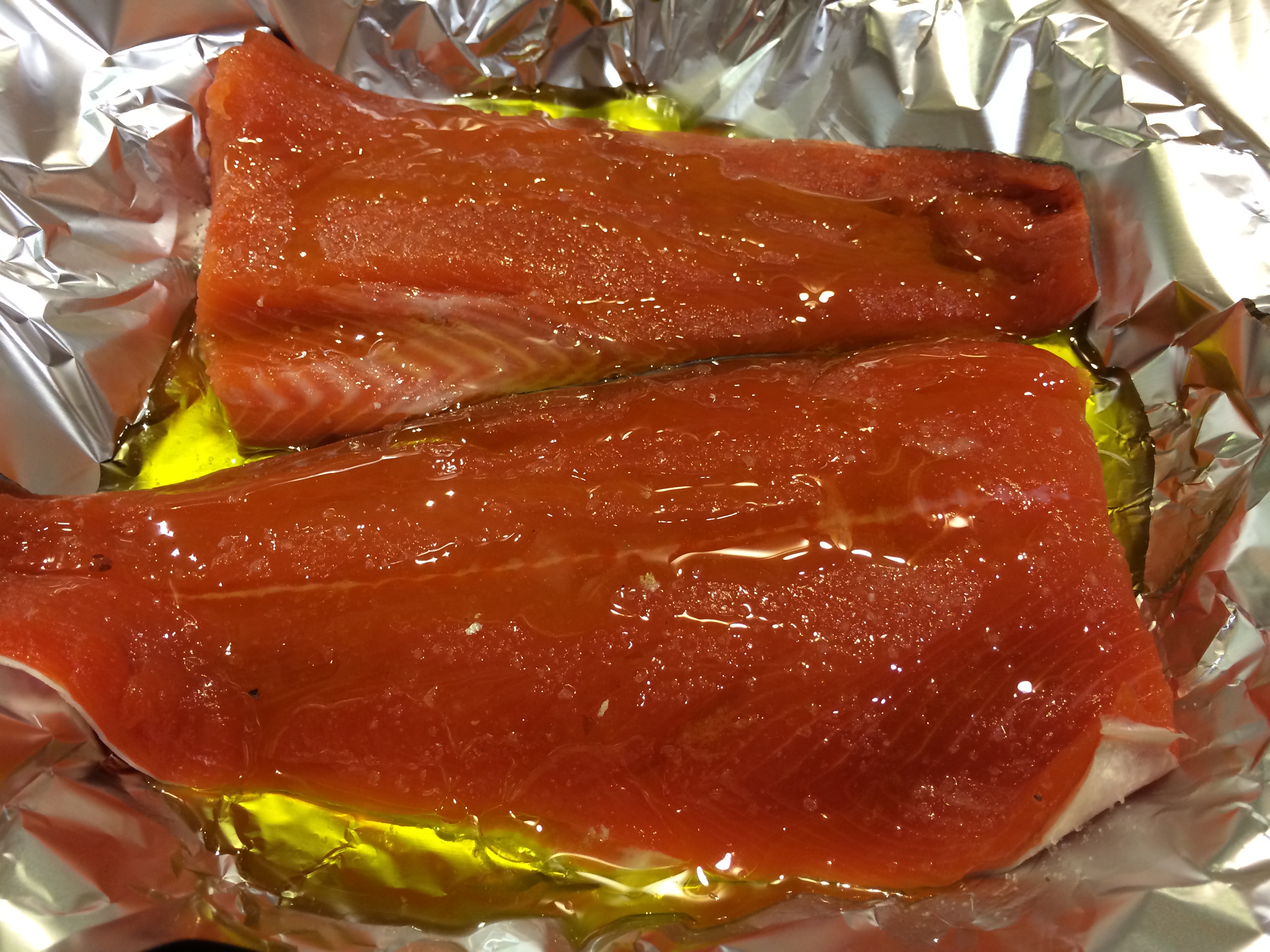
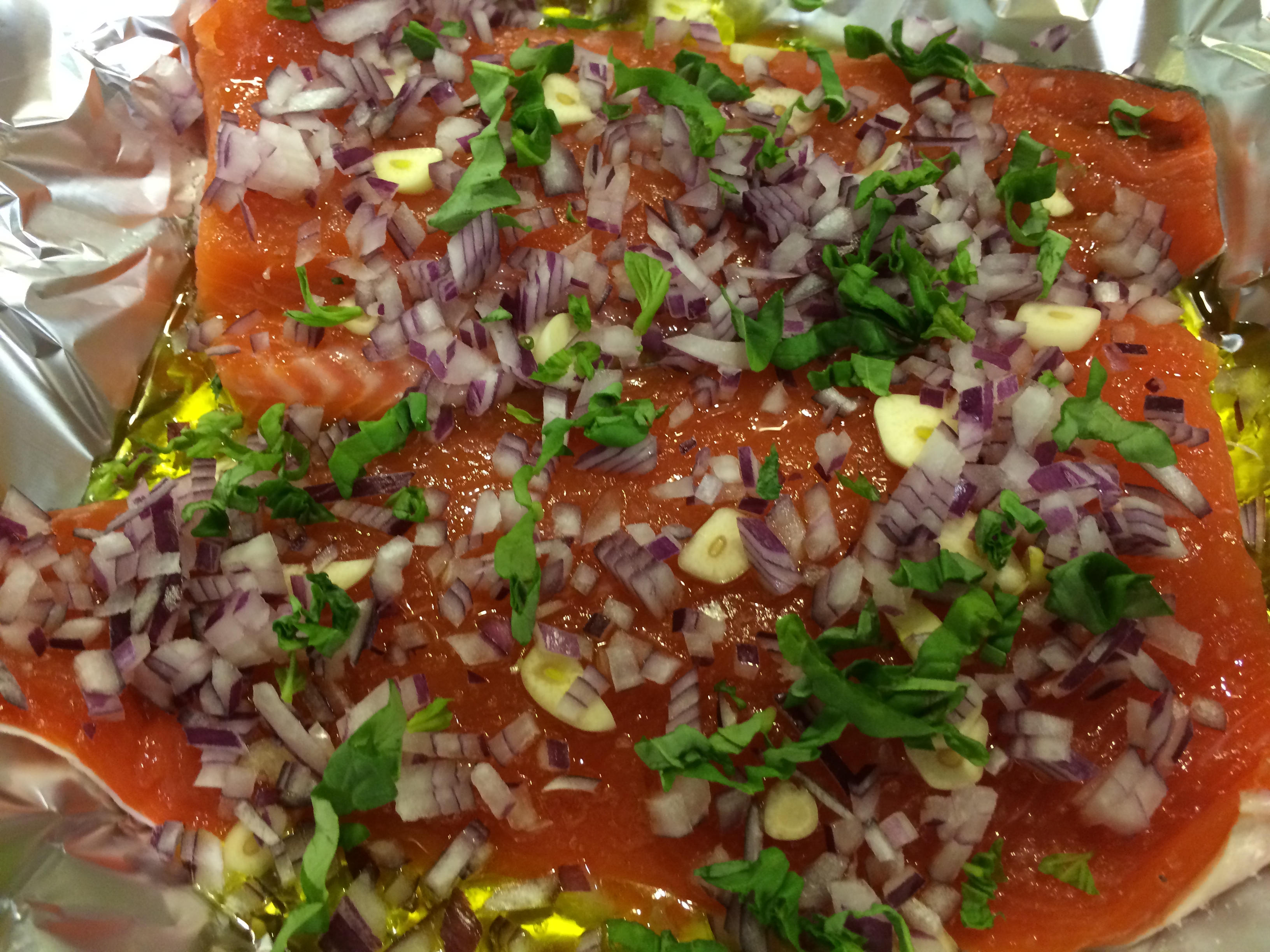
Lay out a piece of aluminium foil 18 inches wide and at least twice that long. Spread a teaspoon of oil on it, then place the fish fillets on, side by side. Spread the rest of the oil on the fillets evenly, then salt them both evenly. Now spread the onion, garlic and basil on the fillets evenly; and then the lemon juice.

IMG_0783 IMG_0784 IMG_0786 IMG_0787

Now make your pouch. I apologize I forgot to take pictures of this process but you basically fold the edges in, then take the long overhang of the foil over, to cover the salmon completely and fold it under to make a sealed package.

Put it in a 400 F oven. In 20 minutes the fish should be done to medium-rare, translucent inside but cooked to a safe 140 F. If you like it cooked more, leave it in for at most 5 more minutes. At this point the fish should be opaque through and through but still flaky.

You will know what I mean by ‘aroma bomb’ when you unwrap the package at the table. Here is our dinner with a side of wild rice and broccoli.

IMG_0790 IMG_0793

Avocado Relish

There are some Westerners who go to India and fall in love with being Indian. They make all sorts of claims about their souls being Indian, or having been Indian in some previous life time; and, if you think about it, there couldn’t be a better proof of feeling Indian than throwing around claims about previous life times. Some start to wear rudraksha beads and saffron robes. The more extreme among them might take on a Hindu name.

We have all met at least a couple such people; if not, visit your nearest ISKCON and you will. But today I will introduce you to one such friend of mine — the avocado.

This fruit with buttery green flesh is native to Mexico. To me, the taste of the avocado has always been reminiscent of the flesh of young coconut: the kind you stick a straw in first to drink up the water and then the coconut-wallah scrapes the flesh off from the inside and hands it to you, using the shell as a bowl.

But stick it in a saffron robe and you would think this fruit was born and raised in India. It takes well to a number of Indian preparations. Mix it with yogurt to make a raita. Stick in a paratha. Spice it up to make chutneys. As I experiment I will be blogging about various Indian treatments for the avocado. But today, I will make that quintessential fresh accompaniment to rich and heavily spiced food — the kachumber.

Kachumbers are little salads or relishes that emphasize freshness and coolness. A bite of this is supposed to freshen your mouth during the meal. It usually consists some combination of onion, tomato, cucumber with lime juice. Try it with avocado, as below; it brings the taste of kachumber up to lusciousness.

This makes enough as a dinner side for two.

Avocado Kachumber

Ingredients:

  • Half an avocado, large, diced
  • Quarter cup finely diced red onion
  • Quarter cup finely diced tomato
  • One third cup finely diced cucumber
  • 1 green chili, serrano or jalapeno, finely diced
  • 1-2 teaspoon minced cilantro
  • Juice of one lime or lemon
  • Half a teaspoon salt

Method:

Couldn’t be simpler. Mix it all up! We had this as a side to fish and rice.

IMG_0693IMG_0695

Post script: Although I first tasted the avocado only after I came to California, where it grows easily even in home gardens, it turns out that avocado grows in India as well, under the guise of butter fruit. It seems to be known mostly in the south, and is only available during August and September. It also has trouble hitting that right moment of ripening — sometimes the fruit rots before getting there. But if you see it, do purchase it!

Curds and whey

IMG_0087

I have before rather blithely thrown around assertions about how easy it is to make yogurt at home. Room temperature, time, blah. blah. So, madam, how about you put your money where your mouth is, hunh? Hunh?

Fine. Let’s do it. And in the process, get answers to a few persistent questions.

Those of you who hire a house cleaner — you know how easy it is to have your house cleaned, right? You prepare the house and leave. They come over, do the job while you are out working, whooping it up, or waiting watchfully outside the door. Come back home and enjoy your clean house.

Did you do any hard work? No — you waited. Of course, you had to hire the cleaners and set things up for them. But you didn’t actually dust a single chair or sweep a single room. Someone did though.

Delegation! That is what making yogurt is about. We delegate the making of yogurt to the lactic acid bacteria. We ourselves do nothing but wait while they are about their task. Of course my analogy breaks down somewhat because the lactic acid bacteria are not really hard at work with their dustpans and brooms, but rather simply enjoying a meal. It is as though you hired house cleaners to come over and dine at your house, and magically when they were done eating, your house sparkled.

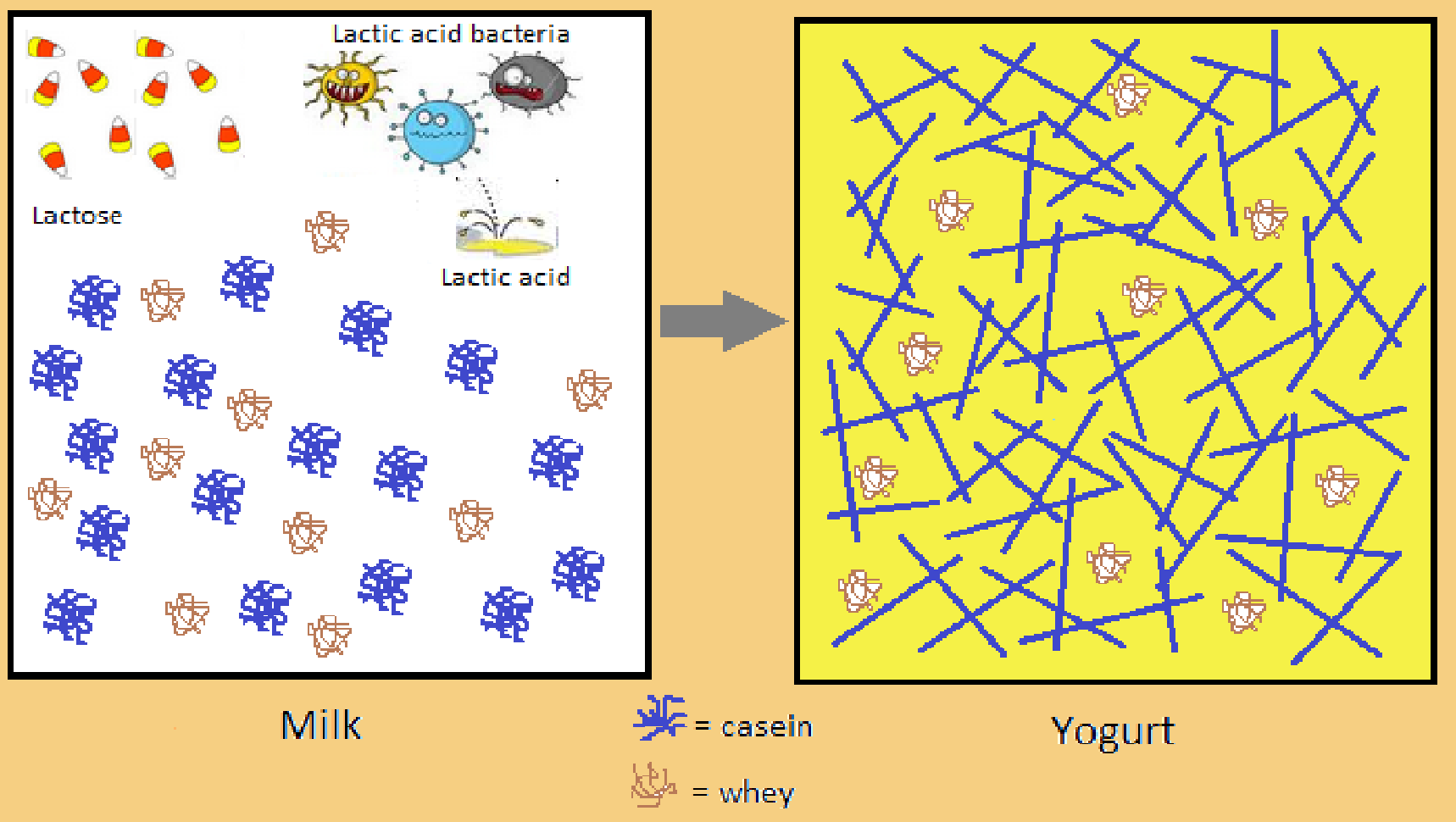
Yogurt-making process

Yogurt-making process

The picture above describes the process.

  1. Milk is full of two kinds of proteins floating about in the liquid — casein and whey.
  2. It also has a special type of milk sugar called lactose
  3. We add in yogurt starter, which contains lactic acid bacteria. They simply love to dine on the lactose
  4. As they do so, they give out lactic acid
  5. The lactic acid amount in milk builds up over time, turning the whole thing somewhat acidic (sour) — you see how it turns yellow?
  6. In that acidic (sour) environment, the casein knots of protein relax and spread out into long strands. Once they are all open they knit with each other into a web that traps the whey proteins and the liquid in milk. This is why the curds are jelly-like.

The experiment

Enough theory. Let’s get to action. In my home in Bombay we made a batch of yogurt every night. Most times it was delicious but every once in a while we would have a runny mess that us kids refused to eat. What went wrong? I have also made yogurt at home in California many, many times. Sometimes with spectacular success. Other times not. Why?
IMG_0075 IMG_0081 IMG_0086 IMG_0089

The ideal yogurt recipe is this: Heat milk to 185 F (scalding), wait till it cools to 110 F (warm). For each cup of milk, add a tablespoon of whipped yogurt and stir. Keep it warm for about 8 hours.

But what happens if you add less starter? What if you skip the step of heating to scalding first? Will room temperature work, just take longer? Time for…

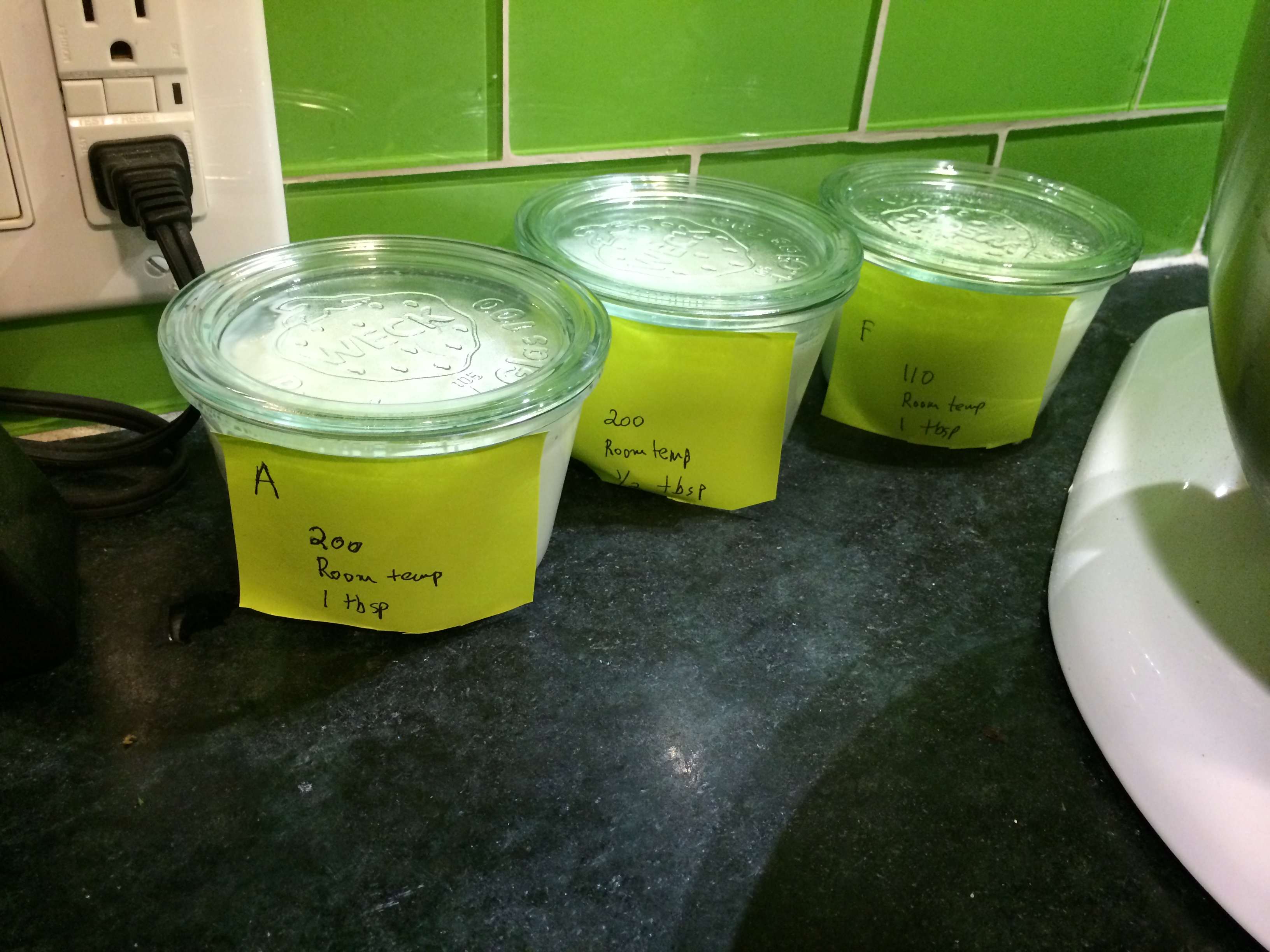
The experiment! I made 7 cups of yogurt:

Cup 1: Left at room temperature to set, not scalded first, one tablespoon starter

Cup 2: Left at room temperature to set, scalded to 185 F first, half tablespoon starter

Cup 3: Left at room temperature to set, scalded to 185 F first, one tablespoon starter

Cup 4: In warm oven to set, not scalded first, half tablespoon starter

Cup 5: In warm oven to set, not scalded first, one tablespoon starter

Cup 6: In warm oven to set, scalded to 185 F first, half tablespoon starter

Cup 7: In warm oven to set, scalded to 185 F first, one tablespoon starter

The Results:

The most important factor that good yogurt depends on is warmth while leaving it out to set. In my home in San Francisco room temperature is around 70 F. The first 3 cups, that were left out on the counter to set, turned out terrible. It took 2 – 3 entire days for them to set, and those that eventually did, had by then developed off flavors. Cups 1, 2 and 3 ended up down the drain. To avoid that fate, yogurt must be set in a warm environment!

The second factor that mattered was whether milk was scalded up to 185 F first, then cooled, or was it just warmed up to 110 F directly. Funny thing is, yogurt formed either way. But the yogurt that formed when milk was scalded first was firmer with a more even texture. The reason for this is: when milk is scalded, some of the whey proteins get relaxed (denatured), and they help the casein proteins form a more even web, rather than clustering together. The actual effect of this is that when milk has been scalded first, the yogurt is firmer and more even, while if it hasn’t been scalded, the curds are more clumpy and separate from the whey.

The third factor — whether we used one or half tablespoon of starter, hardly seemed to matter at all. If the other two things were done right, you could not detect a difference. For the borderline cases, one tablespoon helped it some. It did not solve all problems though.

The Ideal Yogurt:

Now I am equipped to give you the most ideal yogurt recipe as tested by my household.

Start with whole milk. And if you are starting with store-bought yogurt, make sure it says ‘live cultures’. Warm up an measured amount of milk till the point it starts to rise and foam up. Turn it off. Wait till it cools down to just lukewarm. If you want to be precise, the first temperature is 185 F and the second temperature is 110 F.

IMG_0077

Fine. Turn on the oven to about 150 F or so. Turn off as soon as it reaches that, and turn on the oven light. Leave it on. Put the milk in the jar that you want the yogurt to set in. For each cup, put in a half tablespoon of stirred yogurt and stir to meld. Cover and leave in the warm oven for at least 6 hours. In 8, 10 or 12 hours, it will turn more and more sour, so it depends on your preference. Store in the fridge thereafter.

I have often woken up in the morning and, completely forgetting I have yogurt setting in the oven, turned it on with melted plastic lids, ruined yogurt and other disastrous results. So now, I use oven-proof glass Weck jars, and put a sticky note on the oven to remind myself.

IMG_0084

No more accidents. Just good creamy sour yogurt which is not accidental at all.

Pomo tofu

Pomo tofu with fried rice

Pomo tofu with fried rice

Long, long ago, there lived a pockmarked old lady in Sichuan, China who came up with a good tofu dish. Lest you think I’m being rude by calling a poor senior citizen names, I assure you, I have no choice in the matter. My hands are tied; that is what the dish is named!

The dish of course is ma po tofu, a luscious tofu-blocks dish with a spicy brown gel around it, flecked with red chili and other unidentifiable stuff. ‘Ma’ = pockmarked and ‘po’ = old lady. I have eaten and enjoyed this dish at many restaurants (some more than others) and tried to recreate it at home. The problem of course is that not being Chinese myself, my usual skill at recipe-divining that works fine for Indian food, flops miserably for Chinese food.

But do I give up that easily? Not I, she said evenly. Here is my version which has actually turned out to be a easy and yummy option for week night dinners, that according to my husband tastes quite Chinese, but also quite Indian, but not Burmese at all (Burma — which lies between India and China — often has cuisine that tastes like a cross between both). This dish is from quite a different border between India and China, very far away from Burma indeed; a nexus, if you want to call it that. Geographically that nexus lies in California.

It is very good but not too much like ma po tofu at all. It is all in the perception. In that sense this dish is quite postmodern. Therefore I call it

Pomo Tofu

Ingredients:

  • Firm tofu block, about 14 oz — I use Wildwood sprouted
  • 2 – 3 tablespoons oil
  • 1 oz mung bean thread noodles, dried (about half a bag)
  • Quarter cup raw peanuts
  • Half cup chicken broth
  • Quarter cup rice wine, sherry, vermouth or white wine
  • 1 tablespoon cornstarch
  • 2 tablespoons soy sauce
  • 1 tablespoon chili-garlic sauce, I use Lee Kum Kee

Method:

Dry the tofu block with a paper towel and cut it neatly into blocks. To do this, stand it on one edge, and make two vertical cuts first, to divide the tofu into three equal slices. Then place the slices horizontally on a cutting board, stacked one on top of the other, then give it three vertical cuts to divide the tofu into four longitudinal sections. Now give the tofu block a quarter turn and repeat the three vertical cuts to make blocks.

IMG_0610

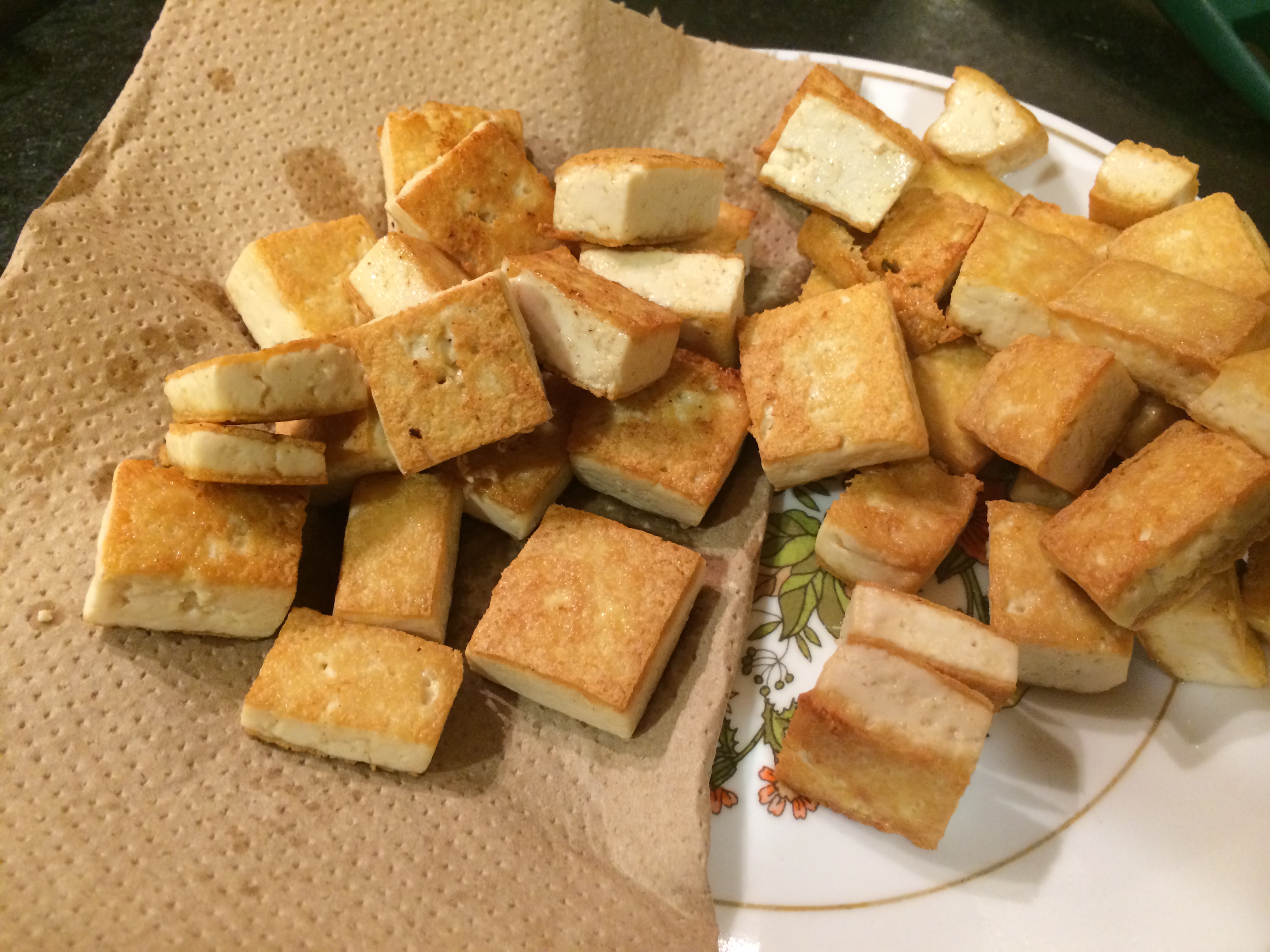
Heat two tablespoons of oil in a non-stick pan. Fry the tofu blocks on medium-high heat, about 3 minutes on each side. I needed to do this in two batches; one doesn’t want to overcrowd the tofu in the pan. Ideally one crisps up each block on all 6 sides; but two be honest I only have the patience to crisp up the two widest faces. That seems to be quite enough.

For the second batch, you may need to drizzle another half to one tablespoon oil on the pan. Remove the crisped up tofu blocks onto a plate. In the same pan, roast the peanuts for a few minutes till they look a little browned. Remove onto the same plate.

IMG_0611 tofu 002 tofu 003 tofu 005

Meanwhile, soak the mung bean threads in hot water for five minutes to soften them. Also prepare the sauce thusly: In a bowl, combine the following ingredients: chicken broth, wine, soy sauce, chili paste, cornstarch. Stir it well to dissolve the cornstarch.

tofu 004 IMG_0612

Now that your three-legume brigade is ready (tofu, peanuts and mung bean threads are all derived from legume seeds), put all three of them into the pan, pour the sauce around, and heat while stirring till the mixture gels and turns shiny. Coat all ingredients with the sauce. Garnish, if you like, with any green herbs — I have used scallions, basil, cilantro; but in this example I went with arugula.

tofu 006 tofu 007 tofu 008

A method to the meadness — Update after 6 days

The first post in this series is here. Six days in, our mead-to-be is bubbling along nicely. We have reached peak bubbling of about a bubble every two seconds in the airlock, look:

Bubbles in jug and airlock

Bubbles in jug and airlock

To recap, we have put yeast into a solution of honey and water, shaken it, and waited. What is going on in there?

My friend Saccharomyces cerevisiae ICV D-47

Let us get to know this worthy fellow — Saccharomyces cerevisiae. Out of the many single-celled yeasts out there, that is the one we humans have chosen to adopt. This is the yeast that brewers and bakers cultivate; we see it sold on grocery shelves under various labels: active dry yeast, instant yeast, bread-machine yeast, wine yeast and so on.
Saccharomyces cerevisiae -- the brewer's and baker's yeast from MicrobiologyOnline.org

Saccharomyces cerevisiae — the brewer’s and baker’s yeast from MicrobiologyOnline.org

What is so special about it? Beats me, but I got some clues from my obsessive googling. It reproduces quickly — in an hour and a half, it can double its population. It can ferment both in the presence of oxygen and outside it. In the presence of oxygen it ferments faster. Without, it goes slower. But ferment it does. As for reproducing — it can blithely switch between simply diving into two, like a plant, or having male and female babies that have sex to produce babies, the familiar way.
Yes, all of this parade of life is going on in the glass jug while it ferments.

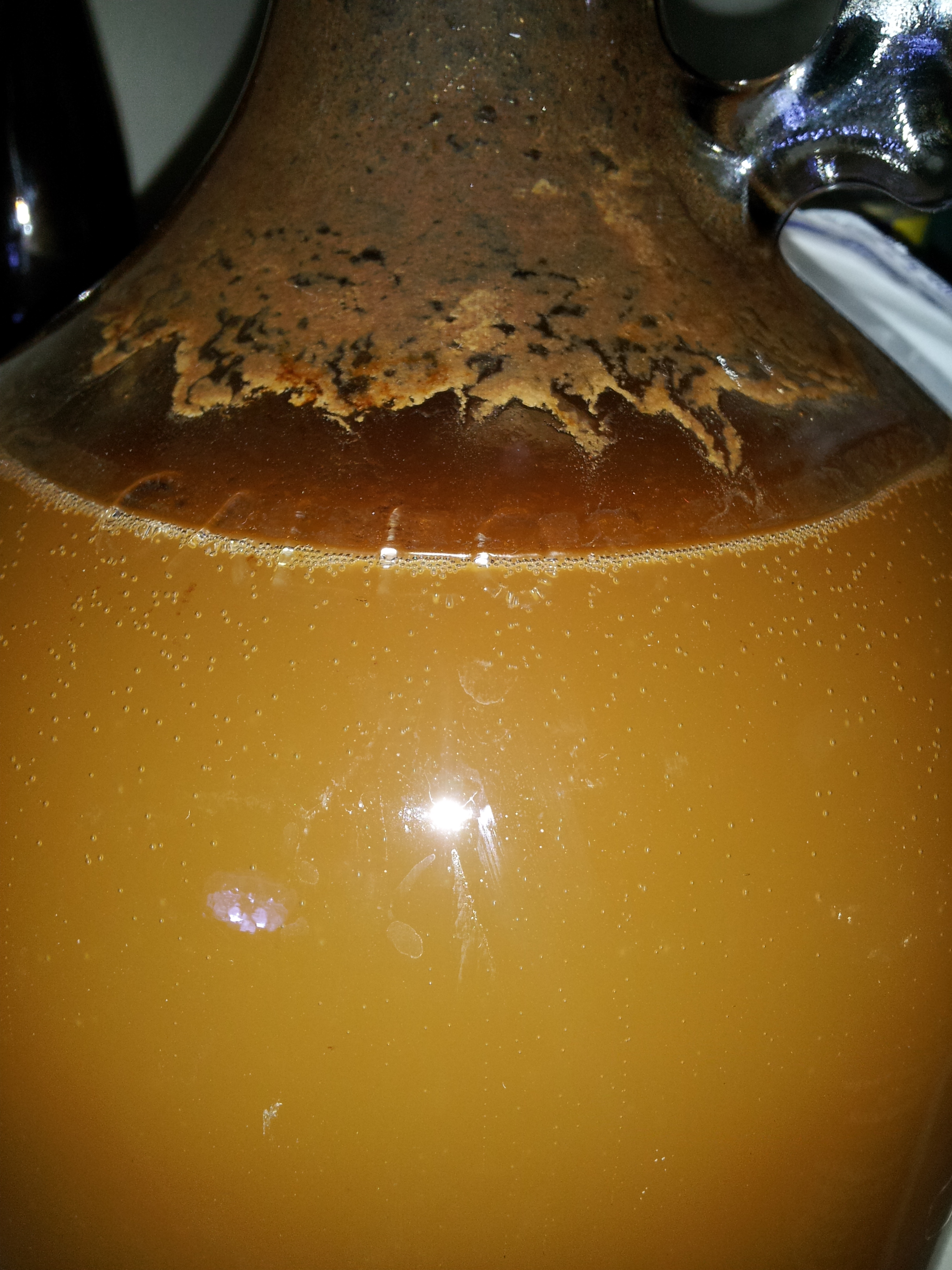
Actually seeing a microbe with a naked eye is not something one usually aspires to (you could fit about two hundred of these, end-to-end, within a single millimeter of your tape measure). But one of the talents this yeast has is to ‘flocculate’. What that means is that individual creatures come together into a ‘floc’, which sounds conveniently like ‘flock’. If only all science words were so conveniently named. Now a flock is actually visible, it looks like brownish residue — as you see below in the picture:

Floc of yeast

Floc of yeast

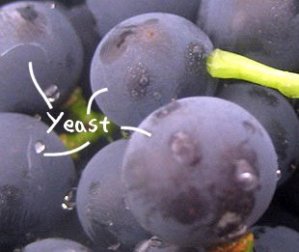
Another way you can actually see it is: next time you buy some red grapes at the store, dust off the whitish powder that you find on its surface. This is nothing but our friend Saccharomyces cerevisiae.

In fact the exact strain of this yeast that we used — ICV D-47 — was dusted off grapes originally in France by a man named Dr. Dominique Delteil, somewhere in the 1980’s.

Airy fermentation

I think of fermentation as ‘incomplete eating by a microbe’. ‘Incomplete’ because even after the microbes have had their fill, there is plenty of stuff left over for you to enjoy, whether it is wine, beer, bread or dosa. ‘Eating’ because that is what the microbes are doing, gorging themselves silly on your sugars, gaining energy enough to meet, marry and multiply. Why only microbes? Because clearly, you would not look very kindly at bigger creatures gorging on your food — we would call them pests.

Our mead right now is in the process of fermenting in an airy way (aerobic fermentation). Remember we shook the jug to allow air to disperse throughout the liquid? Well the yeast is rapidly using that oxygen to produce the bubbles of carbon-dioxide that we see filling the airlock.

These are the same bubbles that we aim to trap inside a loaf of bread to make it rise. In this case, we allow those bubbles to escape. Because what we care about (the alcohol) will come about after all the oxygen has been used up, and we go into the next stage. Stay tuned….