Truly Tabouli

Tablouli

Tablouli

We are on a middle-eastern kick here at The Odd Pantry, and when I say ‘we’ of course I mean ‘me’. When last seen, your loyal correspondent was flipping falafels like a fiend; this time, let’s take a freshly-scented walk through the tabouli trails, a whiff of mint here, a whiff of parsley there, the tingling freshness of lemon all over.

Tabouli is a salad. Originally from the mountains of Lebanon and Syria, it is adopted all over the middle-east now. Unlike most salads here in the West (slaw being the exception), every ingredient is minced to fineness. For body and bite, it uses bulgur wheat that has been plumped up in hot water; I’m not aware of any Western salad that uses grain in a similar way. The dressing is not premixed, but rather, each ingredient is poured on and mixed in thereafter. And parsley — that sprig that is pushed to the side of every restaurant meal in America — that parsley plays a starring role.

I called it a salad, but it in the middle-east it is considered part of mezze, a kind of smorgasbord of appetizers. When it is part of a mezze platter it may be served on lettuce leaf boats. Or it might be considered a side or condiment to be stuffed inside pita bread along with other ingredients. I personally can eat a plateful all by myself.

Things to watch for

Tabouli is the descendant of an ancient Arab love of herbs, which they called qadb. And the very word tabouli comes from the word taabil meaning seasoning. What I am trying to say is, do not skimp on the herbs. The bulgur grain plays an essential but minor role, while the parsley and mint take center stage. Make sure to salt well, and lemon juice is your friend.

Also, make sure to dry each ingredient scrupulously. The herbs might be washed, then spun-dry, then laid flat on a towel to air-dry. The bulgur must be drained well. Tomatoes can be finely chopped, salted lightly and placed in a strainer to drain for ten minutes.

Armed with these notions, we are ready.

Bulgur and salt

Bulgur and salt

Bunch of parsley

Bunch of parsley

Mincing parsley

Mincing parsley

Mint

Mint

Minced mint

Minced mint

Scallions

Scallions

Herbs piled up

Herbs piled up

Squeezing  a lemon

Squeezing a lemon

Bulgur added

Bulgur added

Pouring EVOO

Pouring EVOO

Tabouli

Ingredients:
  • 1/4 cup bulgur wheat + 1/2 teaspoon salt + 1/2 cup very hot water
  • 4 loosely packed cups parsley
  • 1/2 cup to 1 cup mint leaves
  • 4 scallions, or 1/4 onion, or 1/2 shallot
  • 1 small roma tomato
  • 1/4 cup lemon juice (about one and a half lemons)
  • 1/4 cup extra virgin olive oil
  • Salt to taste
Method:

Before you begin, soak the bulgur and salt in half a cup of very hot water. Leave it covered, undisturbed, for half an hour. The grains will slowly swell up to the water line.

While the bulgur is soaking, rinse and spin-dry, then air-dry the herbs. Chop the tomatoes, lightly salt them and place them on a strainer to drain. Squeeze lemons for the juice.

Finely mince the parsley, mint and scallions and collect them in a big round bowl. Add the tomatoes and the drained bulgur wheat. Pour on the olive oil. Toss to combine. At this point, stop to taste for salt and add the required amount.

Pour on the lemon juice and mix nicely. Serve on lettuce leaf boats or as a side in a falafel meal.


(Click here to find me on Facebook and here on Twitter.)

Man meets bean: falafel results

Falafel

Falafel with chili paste and tzatziki

Let’s say you are a human being who has encountered a bean for the first time. I’m speaking of a bean with a hard shell, the kind that looks more like a pretty rock than anything to do with food. Your mission — find a way to turn it into food. What do you do?

You could boil it, of course. Boil it and boil it and boil it. This will work, and you will get a nice mushy meal.

Or you could keep that bean dry, and grind it into a fine powder. Then, you can use the resulting flour in all kinds of batters and doughs. This works too.

What else? Well, some creative people in the middle east decided on a third route. Soak it overnight, and when it is plumped up, grind it, and fry the resulting mash. This time it will be more like a dough that clumps together, rather than a fine powder, because the beans have drawn in all that water and gotten rather plump and soft with it. The only cooking the notoriously hard-to-cook bean will get is at the end, frying in a pan. Is that foolhardy? No, the soaking did most of the work.

"Il Falafel di Ramallah" by OneArmedMan - Own work. Licensed under Public Domain via Wikimedia Commons

“Il Falafel di Ramallah” by OneArmedMan – Own work. Licensed under Public Domain via Wikimedia Commons

Well, well, falafel! That is what a falafel is, and the bean in question is the garbanzo bean (a.k.a. chickpea).

(Cooks in India discovered this trick also, but with a different bean: vadas are made by first soaking the split urad bean overnight and then wet-grinding it after).

Falafel, though, is made out of the whole garbanzo bean, soaked overnight. Parsley, onion and garlic are ground up along with the garbanzo for flavor. The resulting mash is bound with flour, or left as is. Balls made of this mash can be deep-fried or, as I did, patties formed in one’s palms can be shallow-fried. The result — an outside surface that is crunchy and satisfying, while the insides are still pliable and savory to the hilt.

Falafel: street food and mezze

Now you will agree that this is a pretty neat invention. Nifty, even. Tucked inside a pita bread, drenched with chili pastes and salads and strong stuff like onion, it makes a convenient item to eat while holding in one’s hand without ceremony. This is why falafel is known as the king of street food all over the middle east.

San Francisco has its own share of immigrants from all over the world, and of course we have our share of falafel food trucks and hole-in-the-wall restaurants. Some are famous for their hot sauces, others for their pita, and yet others made their name for the pickled or fried vegetables that they tucked into the pita pocket.

Kan Zaman restaurant in SF (source: http://Pakibarbie.blogspot.com)

Erstwhile Kan Zaman restaurant in SF (source: http://Pakibarbie.blogspot.com)

Some serve falafel not as a sandwich or a wrap, but as one of a platter full of appetizers known as mezze. (This word, by the way, comes from the Persian mazze, the root of the Hindi mazza, meaning ‘fun’). One particular restaurant that ran for years near Haight Ashbury — and one that I sorely miss — served their falafel this way, on a giant brass platter with embossed designs, while you lounged on floor cushions and smoked flavored hookahs, and watched a raucous belly dance. Much as I love falafel, that was not the highlight of this particular establishment — it had so many others.

Soaking garbanzo beans and other ingredients

Soaking garbanzo beans and other ingredients

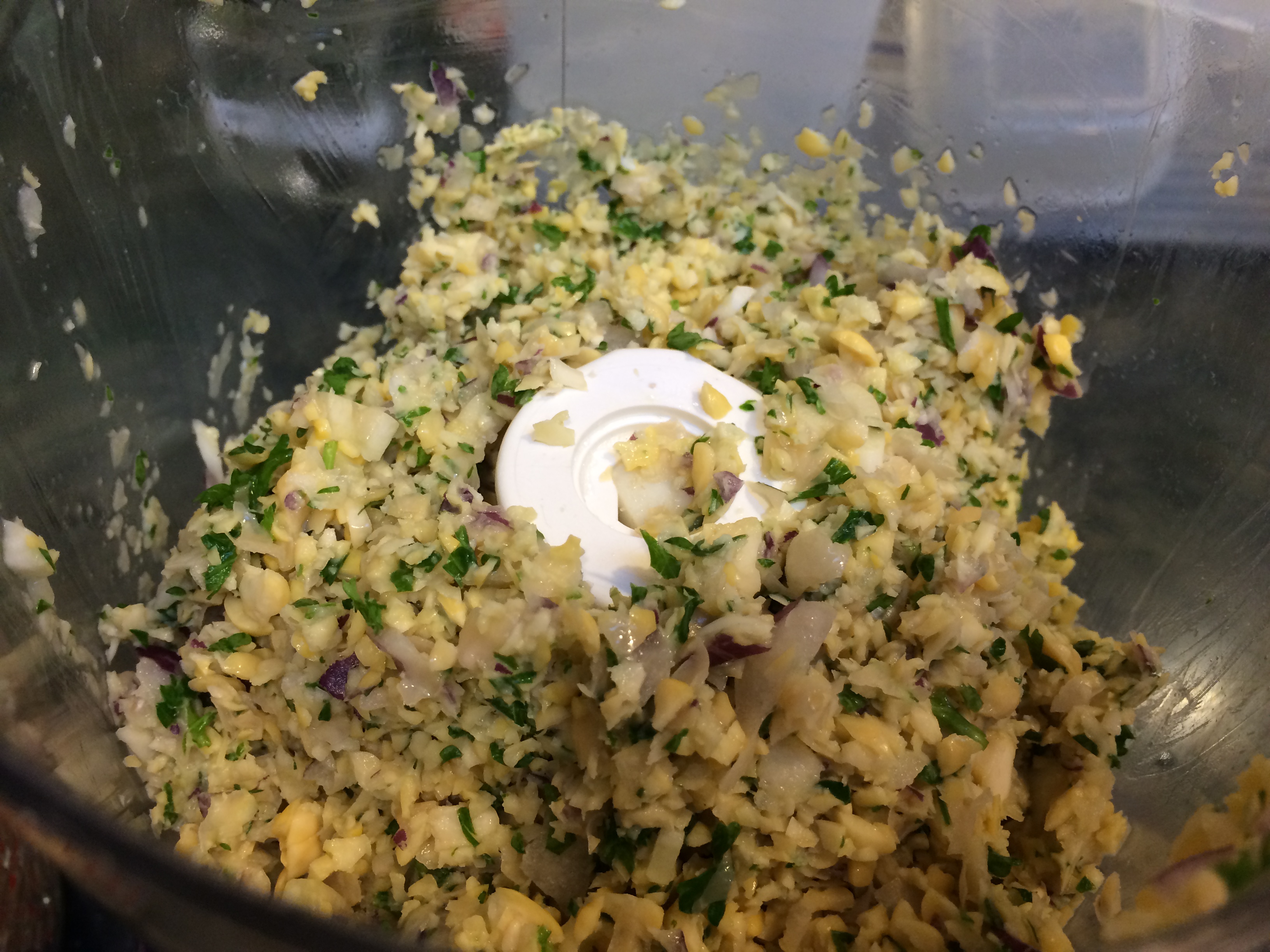
Everything in food processor

Everything in food processor

Ground up mash

Ground up mash

Add some spices

Add some spices

Mixture

Mixture

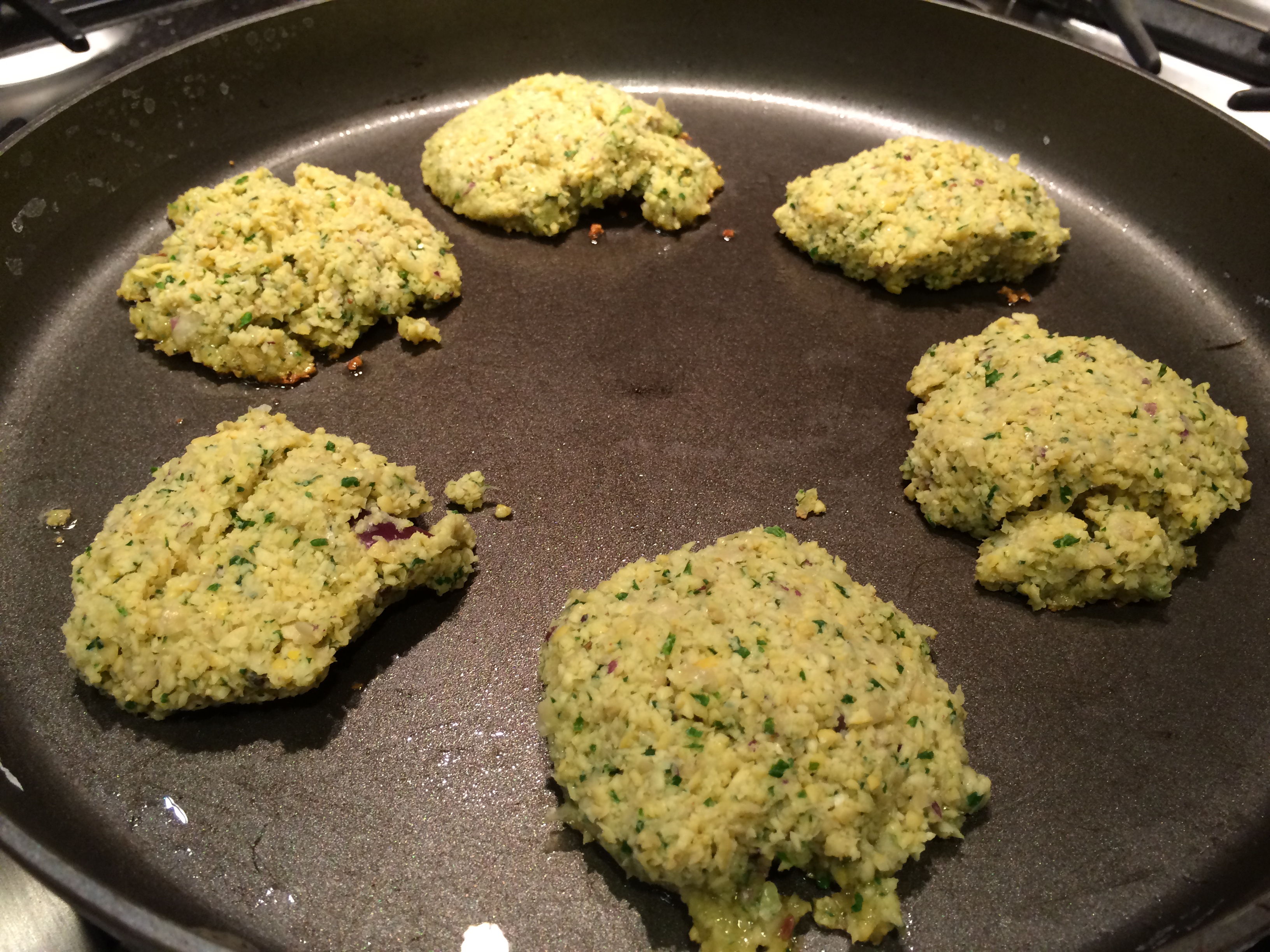
Pan-fry

Pan-fry

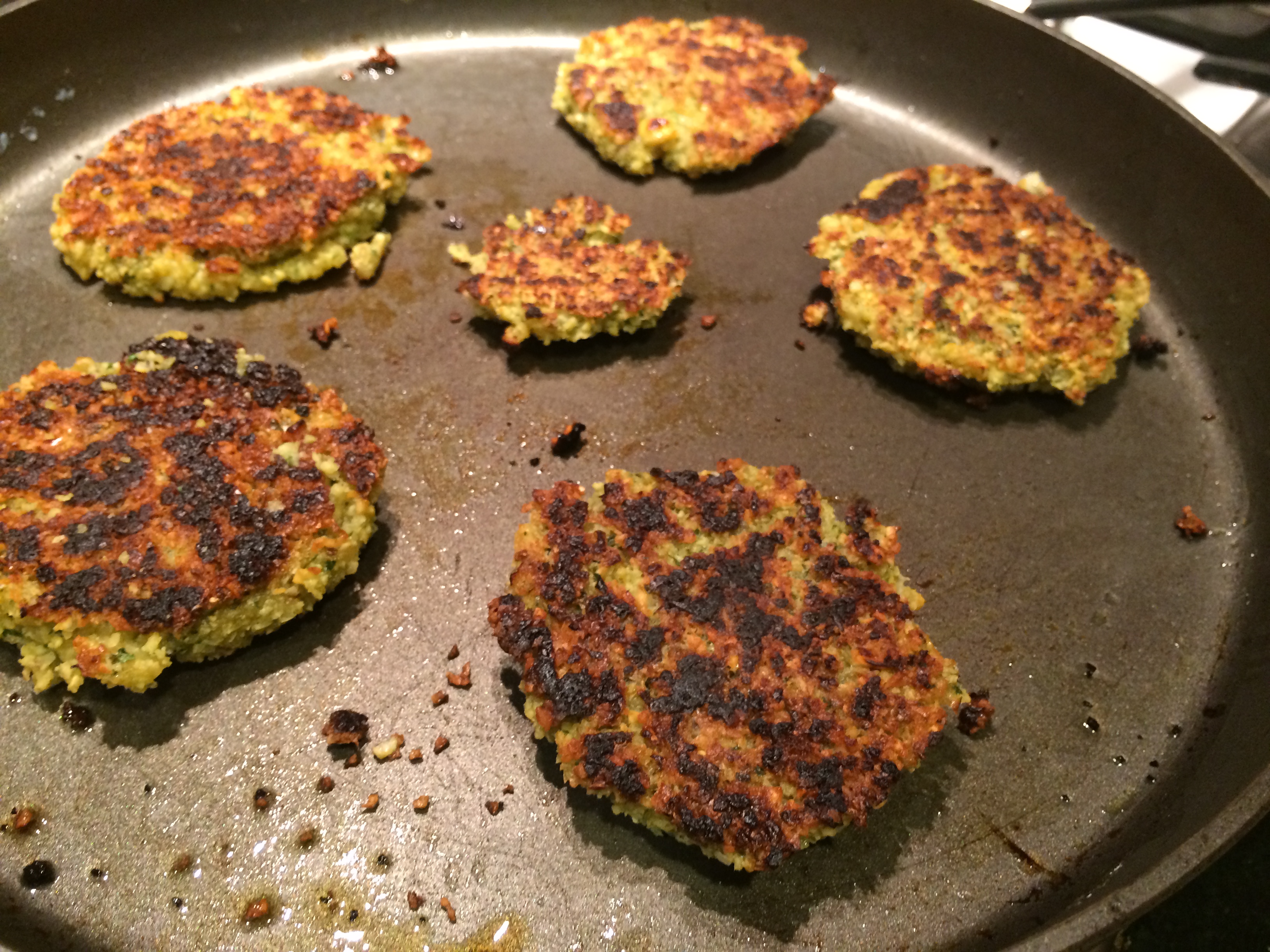
Flipped

Flipped

Stacked up

Stacked up

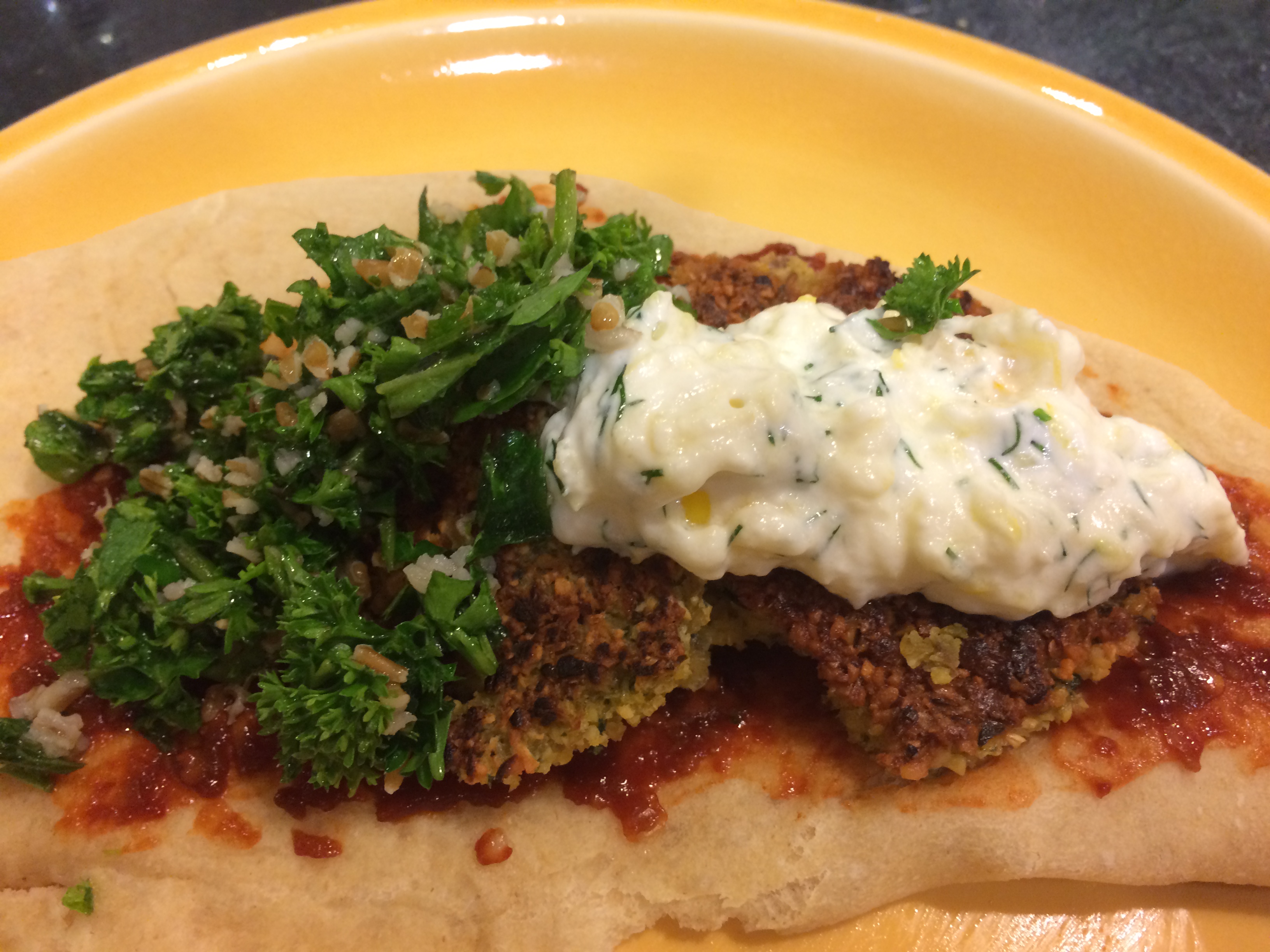
Served on pita

Served on pita

Falafel

  • Servings: About 10 patties
  • Print
Ingredients:
  • 1 cup dry garbanzo beans (a.k.a. kabuli channa, a.k.a chickpeas), soaked for 8-10 hours
  • 1/2 a medium onion
  • 3 fat cloves garlic
  • 1/2 cup loosely packed parley leaves
  • 1 teaspoon salt
  • 1/2 teaspoon paprika or red chili powder (optional)
  • 1/2 teaspoon roasted cumin powder (optional)
  • Oil for pan-frying
  • 1-2 tablespoons all-purpose flour (optional)
Method:

Soak the beans overnight in four cups of water. The next day, they will have swelled enough to fill up almost the entire container. Drain and rinse.

Roughly chop the onion and garlic. Rinse, dry, and take tough stems out of the parsley. Put the beans and vegetables into a food processor, but make sure that everything is well-dried — one does not want extra liquid in the mash. Add salt and the optional spices. I needed two batches of processing.

The resulting mash should be able to clump together, and yet, not be dripping with liquid. At this point, you can add a tablespoon or two of dry flour if you like to bind it. I skipped this step.

When you are ready to fry, get a wide, thick-bottomed pan, preferably non-stick, nicely hot. Add oil generously. Spread oil on your hands and form the patties within your palms. You will need about a golf-ball sized amount of mash for one patty.

Lay it flat on the pan. It will sizzle. Press it flat with a spatula. When the underside seems browned (this will take about five minutes on medium-high heat), put a few drops of additional oil on the top (uncooked) surface of each and flip each gently. Another five minutes and you are done.

Alternatively, you can form balls and deep-fry them. You should make doubly sure that the mash is binding well with the added flour if this is your approach.

Have as a side or in a pita with tabouli (recipe forthcoming), chili pastes, and tzatziki (recipe forthcoming)


(Click here to find me on Facebook and here on Twitter.)

vvlpbutton1300px

I submitted this recipe to the Virtual Vegan Linky Potluck!

A thousand names for eggplant

Eggplant display (source: via Wikimedia Commons, user Phoebe (Own work))

Eggplant display (source: via Wikimedia Commons, user Phoebe (Own work))

Writing the eggplant post last week left me in a quandary. Since I live in the US, calling it eggplant seems natural. But then all through my childhood I called it baingan in Hindi and brinjal in English. Some of my readers from the UK will probably want to call it aubergine, while Australians, I hear, prefer the term egg fruit. [Update, 3/22: no, from comments, turns out they call it eggplant too.]

United by a common language indeed!

Well it turns out that the names of this humble vegetable have come about through a global game of Telephone (Chinese Whispers in India) involving empires and migrations of peoples. Sometimes the names have gone around the world and even come back to the source, changed, to go another round.

Intriguing.

Wight, R., Illustrations of Indian botany, or figures illustrative of each of the natural orders of Indian plants, vol. 2: t. 166 (1850) [Goovindo] (Source: http://plantillustrations.org)

Wight, R., Illustrations of Indian botany, or figures illustrative of each of the natural orders of Indian plants, vol. 2: t. 166 (1850) [Goovindo] (Source: http://plantillustrations.org)

The story begins somewhere in India near Burma. Before the Sanskrit speakers and even the Dravidian speakers migrated to India, it was largely occupied by the Munda people. Remnants of the Munda people survive today as tribes in pockets. They were already eating a small, spiny, yellowish fruit that tended to be bitter. Being from the nightshade family, it was also toxic. Over the years they cultivated it to be edible, larger, less spiny, less bitter, and to grow in a season. Once in a while, you still feel super sharp spines on the green tops of eggplants — a reminder of how difficult this vegetable once was to harvest.

The later arrivals to India, the Dravidian-speakers and the Sanskrit speakers, based their words for local vegetables on the original Munda words. The Munda word for eggplant survives as echoes in the Sanskrit vrintaka. In fact, they must have known that the tomato and the eggplant are both from the nightshade family, because the eggplant was known as ‘kanta vrintaka‘ while tomatoes were known as ‘rakta vrintaka‘ — presumably, spiny nightshade and blood nightshade respectively.
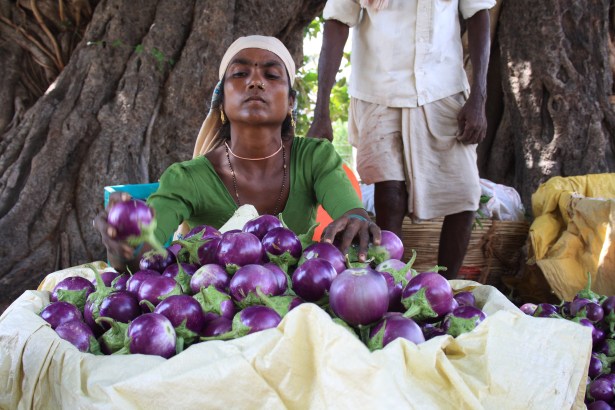
Farmworker in Sejwat, Gujarat, India (source: Wikimedia commons, user Arne Hückelheim)

Farmworker in Sejwat, Gujarat, India (source: Wikimedia commons, user Arne Hückelheim)

Another Sanskrit name that eggplant was given was ‘vatingan‘ which comes from its abilities to remove gas (=wind gone, or, more pointedly, fart gone). This word became the ancestor of a number of words used all over India:

  • Hindi: baingan
  • Kannada: badne kai (‘kai’ = vegetable)
  • Telugu: vankaya
  • Bengali: begun
  • Marathi: vangi
  • Sindhi: vangan

Interesting. I love eggplant, but I’ve never thought of it as a substitute for Gas-X. Perhaps I should.

Meanwhile, still in the cloudy ancient past, Persian cooks caught wind of it also. There the Sanskrit word vatingan became transformed into badenjan. Iranian dialects still have a range of similar words for eggplant, showing its ancestry: from the Encyclopedia Iranica, we have badengan, patlejan, vangun (similar to Sindhi) and vayemjun. In Afghanistan, smack in the middle, the word is bademjan.

Now remember that eggplant is a member of the nightshade family, famed producer of toxins (for instance tobacco with nicotine, chilies with capsaicin). And by this point eggplant hadn’t had the track record in cultivation to have the toxins bred out of it. So some of the writings on this vegetable from those ancient days are filled with warnings. Persian writers from the Middle Ages blame eggplant for all kinds of ills from leprosy to the mysterious black bile.

But then, they went on to say, salting it removed those toxins, turning it beneficial, and neutralizing the bile. Could that advice be the reason that we in the modern age of the cultivated, toxin-free eggplant, continue to salt it like dolts? Sorry, I meant to say, the Persian scholars have been hugely influential in our current cuisine.

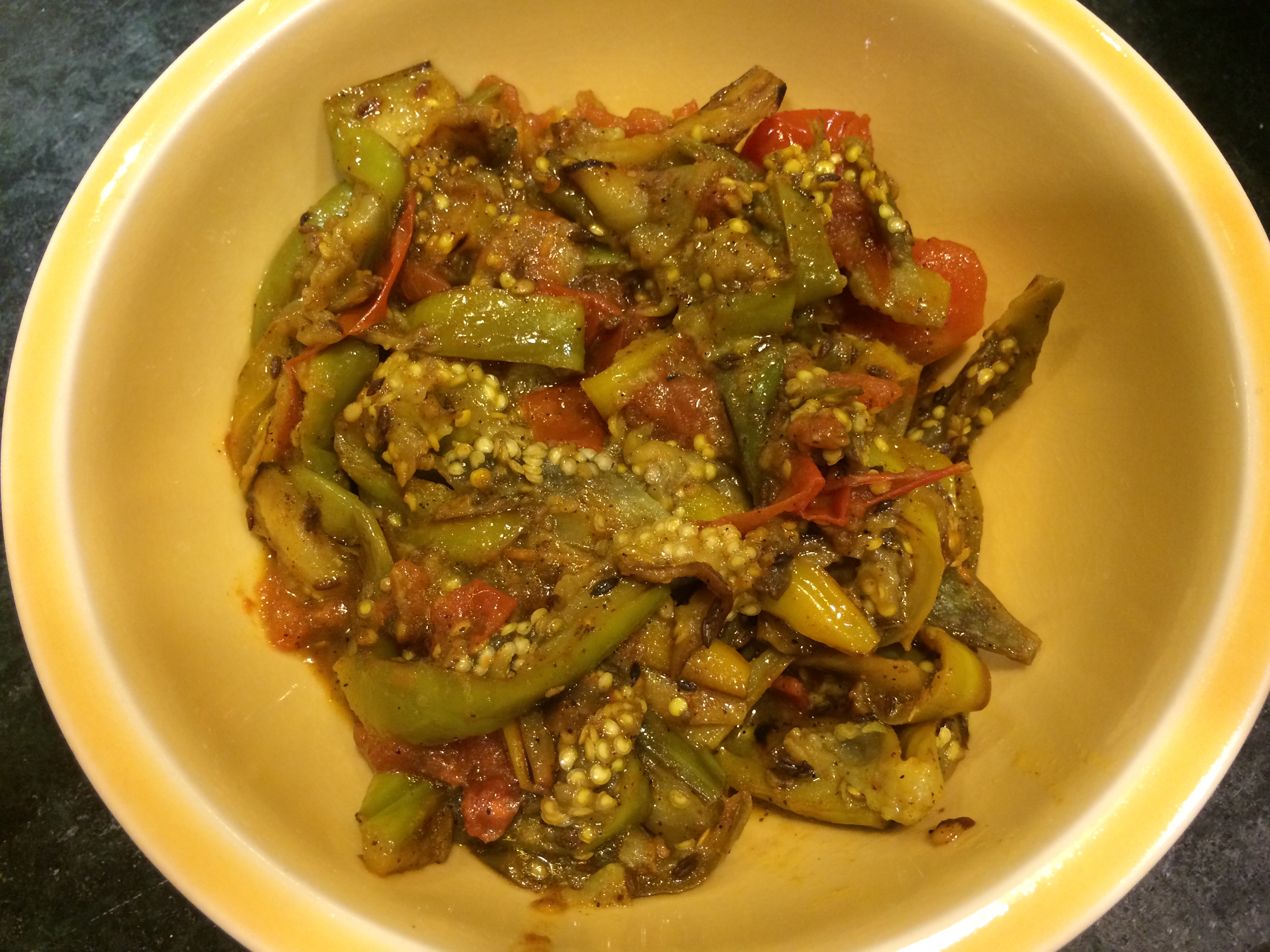
A dish made from eggplant and tomato -- two nightshades

A dish made from eggplant and tomato — two nightshades

By getting the Persian cooks interested, eggplant hit the big time. The Persian lands were conquered by the Arabs in the seventh century. As food historian Rachel Laudan recounts in this essay, from the eighth century on, as the Islamic empire flourished in Baghdad, their chefs adapted Persian cuisine and spread it to their newly conquered capitals. They conquered Spain across the Mediterranean, and took the eggplant with them. The Arabs called it al-badinjan from the Persian, prefixing it with the Arabic definite article ‘al’. The Spanish dropped the ‘al’, and called it berenjena, as did the Portuguese, with their beringela. But Catalan kept the ‘al’, so eggplant became alberginia.

Now the French, nestled close to the Catalan lands, picked up this vegetable and also this word, but they had difficulty with the ‘al-‘ prefix, and rendered the word as aubergine. This word continues to be used today in France as well as England.

Interestingly, the Persian word for eggplant spread to Europe through two independent routes. West of the Mediterranean, it went to Spain and eventually France as aubergine. But east of the Mediterranean, the Arab conquest of Iran took it to Turkey, then to Greece, Italy and Eastern Europe. From the Encyclopedia Iranica again, “the spread of the word bādenjān can be traced in the Eastern Turkish patingen, Turkish and Russian patinjan, Georgian badnjan, Astrakhan Tatar badarjan or badijan.”
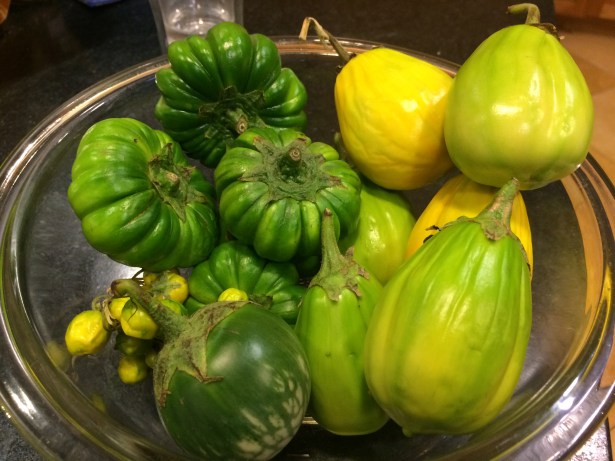
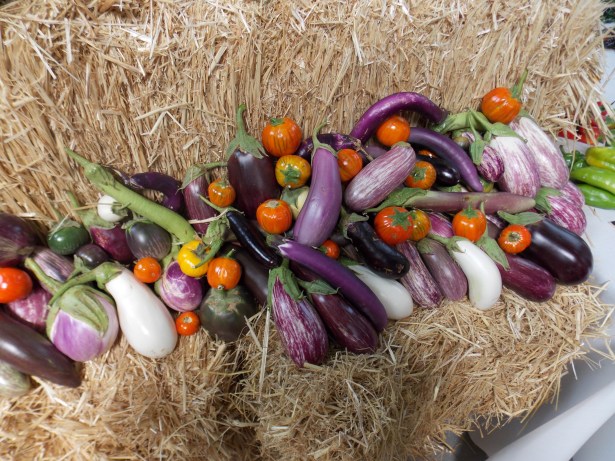
Yes, these are eggplants too. A farmer's market haul

Yes, these are eggplants too. A farmer’s market haul

From that to Greek melitzana, and Latin melongena. Latin being a mother language in its own right, its word for eggplant became another fount of creativity. Linnaes picked it up to give its botanical name: Solanum melongena. Italian still uses the melanzana from the Latin. In fact just the other night I had some delicious melanzane alla Parmigiana. The English picked this up, briefly, as melongene, eventually to drop it in favor of aubergine. But they used that word long enough to bequeath it to Caribbean English as meloongen, as it is still used today.

Still with me? The insanity is not over yet, in fact, it is just beginning. Some in England heard the Latin melongena and took it to be mala insana — mad apple.

Mad Apple? We are a long way from Fart Gone. Are we still talking about Egg Plant? Yes.

As a matter of fact, the Old Foodie website quotes what seems to be the source of this mistranslation to ‘mad apple’ — a treatise known as Botanologia, the English herbal, or, History of plants (1710) by William Salmon. The English didn’t just mishear and corrupt melongena as mad apple. They also corrupted Badenjan to Brevun Jains, and the Portuguese beringela to Brown Jolly. It is still known as brown jolly today in the West Indies.

Four kinds of eggplants (source: Thai food blog on Flickr under Creative Commons License)

Four kinds of eggplants (source: https://www.flickr.com/photos/thai-food-blog/ on Flickr under Creative Commons License)

Now by this point the English were quite peripatetic themselves; rather than sitting in place waiting for fruits to land on their shores, they were out colonizing and bringing back botanical curiosities to grow at home. They had already become acquainted with eggplant through this route, and grew it as an ornamental. In the sixteenth century, it got described by an English herbalist known as John Gerard as ‘having the bignesse of a Swans egge’. This is probably the source of its current name, eggplant.

However, at this point the English did not consider it food, being from the nightshade family; just like Persian scholars from a thousand years ago, they warned of its propensity to cause disease, everything from cancer to piles to bad breath. ‘Doubtlesse these Apples have a mischevous qualitie,” John Gerard wrote, “It is therefore better to esteem this plant and have it in the garden for your pleasure and the rarenesse thereof, than for any virtue or good qualities yet knowne.’

This name, eggplant, is the one that the English took with them to America and Australia. It must be that they finally learned to enjoy it as food from the French, hence their word for it came from the French also — the elegant aubergine. (There are other examples of this Frenchification of food words: for instance, the English have a perfectly decent word that means ‘cow’ — it is, ‘cow’. But when they used the cow as food, they called it ‘beef’ from the French ‘boeuf’.)

Now, we are ready to come full circle, where I began, and where we began, back to India. The Portuguese colonized India in the sixteenth century, and brought their beringela back home. Either the Indians, or the later colonizers, the English, turned this into brinjal. This is the word that still survives today, as an English word, in India, Malaysia, and elsewhere. We think of this as an English word, but none of the English-speaking countries actually use it.

Notes: Eggplant was actually domesticated in China very early as well, in 500 BC; but I did not cover its trajectory through those lands, mostly because I lack familiarity with the languages. Also, I linked to my sources throughout, and my information is only as good as theirs is. 

Hungry for more eggplant names? Here you go. Not satisfied? What’s it going to take? Here you go.

Tl;dr? Here you go.
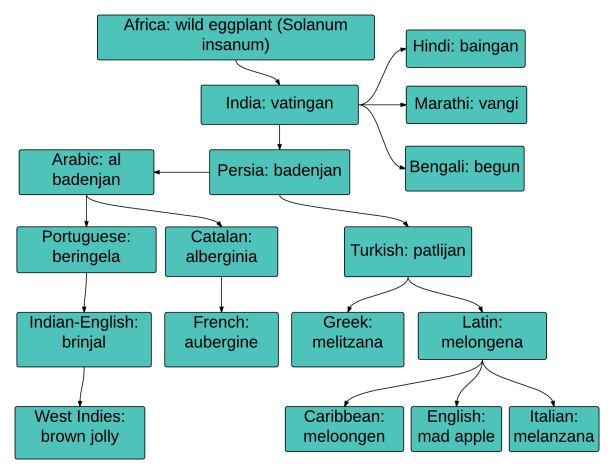
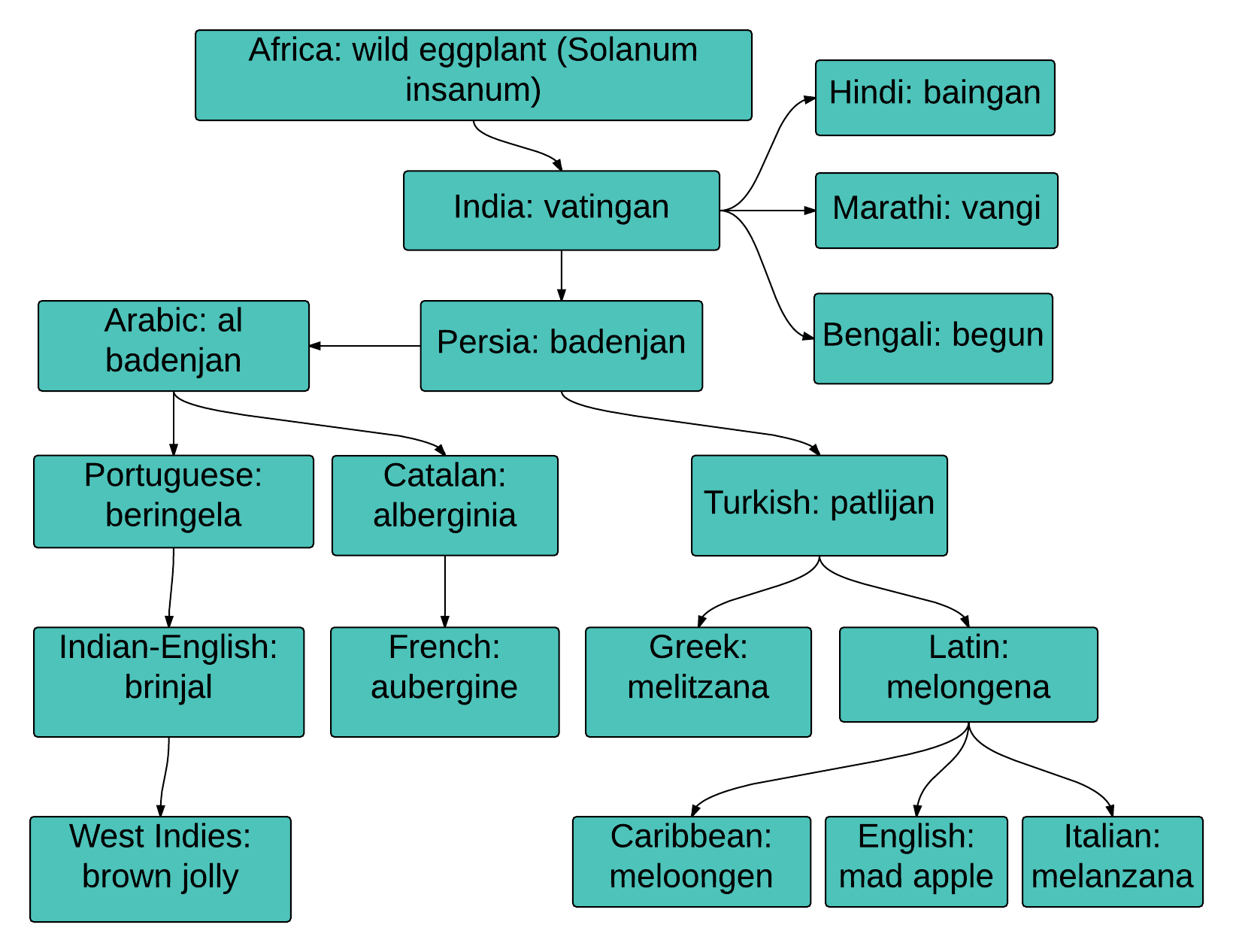
Eggplant words

Eggplant words

(Click here to find me on Facebook and here on Twitter.)
How to make eggplant delicious

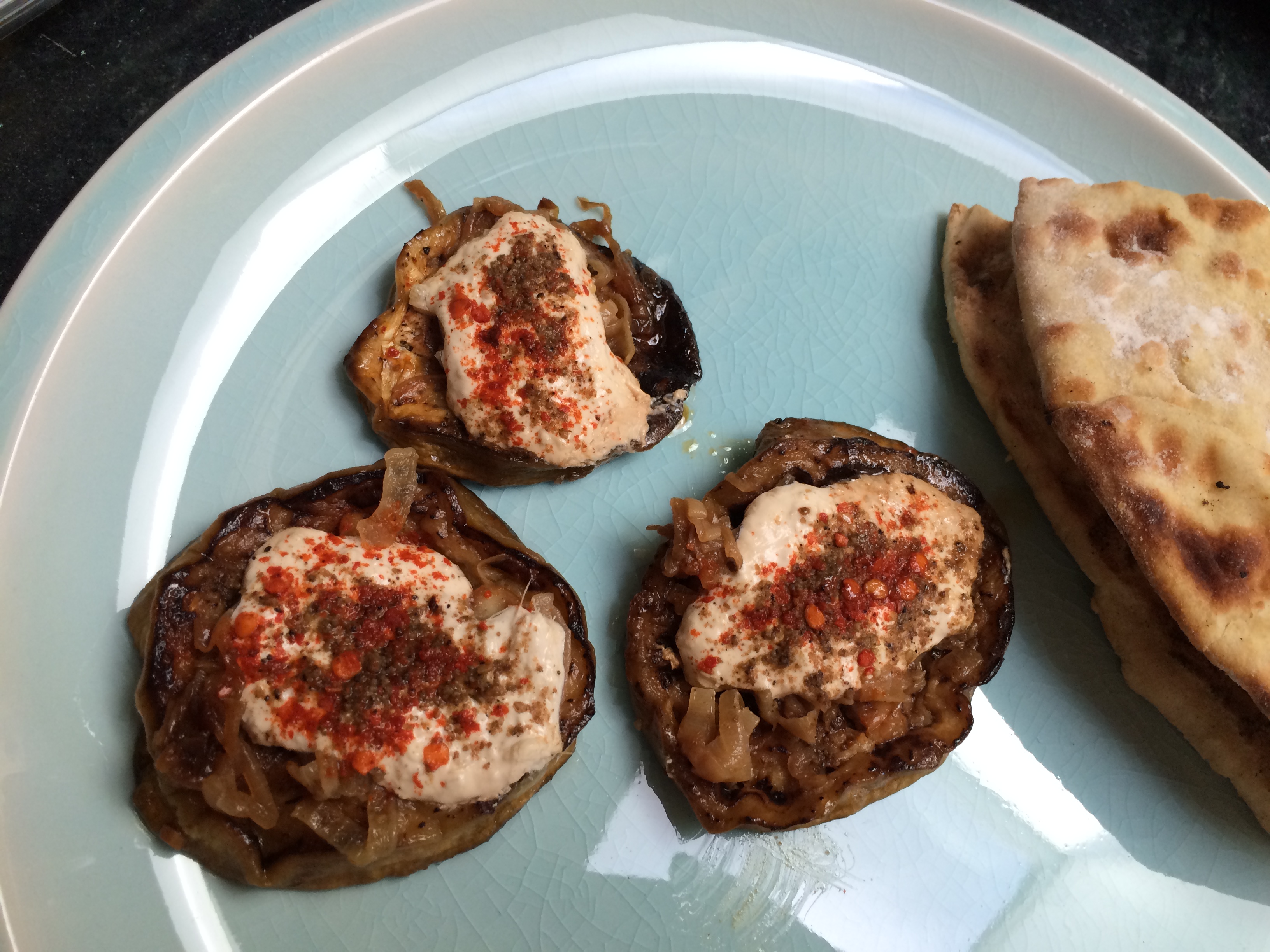
Eggplant topped with yogurt

Eggplant topped with yogurt

Call it eggplant, call it aubergine, or call it brinjal. Many will tell you that this is their most hated vegetable. I’m not sure what it is — is it that the flesh turns mushy and dark when cooked? Or that it is studded with seeds throughout? Or is it the sharp and yet bland flavor?

Whatever it is, while most people are cowering in fright from the onslaught of the dreaded eggplant, a vast swath of Asia from Iran to northern India is shoveling great mouthfuls of it down the hatch and passing the dish around for seconds. Why? What have they discovered?

One, that eggplant must be cooked through. Completely soft on the inside, almost charred on the outside. None of this fashionable light grill-marks with the al dente bite remaining. (What is the deal with that anyway? Why can’t we cook each vegetable the way the vegetable itself demands it, instead of applying one fashionable cooking method to all?)

Two, use oil. Enough oil. Be not afraid of the fat — haven’t you heard? Fat is good for you again! Eggplant soaks in oil like a sponge, they say, in faintly disapproving tones; not mentioning the crucial fact — that the oil, once it hits the inside at heat, is turning a rubbery sponge into sheer lusciousness.

The other trick? That eggplant goes well with the aromatic trio — onion, garlic and ginger, used in creative ways; and goes specially well layered with plain, thick, slightly-sour-and-slightly-creamy yogurt.

Eggplant peel — a fraught subject. And pre-salting?

One of the first disputes we had in our marriage was over eggplant peel. I love how it crisps up and adds a nice dimension to each bite of pan-grilled slices. While for my husband the peel sliding off the flesh in long strands causes psychic distress. In order to ever be able to have eggplant for dinner, I had to get him to partake; and in order to get him to eat it, I had to peel it.

So I do. But if you do not have a problem with the peel, you should leave it on, because the purple hues of the peel contain the same purple nutrient that blueberries do.

Also, I read in a lot of cooking advice that one must salt the eggplant for 30 minutes, and drain the resulting liquid, in order to remove the bitterness. I’m not sure what I am missing but I don’t find eggplant bitter in the first place. I never pre-salt it, and the result is not in the slightest bit objectionable. Is it possible that the eggplant of yore was indeed bitter and we have bred it out over the centuries? Yes, it is possible. So, skip the salting.

Baingan ki Boorani

A dish very similar to this was made in our home to be eaten with rotis. It is a classic all over Afghanistan and other parts of North India. Madhur Jaffrey has covered it in several of her books as well. But my recent inspiration came from the Feeding the Sonis blog, where Sanjana has made a dish with the same ingredients but different presentation. Check it out!

It involves pan-fried eggplant slices covered with flavored yogurt. Here, let your imagination be your guide. I did not add any green herbs, but anything from mint to scallions or cilantro would work; I did not make a tomato gravy, but that could be used  to cover the eggplant slices as well.

Slicing eggplant, half inch thick

Slicing eggplant, half inch thick

Tic-tac-toe cuts on one surface

Tic-tac-toe cuts on one surface

Pan-fry

Pan-fry

Flipped

Flipped

Flavor ingredients: yogurt, onions, garlic, ginger, chaat masala, red chili powder

Flavor ingredients: yogurt, onions, garlic, ginger, chaat masala, red chili powder

Salt and mash garlic

Salt and mash garlic

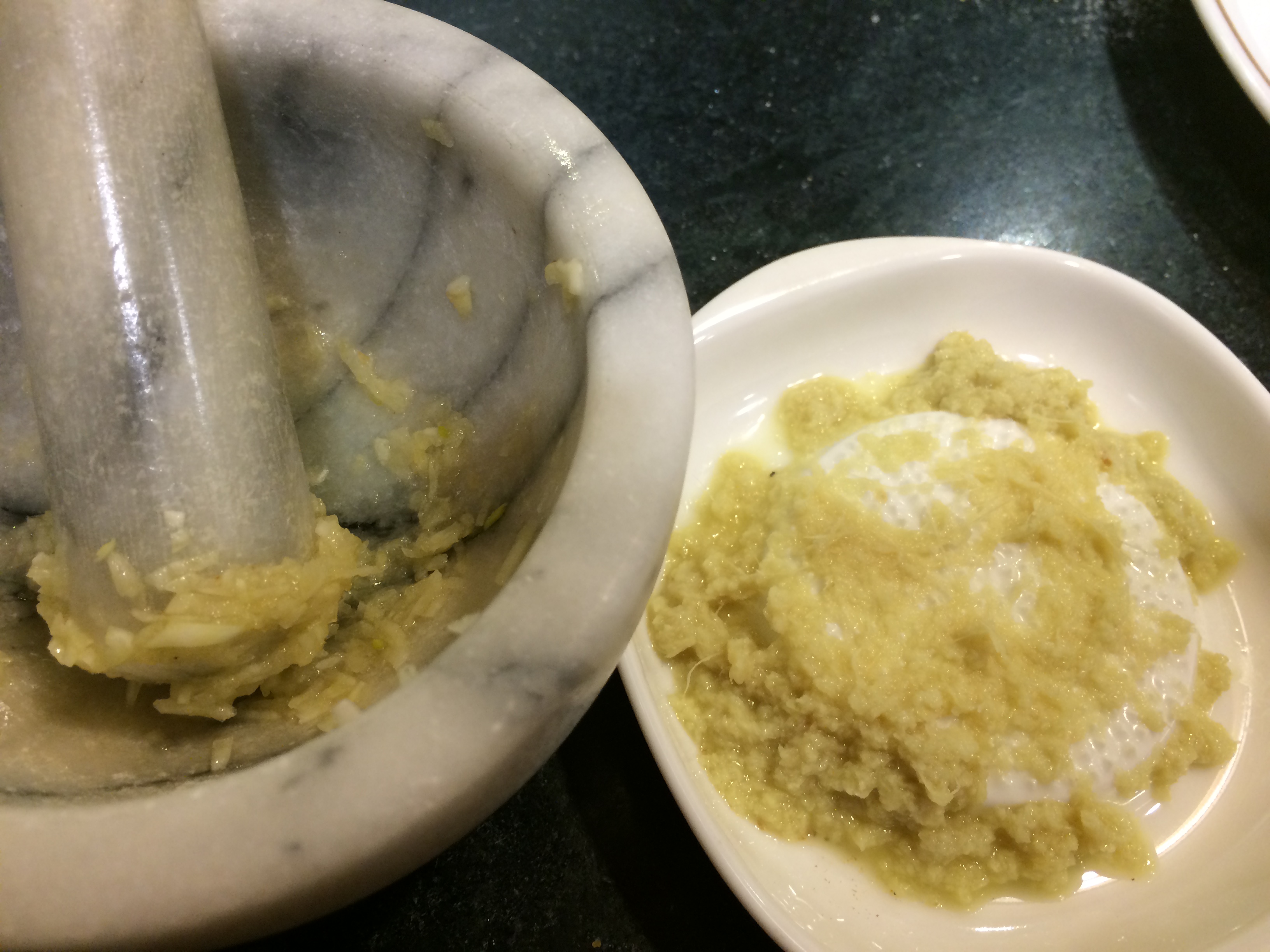
Mashed garlic, mashed ginger

Mashed garlic, mashed ginger

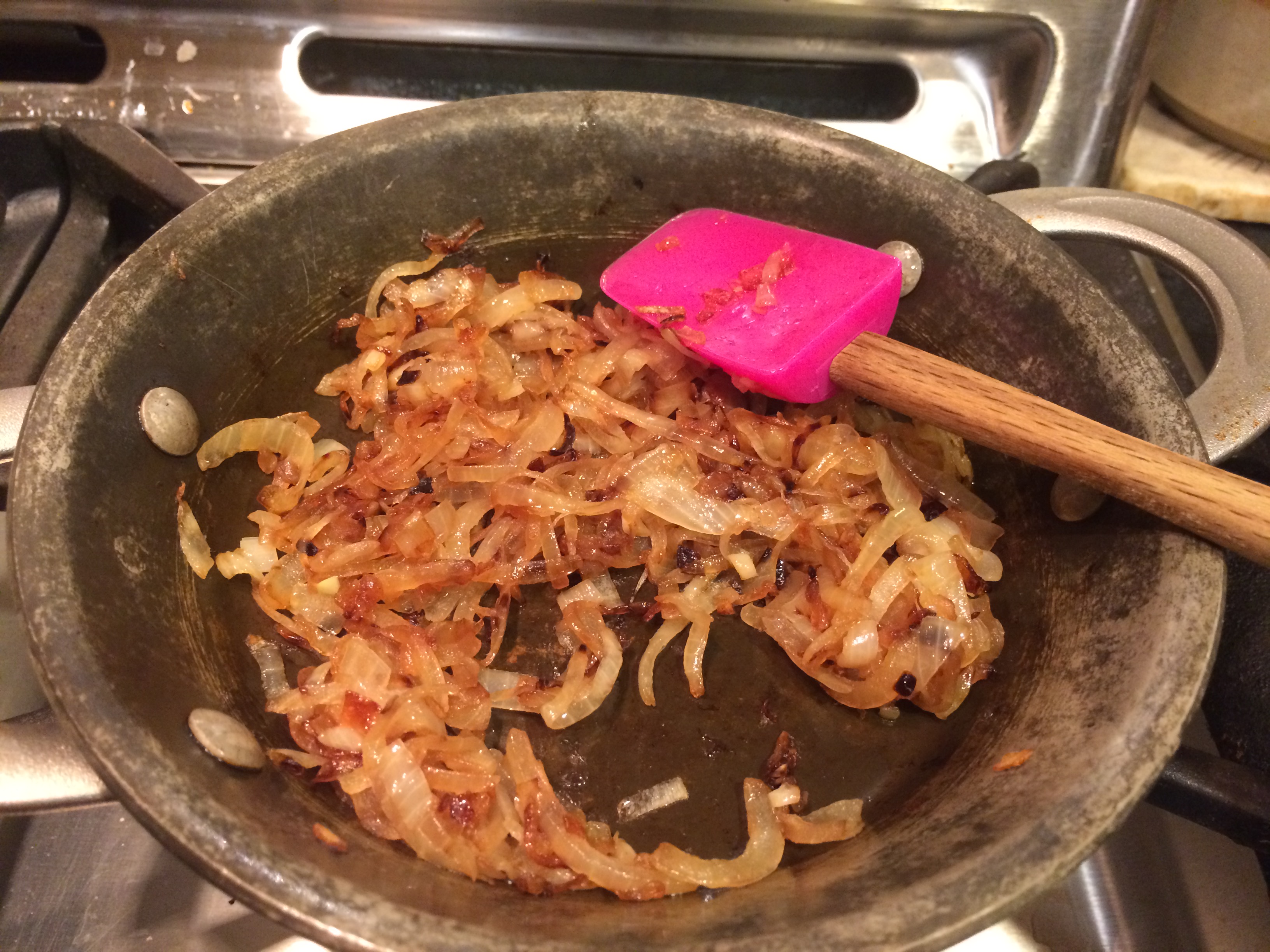
Fried onion

Fried onion

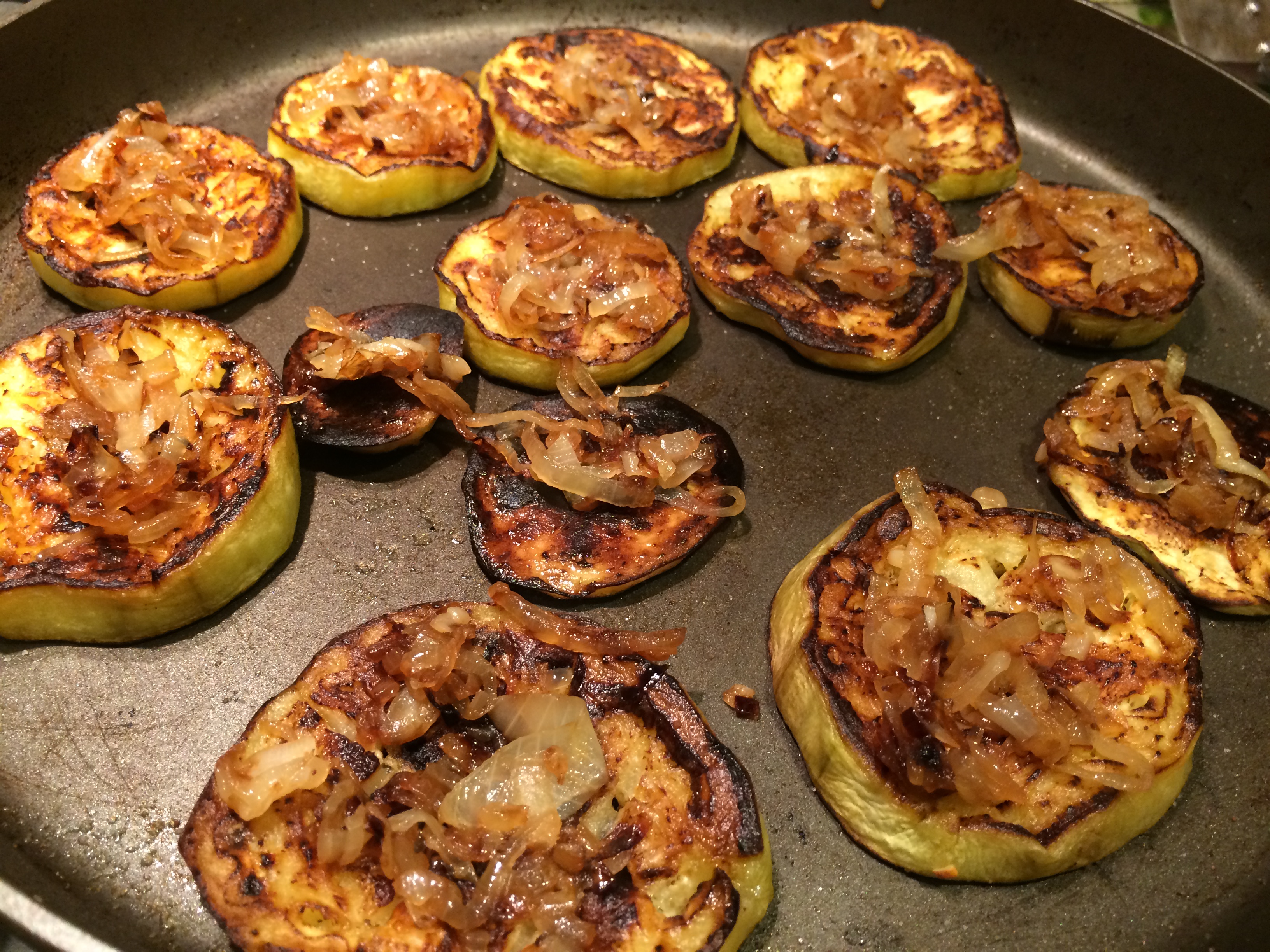
Topped with onion

Topped with onion

Topped with yogurt and spices

Topped with yogurt and spices

baingan ki boorani

Ingredients:
  • One large globe eggplant
  • Up to a quarter cup of oil
  • Half to one cup yogurt
  • Half of a medium onion, thinly sliced
  • 1 large clove garlic
  • 1 inch piece of ginger, less if you prefer
  • 1 teaspoon chaat masala, substitute with roasted and ground cumin
  • 1/2 teaspoon red chili powder, substitute with paprika for no heat
  • Salt to taste
Method:

Slice the eggplant into half inch wide rounds. Keep the peel on (see notes above). Make slashes across one surface of the slice, in a vaguely tic-tac-toe pattern. The slashes do not have to penetrate to the other side.

Heat a couple tablespoons of oil in a large non-stick pan and when shimmering, lay the eggplant slices out in a single layer, slashed side down. They will start to sizzle and slowly brown. It will take about five minutes. Salt the tops with a light hand. Flip each slice, adding more drops of oil if needed and if it looks too dry. Salt the other side too.

Meanwhile prepare the flavorings. Whisk about half to one cup of plain yogurt to make it smooth. Thinly slice the onion. Mince the garlic, and salt it for about five minutes, then mash with a fork or in a mortar and pestle. Also grate the ginger. For this, I prefer my Japanese ceramic ginger grater, that does the job beautifully. But another means of grating it would work as well.

The garlic and ginger, once mashed, simply get mixed into the yogurt. Fry the onion slices in another tablespoon of oil until browned. Take care to salt the onions lightly as they cook, and add a small pinch of salt to the yogurt as well.

At this point, all ingredients are individually salted and can simply be assembled. Before serving, place some slices of onion on each slice, then a dollop of yogurt. Lastly, sprinkle with some chaat masala and some red chili powder, for color and heat. Or if you prefer, and if your onions are crisply fried, place some on top of the yogurt as well.

Enjoy!