
The other day I went to the grocery store looking for fruit with a pretty standard shopping list. On it were such stalwarts as apples, bananas, perhaps a basket of berries or so.
But that is not what I walked out with: not at all. Instead, my eye was drawn to a particular shelf where some odd shapes sat next to each other. There was the horned one. The spiny one. The dried up purple shell caving in to its hollow center. The one that looked painfully familiar, and yet I couldn’t place (it turned out to be a nightshade).
Like eccentric back-benchers, these oddities sat side-by-side casting baleful glances at the mainstream fruit around them. Well, I never could resist the call of the eccentric back-bencher; and there is no reason to start now.
The apples and bananas had to wait for another day. Here is what I came home with: a shopping bag filled with horned melon, passion fruit, pepino melon, and rambutan. We happened to have a friend over, so we spent a pleasant afternoon cutting open these oddities and chronicling the experience.
At first, one is not sure if one is safe approaching a rambutan — it looks like a ruby-toned porcupine with pointy quills. But when you pick it up, you find it fits neatly inside your palm, as big as a ping-pong ball. The spines feel like plastic bristles that fold under pressure.
So far so good. But how is one expected to eat it? The peel offers no clues. It turns out that it takes a rather sharp paring knife to poke a hole in it and keep going. The skin is leathery and tough. You jab with the knife and peel off chunks, revealing smooth, wet, translucent white flesh .
Interestingly, in biological terms, the white flesh is not a fruit part at all, but rather, a thickened seed coat, known as aril. Some plants grow edible and sweet arils, for the same reason that others grow fleshy fruit — to tempt eaters on legs to eat them and thus spread them. Another example of such an aril-based fruit is the pomegranate, where each little seed grows red juicy pockets around it.
The single, oval seed is rather large with a papery exterior. In fact, a note for the squeamish — the taste of the translucent flesh always comes with a hint or two of the papery seed coverings. I don’t mind that at all, but some might.
Rambutan and the closely related lychee are both from the same family as the maple, of the flavorful sap. If I scrunch up my forehead enough I can imagine a maple-like sharpness to the taste of the flesh. It is sweet, resilient, and cool. When overripe, the peel becomes almost as hard as rock, while the pulp develops faintly pineapple notes. Go eat it: you have my blessings. The Odd Pantry rating:
Don’t let those protuberances that make it look like a stegosaurus egg fool you — the horned melon is nothing but a cuddly cucumber inside. With a difference.
It looks rather alike, as you can see from the picture. But the flesh is lime green instead of pale, and much pulpier, so that it needs to be scooped out with a spoon. The seeds that sit inside each little polyp are chewier. With each bite, one notices the chewiness of the seeds, that remains in your mouth once the pulp is eaten. They taste a bit like very thin and small cantaloupe seeds. Some people, I hear, attempt to spit the seeds out, but here’s what I say: why bother?
Mildly sweet with a hint of tartness, the taste is still somehow very close to the watery freshness of cucumber. Unlike a cucumber though this is not a possible salad ingredient at all. Really there seems to be no better way to eat it than with a spoon directly off the cut halves.
So is it actually related to the cucumbers and the cantaloupes? Very closely — about as close as a raspberry to a blackberry (the same genus). Though native to sub-Saharan Africa, it is now grown all over the place from California to Australia. My feeling though, about why it hasn’t caught on, is that it is hard to place it in a food group. Neither a vegetable, nor a hearty fruit that could work as dessert, nor even in a fruit salad — the kiwano is a fruit without a convenient slot to fit into. Nothing that a bit of directed breeding couldn’t fix! The Odd Pantry rating: 
Sigh. One wants to be polite (and I always, always do) but I don’t see what the point of the pepino is. Perhaps a reader will come along and enlighten me.
It has the shape of a golden eggplant with purple streaks. This is not surprising since the pepino melon is neither a pepino (cucumber) nor a melon — but rather closely related to eggplant and other nightshades. Now this family is known for producing toxins, such as nicotine and capsacain (chili heat), but is also known for its tasty edibles. Eggplants have a unique taste, as do tomatoes and the swollen stems known as potatoes.
But the pepino, alas, is bland. Well, let’s start at the beginning. Cutting it open is easy, because the peel is very thin and presents no barriers. The specimen I got had no seeds. Cut into quarter wedges, as you can see, the flesh was easy to get to.
That’s the good part. There is barely a smell at all, though our friend detected faint notes of nicotine (he used to be a smoker). If you could imagine a barely-sweet cantaloupe with most aromas removed, then enhance that with the blandness of lettuce — that is basically what the pepino tasted like. Perhaps cooking it like a vegetable might lead to a better experience.
One hates to do this, like I said, but I won’t be buying this again. The Odd Pantry rating: 
I have never eaten anything quite like a passion fruit. I didn’t know what to expect from just seeing the shell, which feels like a hard, textured globe with a tendency to collapse inward as it ripens. ‘The oysters of the fruit world’, our friend called it, and I could not understand what he meant at all.
When we cut it open I understood right away. Passion fruit pulp is loosely attached to the shell, much like an oyster is attached to it’s, and lies in a gelatinous mass. Each little black seed is surrounded by pulpy aril (that word again), giving the entire pulp the appearance of a different aquatic object — frog spawn.
The taste is intense: sour, a little sweet, tropical. The seeds are like grit in your teeth, but you can crunch through them. A couple scoops with the spoon and the entire fruit is eaten. This is not the kind of fruit one goes to for calories, but rather, the experience.
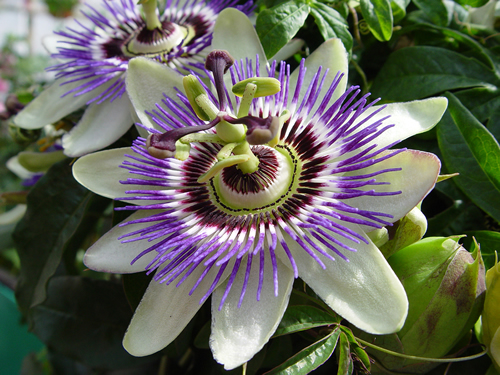
Passionflower
It isn’t surprising that passionfruit is such a unique eating experience, because the flower it springs from — the passion flower — is rather unique too. Most flowers have a row of green sepals beneath the petals; the passion flower alternates a sepal and a petal in a single whorl of ten. Plus, it has a set of purple rays that emanate from the center, called the corona, that look much like the rays of cartoon suns. When early Christian missionaries discovered this plant, they thought its unusual appearance made a perfect teaching aid for the crucifixion of Christ, with each part representing a different aspect of the story. This, by the way, is what the ‘passion’ in the name refers to — the Passion of Christ. It is not a synonym for lust or ardor.
Heavy stuff. In any case, this is a fruit that is worth trying for the experience if nothing else. The Odd Pantry rating: 
(Click here to find me on Facebook and here on Twitter.)
 There are people who like ginger, and there are those who don’t. Both are within the bounds of normalcy. But then there are people who like ginger beyond all reason and sense. My husband is one of them. He is not satisfied with a ginger-flavor suffusing the food; it must have that, and also ginger sticks in addition, so he can actually taste it.
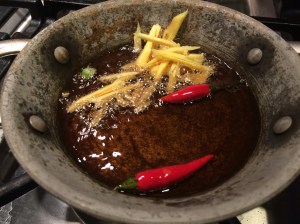
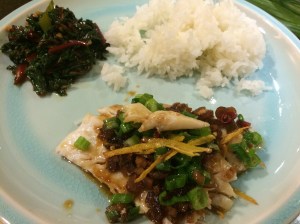
 Both dressings use the same trio of scallions, chilies and ginger. The first dressing, which is simmered in soy, has these items minced fine (on the left). While the second dressing, which is fried in sesame oil, has the chilies whole and the ginger in long sticks (on the right).




 The Odd Pantry