 Once upon a time, the dark cold months were months of deprivation. No green shoots appeared in the ground, no fruit swelled on the trees. The young ones went without, or raided the underground cellars for the grains and husks that they shared with their rodents. But the old ones said no, look, here’s what you do. You collect your bounty in the sunlit months; then you preserve it to feast on in the dark months.
“Preserve?” said the young ones, reflecting that perhaps dementia had claimed the old ones. “We have no fridges, nor vacuum packs. Surely, microbes will feast on our bounty before our clumsy hands are able to tear off a single chunk of it to place at the hungry lips of our babes. Surely a week, perhaps two, is how much one can hope to prolong the lives of these frilly delicate vegetables, whose very fronds seem infused with the light of Solis. But all season long? Respectfully, winter is long and harsh.”
“You fools,” said the old ones then, “have we taught you nothing?” They might have cuffed them with an open hand, I’m not sure. Then they drew out jars and jars of fruits and shoots they had taken the trouble to preserve many moons ago. The glass shone with the still preserved colors of the sun’s bounty.
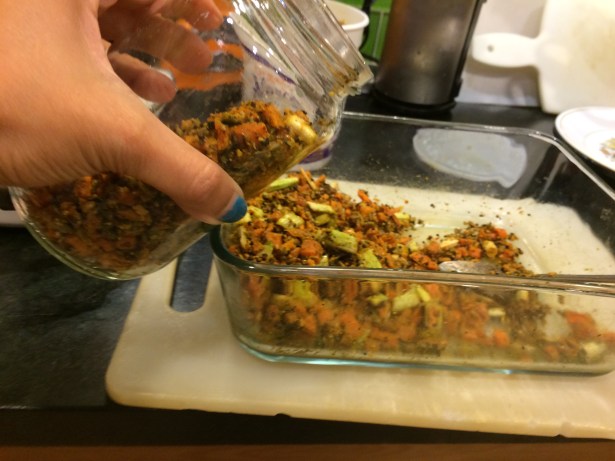 But at first, the young ones shrank from the taste. “Pooh!” they said. “We see that this is imbued with the deep orange of a carrot, but the saltiness scours our tongue. And the mango—did you have to preserve it when green and sour? Could you not have waited for its velvety sweetness to emerge? Ah, we would give our firstborn for the taste of a sweet mango now! That clay jar under the ground—could that be cabbage? But heed the fumes—did a dog die in there?”
“Your trouble,” said the old ones, snatching the kimchee from their hands, “is that your noses are underdeveloped. Look. All of creation loves a good vegetable. You do, and so do the microbes. Food preservation is a race—who shall get to eat the bounty first? The microbes, or the apes known as humans?”
“We are not apes,” the young ones said, with dignity.
“You certainly are,” the old ones returned, “but moving on. Now not all microbes are created alike. Some sicken and extinguish us; others concoct healthful compounds in our foods. Let us call them (because thou hast simple minds, and thy understanding is shallow) the good microbes and the bad microbes. Some of food preservation is nothing but allowing the good microbes to build their colonies in our foods; by their own mysterious devices, the good microbes then form barricades to prevent the bad microbes from entering. Not only that; the guts of these little ones start to break down the foods, thus do our guts get a head start.”
“Shall we then eat microbe-infested foods?” the young ones queried. “Your brains are going soft, perhaps the good microbes have fomented trouble in them.”
“The word is ‘fermented’,” the old ones said, “and you need to understand, your bodies are suffused with microbes at all times. Be not childishly fearful. In fact, in the age of our descendants, fermentation will be thought of with glamour and books and websites shall celebrate the advent of the good microbes in our food, and our partnership with them.”
The old ones then explained how salting the food created a happy place for the good microbes, but instilled fear in the hearts of the bad ones. And how sourness also chased away the bad ones, so one could add to the food an acid-making elixir, such as lemon or vinegar; but if one wanted to be specially tricky, one could have the good microbes produce their own sourness from the depths of their bowels, as they feasted on sugars. Such sourness, the old ones further explained, went by the name of lactic acid, but had little to do with the food of the mammal babes.
 “But heed,” the old ones intoned, “while fermentation is hip, do not forget, it is not the only way. Remember, water is needed for all of creation, and all of creation harbors it; the bad microbes desire it with a thirst so deep that it might be a thirst for life itself. What if one were to draw the water out of our foods, and leave it shrunken and dry; the microbes would find it as bare as a moonscape and would not deign to enter. Then: what if one were to cover the whole thing in oil, perhaps an oil such as from the mustard plant, that is practically a warrior against microbes itself, what then?”
What one has, then, is an Indian pickle.
Indian pickles (achar)
It has been a persistent mystery in the minds of some interested parties as to whether Indian pickles are fermented, or not. Among these, I count myself, and also my dear blogger friend Annie Levy from Kitchen Counter Culture. Well, by applying the powers of my mind deeply to the question in a Holmesian sort of way, I think I have my answer. Indian pickles—the typical kind, that are preserved in mustard oil—are not.
Now there are certainly Indian pickles that are fermented, but those are not the norm and the ones that I am familiar with do not use oil at all. But we will talk about those another time.
The typical pickles use a pretty standard method. First, salt the food: salt wants to reach equilibrium, and if the food isn’t salty already, it wants to enter the food from its surroundings. As it enters, it draws out the moisture and takes its place inside the food.
Next, allow the moisture to dry out by placing it in the sun. Once the pieces are much shrunken, jar it up and pour mustard oil over.
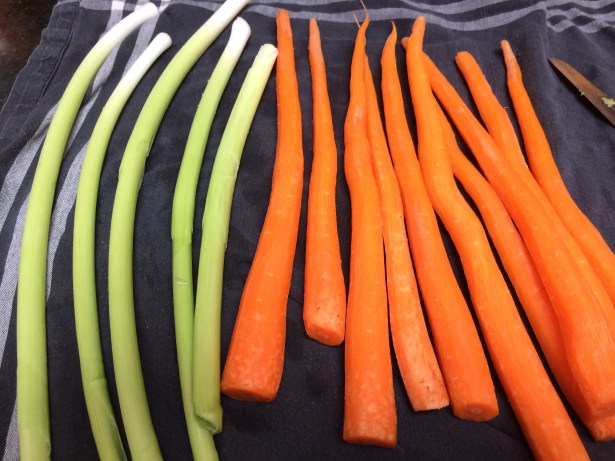 This is the basic method I have used with such disparate ingredients as cranberries and sour mango. This time, we have carrots and some green garlic.
The spices tend to be a similar set. Fennel seed is congenial, and so is the use of nigella seed. Turmeric powder has antiseptic properties so that is always used, and the heat comes from red chilies. Usually, the spices are left whole, this time, I chose to pulverize them a bit. They went from looking like this to this:


Of course, a lot of salt is used, and the carrots and green garlic are thoroughly mixed with the spices and salt and laid out on a wide, flat surface. Cover with cheesecloth, place in the sun, and allow the salt and the sun to perform their magic. Watch the slow shriveling of the carrots over the period of a week:


Once the pieces look pretty dry, it is time to mix in some lemon juice, jar it up and pour mustard oil over. Some like to heat the oil to smoking point and then cool it before using, but I don’t see the point because I want the oil to be at peak pungency.


Carrot pickle
Ingredients:
- About 10 carrots, washed, scraped, and dried completely
- About 5 full stalks of green garlic, washed, trimmed and dried completely
- 3 tablespoons fennel seeds
- 1.5 tablespoons nigella seeds (kalonji)
- 1.5 tablespoons fenugreek seeds (methi)
- 2 tablespoons mustard seeds
- 3 tablespoons sea salt
- 0.5 tablespoons red chili powder
- 0.5 tablespoons turmeric
- 3 tablespoons lemon juice
- About half a cup of mustard oil
Method:
Once the vegetables are completely dry, slice them up in smallish segments, the exact shape does not matter. You could do longish sticks or smallish dice, as I did.
Pulverize the whole spices (fennel, fenugreek, nigella and mustard) slightly using a mortar and pestle. You can skip this step if you like.
Place the vegetables in a wide platter and cover with the pulverized spices, the salt, turmeric and red chili powder. Give it a thorough mixing so all the pieces are evenly covered with the salt and spices.
Cover the platter with cheesecloth and place at a sunny window. My window only gets sun for about an hour in the mornings and that seemed to be enough. Every couple days, give it another mixing with a scrupulously clean spoon.
In about a week the vegetable pieces will look much shriveled, darker and more leathery. Stir in the lemon juice.
Transfer to a scrupulously clean glass jar (you can sterilize it in boiling water first if you like, I didn’t). Pack it down. Pour some of the mustard oil over it and wait for it to settle; pour more. Do this in a few stages, until a thin film of oil shines over the very top of the jar. For me, it took about half a cup. Cover and store in the pantry.
Your pickle (achar) is done. It is great as a side in minuscule portions (since it is highly spiced). It should last for a good long time, even up to a year.
(Click here to find me on Facebook and here on Twitter.)

 I’m guessing that not many of you will have heard about the dal or bean I’m about to write about today. I certainly hadn’t. It is a small flattened bean, multicolored in a spectrum that goes from beige to dark coffee brown. It is commonly known by the rather picturesque name of ‘horse gram’; and if you think that a word like that harks back to a time when crops were named after farm animals, while animals were named for their use on the farm, you’ve got horse gram pinned.
 Some practical matters


 The Odd Pantry